

OET Medical Vocabulary, Word of the Day
Temporal Region (Temple) – Meaning and Usage in Medical English

Nov
👁 What Does “Temporal Region” Mean?
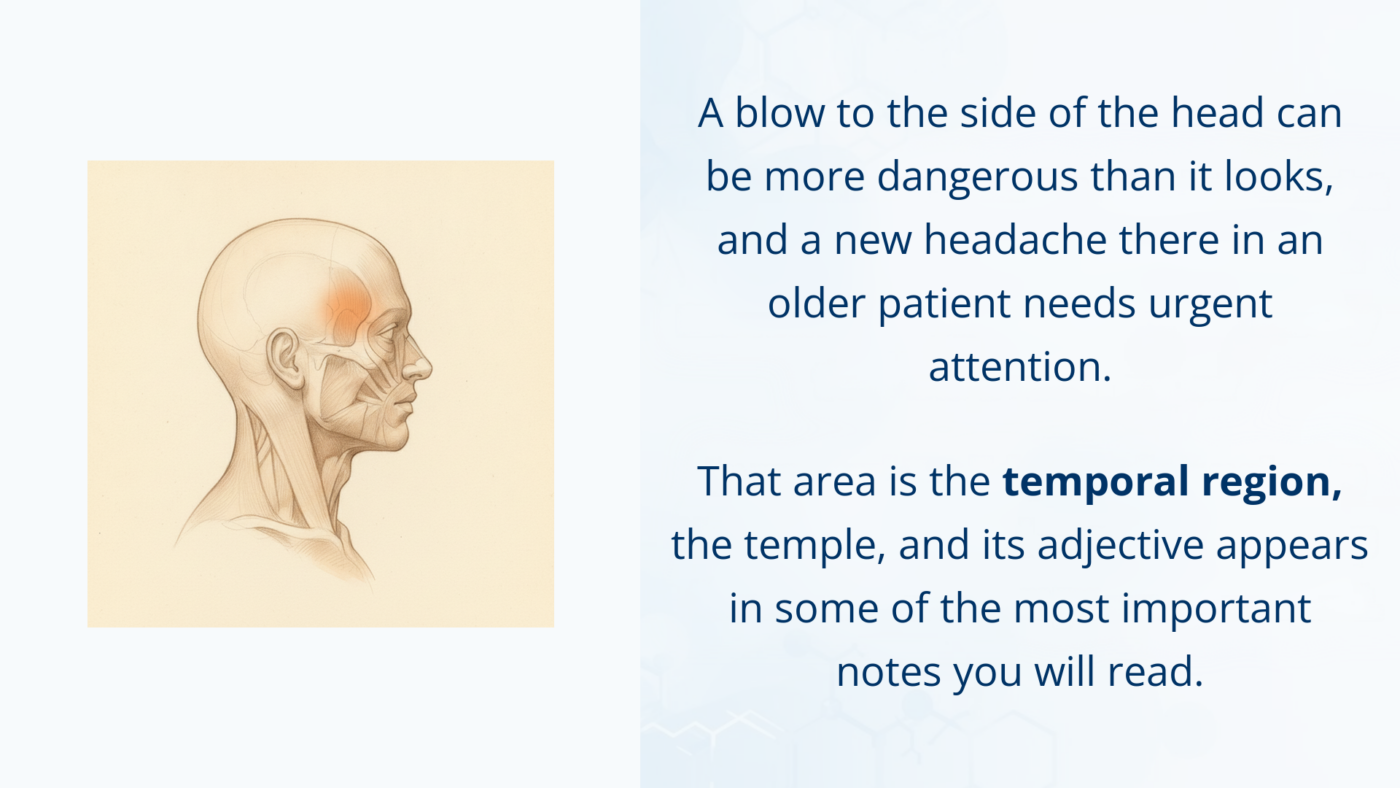
The temporal region is the temple: the flat area on each side of the head between the eye and the ear. It lies over the thin temporal bone and the temporalis muscle used in chewing.
Temporal comes from Latin tempus, “time”; one explanation is that gray hair often appears first at the temples. The adjective temporal is far more common in notes than the full phrase.
🔍 Clinical Usage
The temple and its structures appear in emergency, neurology, rheumatology and dental notes:
- temporal headache — pain at the side of the head
- giant cell (temporal) arteritis — inflammation of the temporal artery, with tenderness over the temple; an urgent diagnosis because of the risk to sight
- temporal bone fracture — a skull fracture near the ear
- temporal lobe — the part of the brain beneath the temple, linked to memory and hearing
- temporal artery thermometer — temperature taken by scanning the forehead and temple
Common collocations include:
- tenderness over the temporal artery
- bitemporal headache
- temporal artery biopsy
- swelling over the left temple
Here’s a natural clinical example:
“New-onset right temporal headache with scalp tenderness and jaw claudication.”
→ Meaning: The patient has a recent headache at the right temple, the scalp is sore to touch, and chewing causes jaw pain.
Try OET Practice Questions for Free
Exam-style questions with every answer explained.
Listening · Reading · Writing · Speaking — No sign-up needed
🗣 Pronunciation
TEM-puh-rul — the stress is on the first syllable.
💡 OET Tip
With patients, say temple or the side of your head. In writing, use temporal with structures and temple for the location. Don’t confuse temporal (temple) with temporary (short-term); they share a root but never replace each other.