

OET Medical Vocabulary, Word of the Day
Femoral Triangle (Upper Inner Thigh) – Meaning and Usage in Medical English

Nov
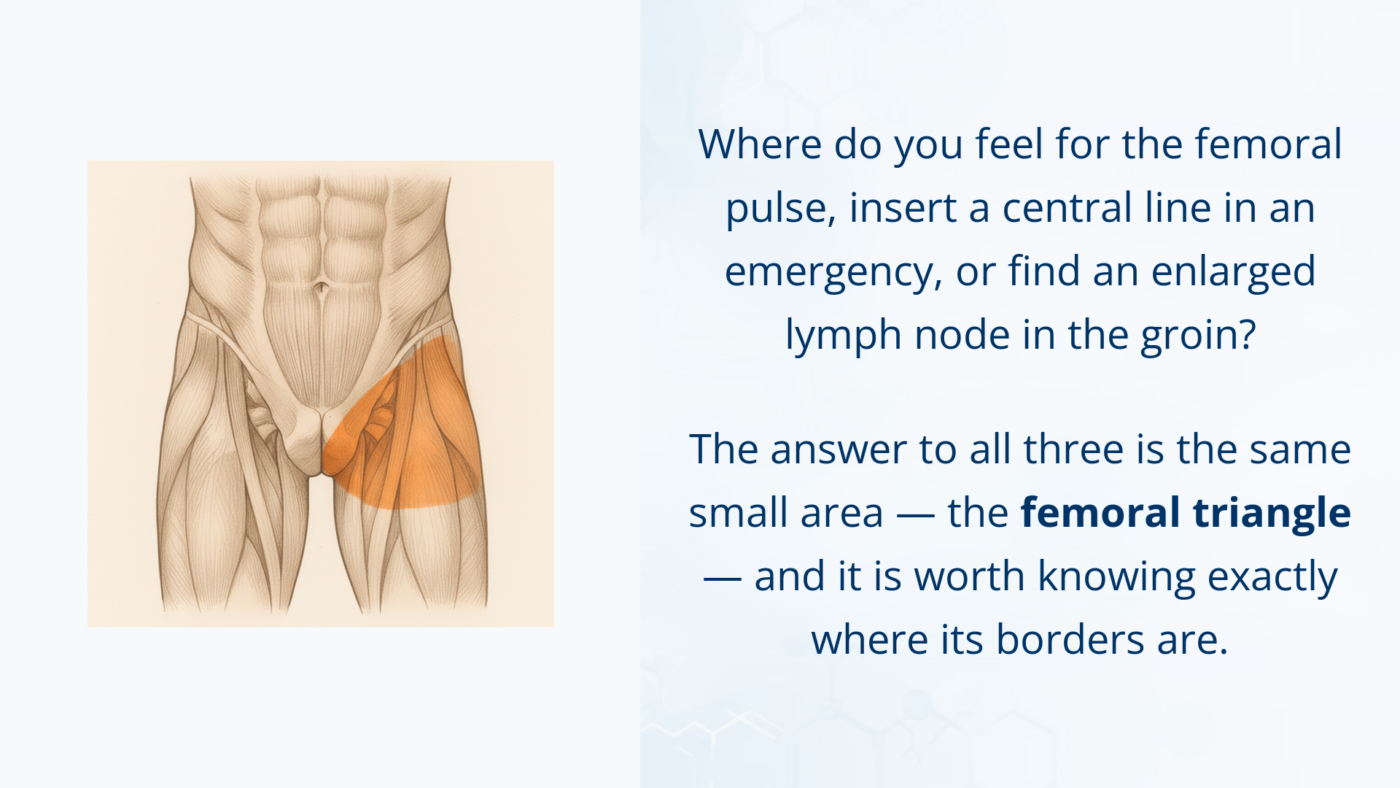
👁 What Does “Femoral Triangle” Mean?
The femoral triangle is the triangular hollow at the top of the inner thigh, just below the groin crease. Its upper border is the inguinal ligament, its outer border is the sartorius muscle and its inner border is the adductor longus muscle.
Inside it, from outer to inner, lie the femoral nerve, artery and vein, remembered by the mnemonic NAVEL (nerve, artery, vein, empty space, lymphatics). Femoral comes from Latin femur, “thigh”.
🔍 Clinical Usage
The femoral triangle appears whenever someone examines or accesses the groin:
- vascular examination (femoral pulse)
- emergency and intensive care notes (femoral line, femoral access)
- hernia and lymph node examinations
- cardiology procedure reports (angiography via the femoral artery)
Common collocations include:
- femoral pulse palpable in the femoral triangle
- lymphadenopathy in the femoral triangle
- femoral artery access
- swelling in the femoral triangle
Here’s a natural clinical example:
“Femoral pulses present bilaterally; no masses in the femoral triangle.”
→ Meaning: The pulse at the top of the inner thigh can be felt on both sides, and there are no lumps in that area.
Try OET Practice Questions for Free
Exam-style questions with every answer explained.
Listening · Reading · Writing · Speaking — No sign-up needed
🗣 Pronunciation
FEM-uh-rul TRY-ang-gul — the stress is on the first syllable of each word.
💡 OET Tip
Patients call this area “my groin” or “the top of my leg”, and “groin” is fine in a letter when you are quoting the complaint. Use femoral triangle when you are describing an examination finding or a procedure site, where precision matters.