

OET Medical Vocabulary, Word of the Day
Sura (Calf) – Meaning and Usage in Medical English

Nov
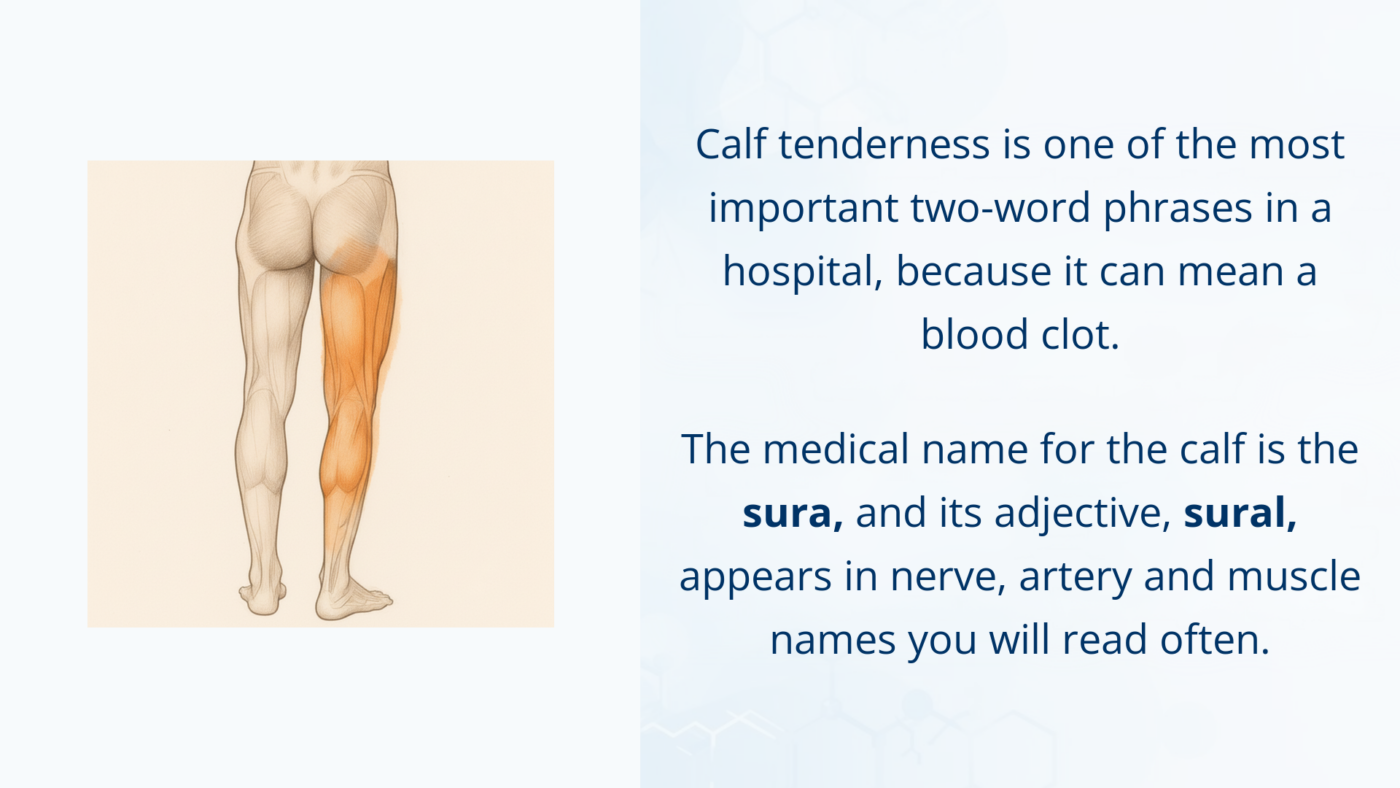
👁 What Does “Sura” Mean?
The sura is the calf: the fleshy back of the lower leg, between the knee and the heel. Its shape comes from two muscles, the gastrocnemius (the bulky one you can see) and the soleus beneath it, which join to form the Achilles tendon.
The word is Latin for “calf of the leg”. You will rarely see sura by itself in notes; the adjective sural is far more common: sural nerve, sural artery, sural region. Everyday notes simply say calf.
🔍 Clinical Usage
The calf matters in several high-stakes situations:
- deep vein thrombosis (DVT) — a swollen, warm, tender calf is the classic sign, and calf circumference is measured on both sides
- calf strain — a tear of the gastrocnemius, typical in middle-aged athletes (“tennis leg”)
- compartment syndrome — severe pain and tightness of the lower leg after injury
- sural nerve biopsy and sural nerve graft in neurology and plastic surgery
Common collocations include:
- calf tenderness / calf swelling
- calf circumference 2 cm greater on the left
- calf claudication (cramping calf pain on walking, from poor arterial supply)
- sural nerve
Here’s a natural clinical example:
“Left calf swollen, warm and tender; circumference 3 cm greater than the right. DVT to be excluded.”
→ Meaning: The left calf is bigger, warmer and more painful than the right, and a blood clot in the leg needs to be ruled out.
Try OET Practice Questions for Free
Exam-style questions with every answer explained.
Listening · Reading · Writing · Speaking — No sign-up needed
🗣 Pronunciation
SOO-ruh — the stress is on the first syllable. Sural is SOO-rul.
💡 OET Tip
Use calf in both speaking and writing; it is the standard clinical word. Sural is for named structures. The one thing to avoid is vagueness: “leg pain” could be anywhere from the hip to the toes. “Calf pain on walking” points the reader to the arteries; “calf tenderness and swelling” points to the veins.
🔗 Related Words
- Popliteal Fossa (Back of the Knee)
- Tibial Tuberosity (Bump Below the Kneecap)
- Pretibial Region (Shin)
Browse every term in our Medical English Body Parts A–Z guide.
For the clinical words you will meet in the OET, with what to say to patients, see our OET Vocabulary guide and our cardiology word list.