

OET Medical Vocabulary, Word of the Day
Iris (Colored Part of the Eye) – Meaning and Usage in Medical English
Nov
👁 What Does “Iris” Mean?
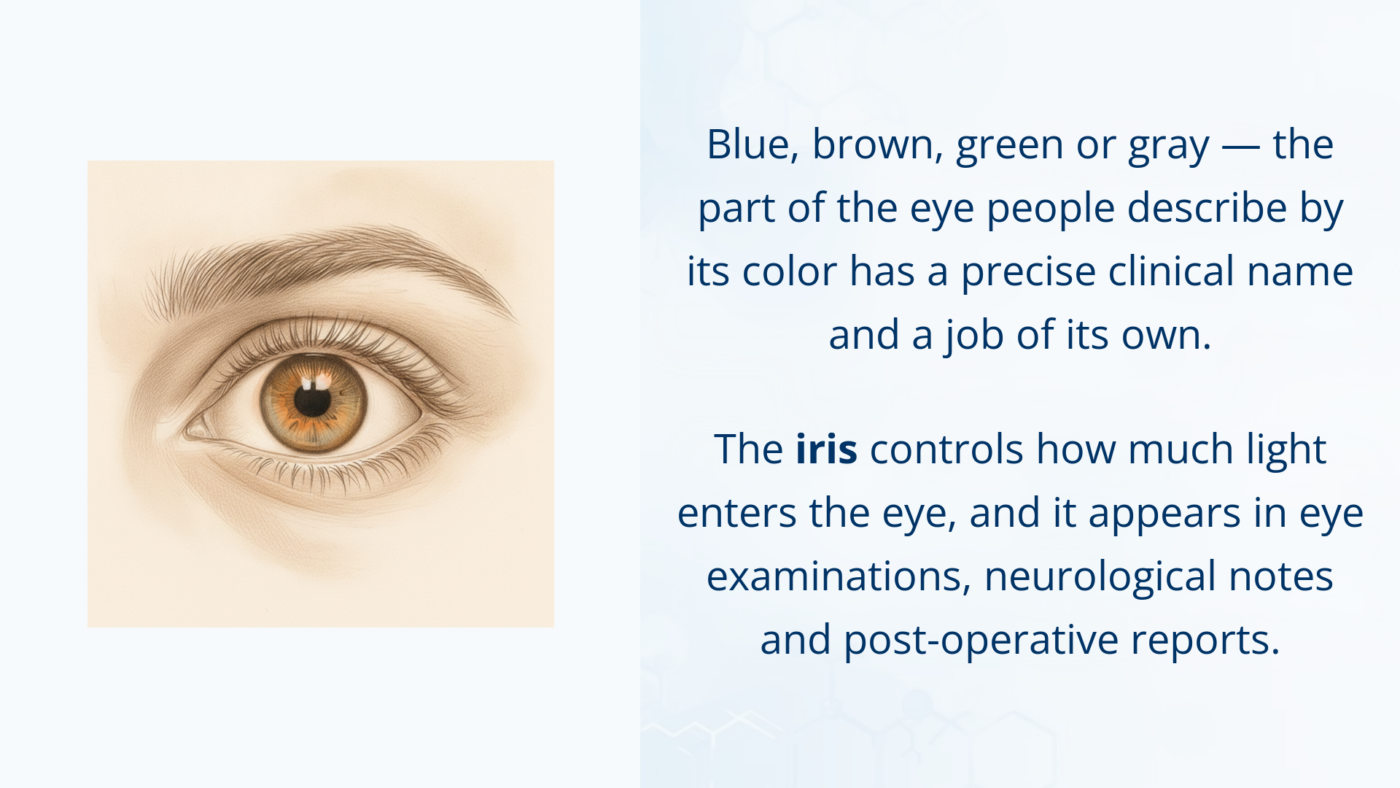
The iris is the colored part of the eye: the thin, circular muscle ring that surrounds the pupil. By contracting and relaxing, it makes the pupil smaller in bright light and larger in dim light.
The word comes from Greek iris, “rainbow”, because of its many possible colors. The plural is irises (or irides in older texts), and the adjective is iridic, though most terms use the prefix irid-, as in iridotomy and iridocyclitis.
🔍 Clinical Usage
The iris appears in ophthalmology, emergency and neurology notes:
- iritis — inflammation of the iris, causing a red, painful, light-sensitive eye
- heterochromia — irises of different colors, or two colors in one iris
- laser iridotomy — a small hole made in the iris to treat or prevent angle-closure glaucoma
- iris prolapse — the iris pushes through a wound after penetrating eye injury
- coloboma — a gap in the iris present from birth
Common collocations include:
- iris color
- iris pigmentation
- iris root
- iris and pupil reactions
Here’s a natural clinical example:
“Circumcorneal injection with photophobia; cells in the anterior chamber, consistent with acute iritis.”
→ Meaning: The eye is red around the clear front surface and sensitive to light, and inflammatory cells are seen in front of the iris, which suggests the iris is inflamed.
Try OET Practice Questions for Free
Exam-style questions with every answer explained.
Listening · Reading · Writing · Speaking — No sign-up needed
🗣 Pronunciation
EYE-ris — the stress is on the first syllable. Iritis is eye-RYE-tis.
💡 OET Tip
With patients, say the colored part of your eye. In writing, iris is standard. Don’t confuse the iris (the colored ring) with the pupil (the black opening in its center): it is the pupil, not the iris, that is described as “equal and reactive to light”.
🔗 Related Words
Browse every term in our Medical English Body Parts A–Z guide.
For the clinical words you will meet in the OET, with what to say to patients, see our OET Vocabulary guide.