

OET Medical Vocabulary, Word of the Day
Palate (Roof of the Mouth) – Meaning and Usage in Medical English
Nov
👁 What Does “Palate” Mean?
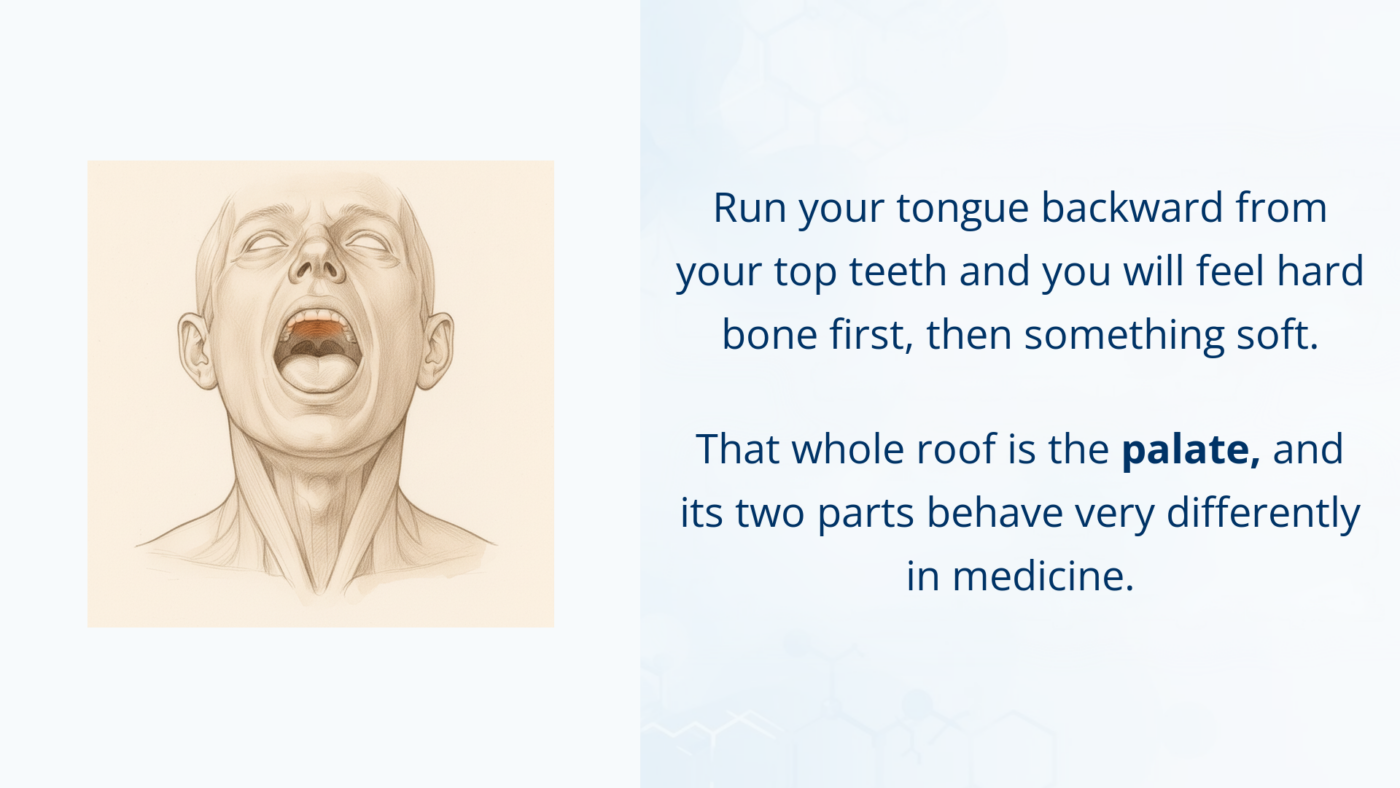
The palate is the roof of the mouth: the partition that separates the mouth from the nasal cavity. The front two-thirds is the hard palate, made of bone; the back third is the soft palate, made of muscle, which ends in the uvula and rises during swallowing to close off the nose.
The word comes from Latin palatum. The adjective is palatal (or palatine for named structures, as in palatine tonsils).
🔍 Clinical Usage
The palate appears in pediatric, ENT, dental and speech therapy notes:
- cleft palate — a gap in the palate present at birth, often with a cleft lip
- palatal petechiae — small red spots on the soft palate, seen in some throat infections
- soft palate elevation — checked to assess cranial nerve function
- high-arched palate — an unusually high roof, noted in some genetic conditions
- palatal lesions — ulcers or swellings examined in oral medicine
Common collocations include:
- hard / soft palate
- cleft lip and palate
- palatal swelling
- repair of the palate
Here’s a natural clinical example:
“Petechiae on the soft palate; tonsils enlarged with exudate.”
→ Meaning: There are tiny red spots on the back of the roof of the mouth, and the tonsils are swollen with pus on them.
Try OET Practice Questions for Free
Exam-style questions with every answer explained.
Listening · Reading · Writing · Speaking — No sign-up needed
🗣 Pronunciation
PAL-it — the stress is on the first syllable. It sounds exactly like palette and pallet.
💡 OET Tip
With patients, say the roof of your mouth. In writing, palate is standard, always with hard or soft when the location matters. Be careful with spelling: palate (mouth), palette (painter’s board) and palpate (to examine by touch) are easily mixed up.
🔗 Related Words
Browse every term in our Medical English Body Parts A–Z guide.
For the clinical words you will meet in the OET, with what to say to patients, see our OET Vocabulary guide.