

OET Medical Vocabulary, Word of the Day
Lingua (Tongue) – Meaning and Usage in Medical English

Nov
👁 What Does “Lingua” Mean?
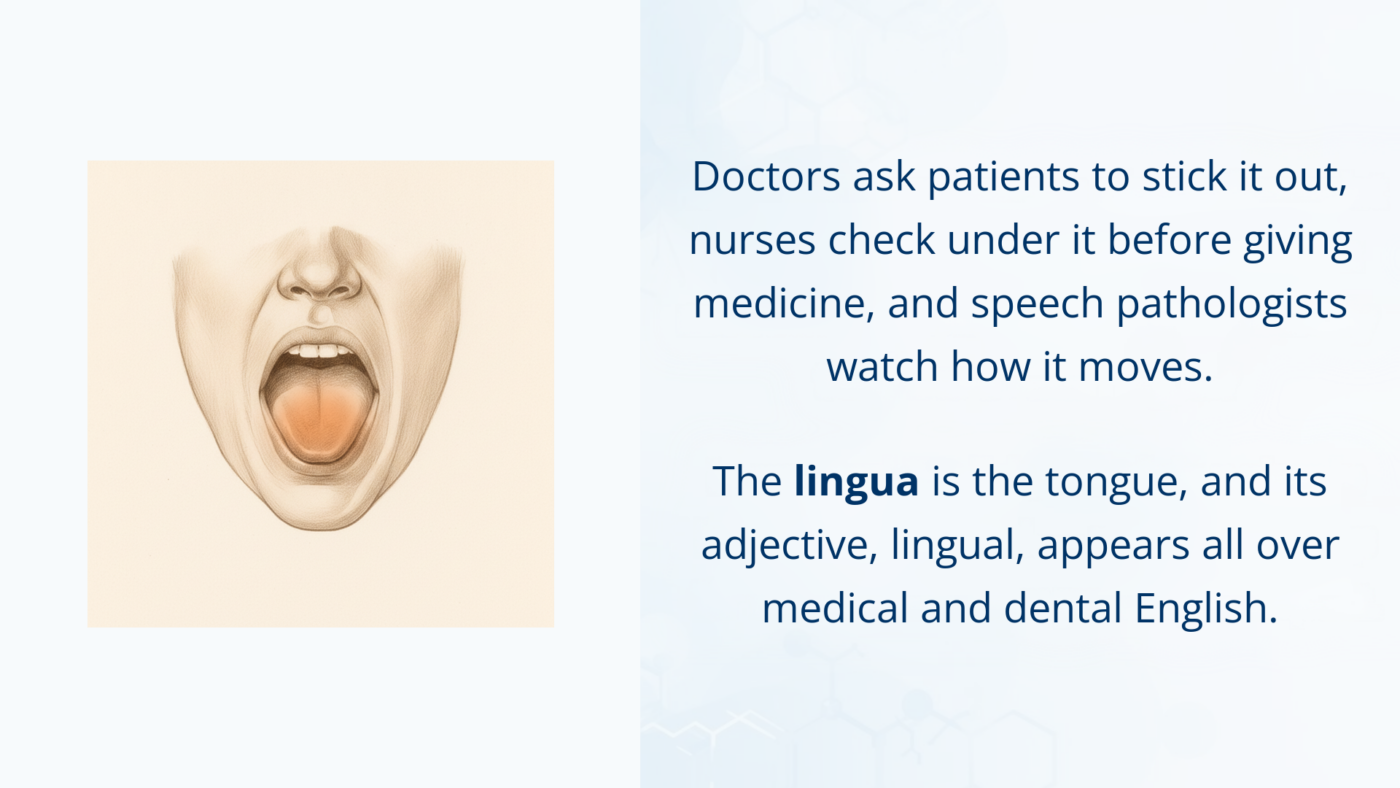
Lingua is the medical term for the tongue: the muscular organ on the floor of the mouth used for taste, chewing, swallowing and speech. Its upper surface is covered with small projections called papillae, many of which carry taste buds.
The word is Latin for “tongue” (and “language”). The plural is linguae, and the adjective is lingual. You will also meet the Greek root gloss-, as in glossitis and hypoglossal nerve.
🔍 Clinical Usage
The tongue appears in general medicine, neurology, dentistry and speech pathology:
- glossitis — inflammation of the tongue, which may look smooth, red and sore
- sublingual — under the tongue, as in sublingual glyceryl trinitrate
- tongue deviation — the tongue points to one side when protruded, a sign of hypoglossal nerve damage
- oral thrush — white patches on the tongue caused by Candida
- tongue-tie (ankyloglossia) — a short band under the tongue that limits movement
Common collocations include:
- coated / furred tongue
- dry tongue (a sign of dehydration)
- protrude the tongue
- lateral border of the tongue
Here’s a natural clinical example:
“Dry mucous membranes; tongue protrudes in the midline, no fasciculations.”
→ Meaning: The mouth is dry, and the tongue sticks out straight with no twitching, so the nerve controlling it appears normal.
Try OET Practice Questions for Free
Exam-style questions with every answer explained.
Listening · Reading · Writing · Speaking — No sign-up needed
🗣 Pronunciation
LING-gwuh — the stress is on the first syllable. Lingual is LING-gwul.
💡 OET Tip
Always say tongue to patients: “Could you stick your tongue out for me?” In writing, tongue is perfectly standard; lingua itself is rare, but the adjectives lingual and sublingual are essential. Don’t confuse sublingual (under the tongue) with buccal (between the cheek and gum).
🔗 Related Words
Browse every term in our Medical English Body Parts A–Z guide.
For the clinical words you will meet in the OET, with what to say to patients, see our OET Vocabulary guide.