

OET Vocabulary, Word of the Day
Jaw – Meaning and Usage in Medical English
Nov
👁 What Does “Jaw” Mean?
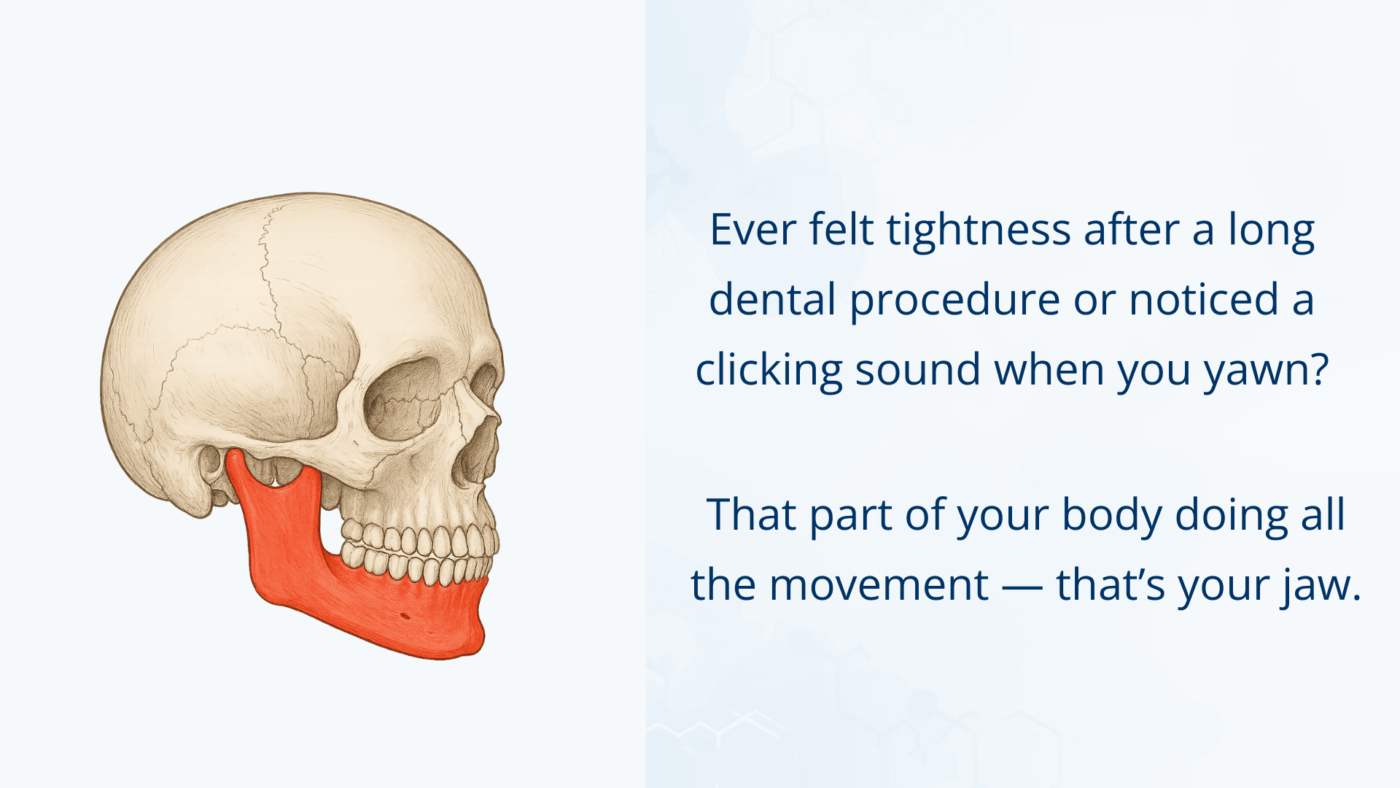
The jaw refers to the bone that forms the lower part of the face and holds the lower teeth.
In anatomy, it’s known as the mandible, while the upper jaw is called the maxilla. The word comes from Old English ceowan, meaning “to chew,” which perfectly describes its function.
In medicine and dentistry, the term appears frequently when describing facial structure, injury, or movement.
🔍 Clinical Usage
In clinical communication, jaw is used to describe both anatomical structure and functional movement.
You’ll find it mentioned in nursing notes, radiology reports, and oral surgery records — often when referring to pain, swelling, or limited motion in the temporomandibular joint (TMJ).
Healthcare professionals may document observations like:
- “Jaw tenderness noted over the right TMJ.”
- “Limited jaw opening due to pain.”
- “Jaw deviation observed on mouth opening.”
Common related terms include:
| Term | Meaning |
|---|---|
| Mandible | Lower jawbone |
| TMJ | Temporomandibular joint, connecting the jaw to the skull |
| Bruxism | Teeth grinding, often causing jaw pain |
| Lockjaw (trismus) | Inability to open the mouth fully, often due to muscle spasm |
Example in context:
“The patient reports pain when opening the jaw, suggesting possible TMJ dysfunction.”
🎥 Watch the Short Video
👉 Watch our 30-second clip: Jaw – Learn how to pronounce it and remember how it’s used in real medical English.
Study with OET BANK
Stop wasting time comparing OET materials.
With OET BANK, you get:
- Premium-quality OET materials, built by professionals
- A focused, efficient study path — no unnecessary content
- A system designed to help you pass OET once — without trial and error
If you want to prepare properly and pass with confidence,
you don’t need to look anywhere else.
Pick your materials and start today — with OET BANK.