

OET Medical Vocabulary, Word of the Day
Femoral Region (Thigh) – Meaning and Usage in Medical English
Nov
👁 What Does “Femoral Region” Mean?
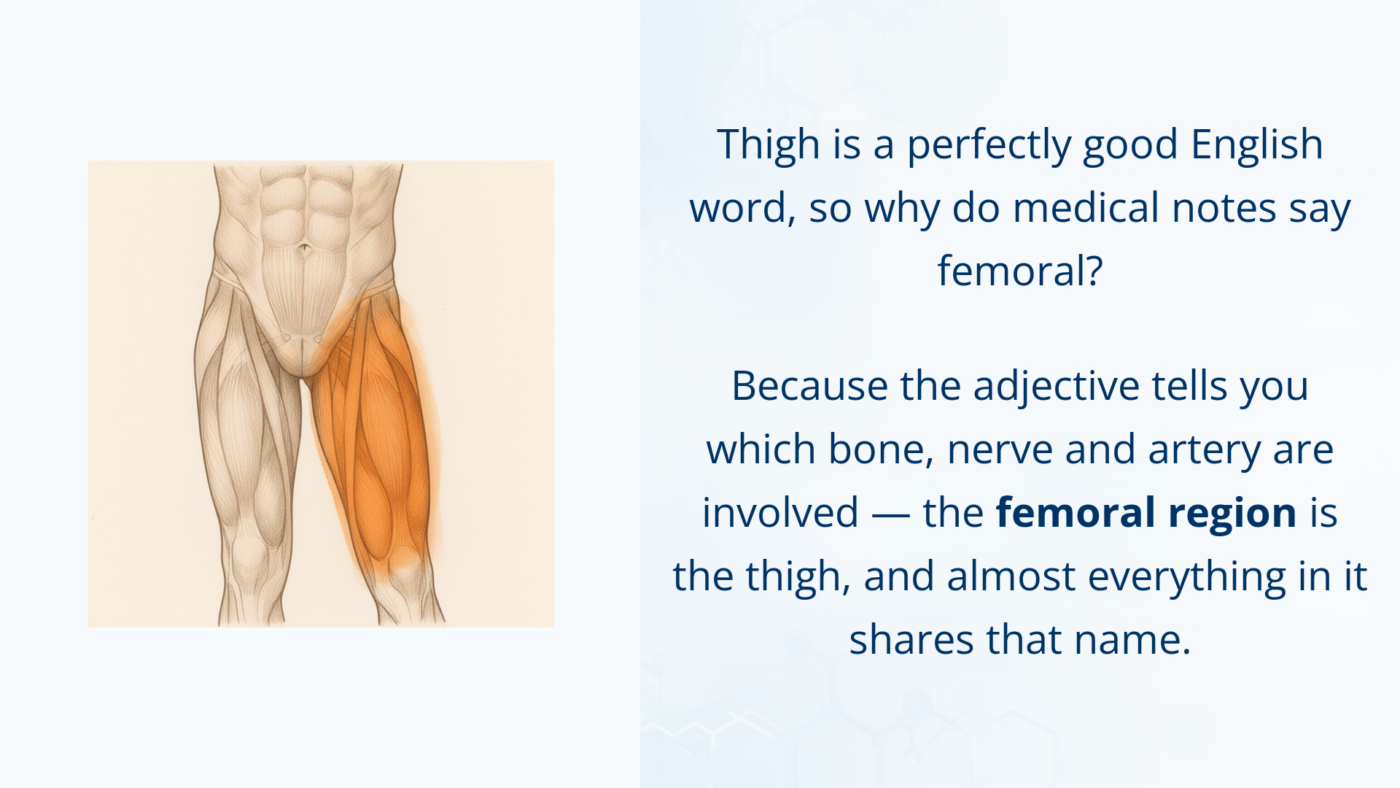
The femoral region is the thigh: the part of the lower limb between the hip and the knee. It contains the femur, the longest and strongest bone in the body, and the large muscle groups at the front (quadriceps) and back (hamstrings).
Femoral comes from Latin femur, “thigh”. You will rarely see “femoral region” on its own; far more often the adjective attaches to a structure: femoral artery, femoral nerve, femoral vein, femoral hernia, femoral fracture.
🔍 Clinical Usage
The thigh and its structures come up in:
- trauma and orthopedic notes (femoral shaft fracture, neck of femur fracture)
- vascular reports (superficial femoral artery, deep vein thrombosis of the femoral vein)
- surgical notes (femoral hernia, femoral nerve block)
- physiotherapy letters on quadriceps and hamstring injuries
Note the difference between the two bones: the femur is the thigh bone; the tibia is the shin bone below the knee.
Common collocations include:
- anterior / posterior / medial thigh
- femoral shaft fracture
- femoral nerve block
- swelling and tenderness of the thigh
Here’s a natural clinical example:
“Closed, displaced fracture of the mid-shaft of the left femur; neurovascularly intact distally.”
→ Meaning: The left thigh bone is broken in the middle and the pieces have moved, but the nerves and blood supply below the break are working.
Try OET Practice Questions for Free
Exam-style questions with every answer explained.
Listening · Reading · Writing · Speaking — No sign-up needed
🗣 Pronunciation
FEM-uh-rul — the stress is on the first syllable. Femur is FEE-mer.
💡 OET Tip
With patients, say thigh. In writing, thigh is still correct for the region (“pain in the right thigh”), but use femoral for named structures. “Femur fracture” is understood, but the standard form is “fracture of the femur” or “femoral fracture”.