

OET Medical Vocabulary, Word of the Day
Lateral Malleolus (Outer Ankle Bone) – Meaning and Usage in Medical English

Nov
👁 What Does “Lateral Malleolus” Mean?
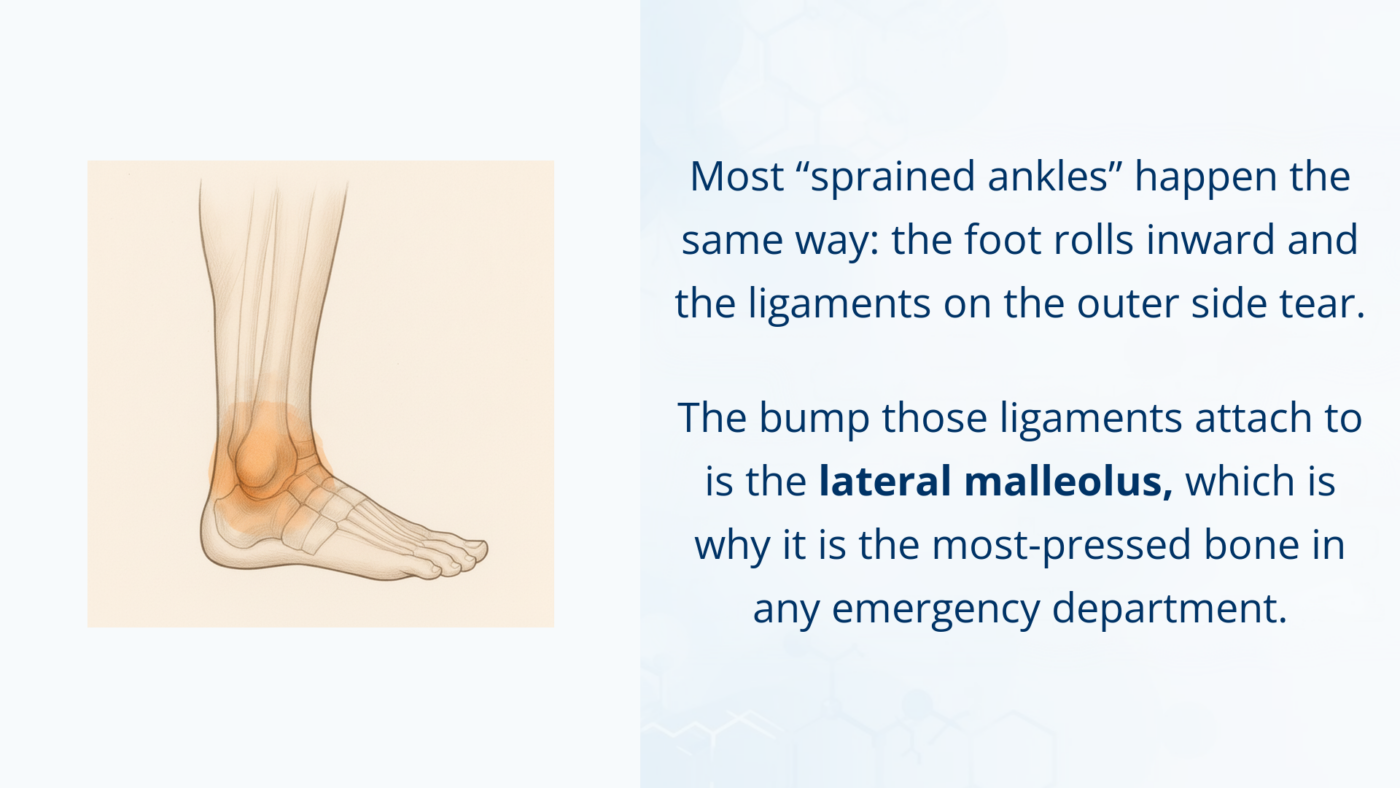
The lateral malleolus is the bony bump on the outer side of the ankle, formed by the lower end of the fibula. It sits a little lower and further back than the medial malleolus on the inner side, which is why the two bumps do not line up when you look at the ankle from the front.
Lateral means “away from the midline”; malleolus is Latin for “little hammer”. The lateral ligaments of the ankle, including the one most often sprained, attach here.
🔍 Clinical Usage
The lateral malleolus is central to ankle injury assessment:
- inversion sprain — the foot rolls in, and the ligaments just in front of and below the lateral malleolus tear
- lateral malleolus fracture — the most common ankle fracture, classified by its level relative to the joint (the Weber classification)
- Ottawa ankle rules — tenderness over the back of the lateral malleolus is one of the criteria for an X-ray
- peroneal tendons, which run behind the lateral malleolus and can dislocate
Common collocations include:
- swelling and bruising over the lateral malleolus
- tenderness distal to the lateral malleolus
- isolated lateral malleolus fracture
- Weber B fracture of the lateral malleolus
Here’s a natural clinical example:
“Marked swelling and ecchymosis over the lateral malleolus; tenderness anterior to the malleolus, no bony tenderness. Likely ATFL sprain.”
→ Meaning: The outer ankle is very swollen and bruised, the pain is in the ligament in front of the bone rather than the bone itself, and the probable diagnosis is a sprain of the anterior talofibular ligament.
Try OET Practice Questions for Free
Exam-style questions with every answer explained.
Listening · Reading · Writing · Speaking — No sign-up needed
🗣 Pronunciation
LAT-uh-rul muh-LEE-uh-lus — the stress in malleolus is on the second syllable.
💡 OET Tip
“Sprained ankle” is the patient’s phrase and is fine for the complaint. In your findings, say where: “tenderness over the lateral malleolus” versus “tenderness below and in front of the lateral malleolus” is the difference between suspecting a fracture and suspecting a ligament injury.
🔗 Related Words
Browse every term in our Medical English Body Parts A–Z guide.
For the clinical words you will meet in the OET, with what to say to patients, see our OET Vocabulary guide.