

OET Vocabulary, Word of the Day
Volar (Palm Side) – Meaning and Usage in Medical English

Oct
Volar means on the palm side of the hand, wrist or forearm; the opposite side is called dorsal.
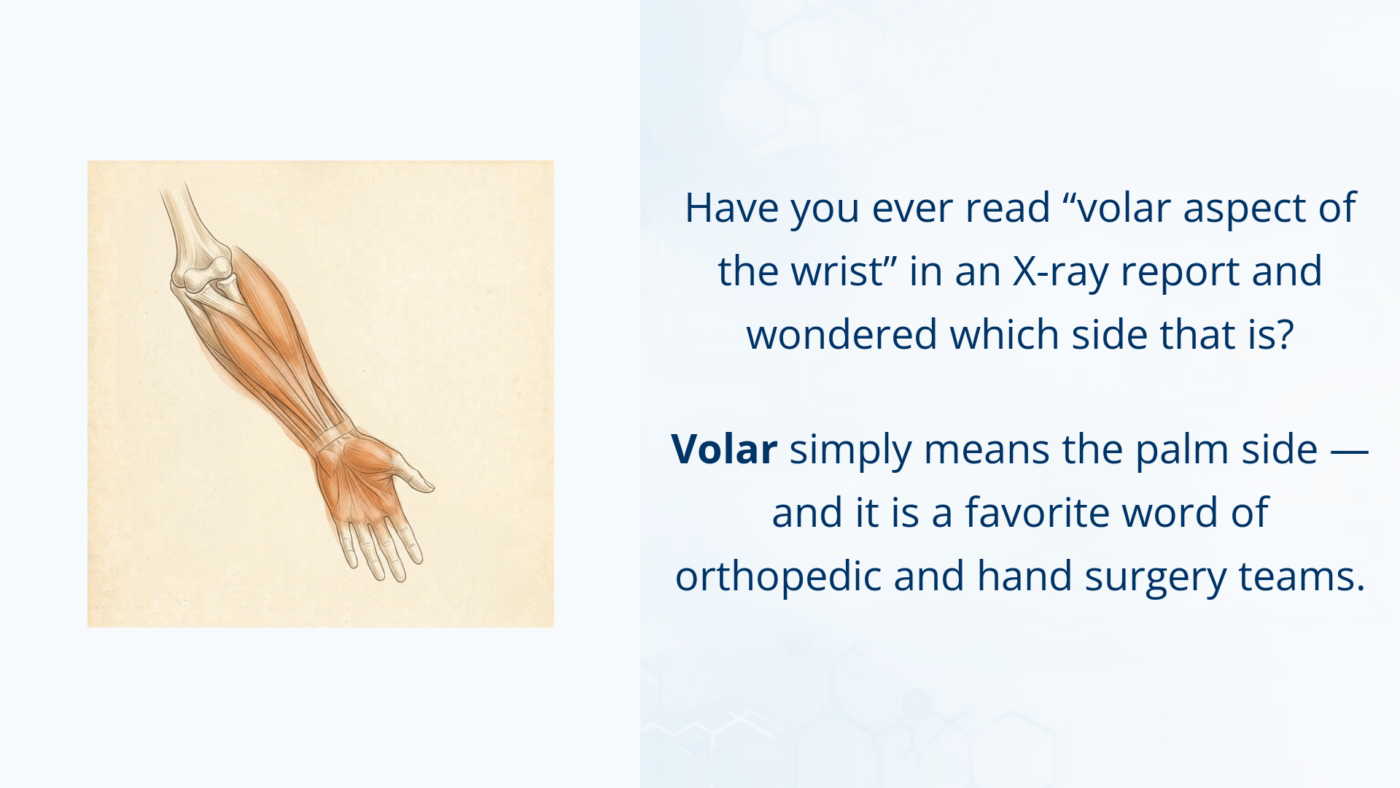
👁 What Does “Volar” Mean?
Volar is an adjective meaning on the palm side of the hand, wrist or forearm. If you stand in anatomical position with your palms facing forward, everything facing forward on your hand and forearm is the volar side.
The word comes from Latin vola, meaning “the palm of the hand” or “the hollow of the hand”.
Volar and palmar mean essentially the same thing. The opposite is dorsal — the back of the hand.
🔍 Clinical Usage
Volar is especially common in orthopedics, hand surgery, emergency medicine and hand therapy. You’ll see it in:
- X-ray and fracture reports
- splinting and plaster instructions
- operation notes
- hand therapy referrals
Common collocations include:
- volar aspect of the wrist / forearm
- volar slab (a plaster splint on the palm side)
- volar plate injury (a finger joint ligament injury)
- volar locking plate (used to fix wrist fractures)
- volar ganglion cyst
Here’s a natural clinical example:
“Distal radius fracture managed in a volar slab; review in fracture clinic in one week.”
→ Meaning: The wrist fracture was supported with a plaster splint on the palm side, and the patient will be checked again in a week.
Try OET Practice Questions for Free
Exam-style questions with every answer explained.
Listening · Reading · Writing · Speaking — No sign-up needed
🗣 Pronunciation
VOH-lar — the stress is on the first syllable.
💡 OET Tip
Patients won’t know volar. In the Speaking test, say “the palm side of your wrist”. In a referral letter, volar or palmar helps a colleague locate a wound or injury precisely.
🔗 Related Words
Browse every term in our Medical English Body Parts A–Z guide.