

OET Vocabulary, Word of the Day
Trunk – Meaning and Usage in Medical English

Nov
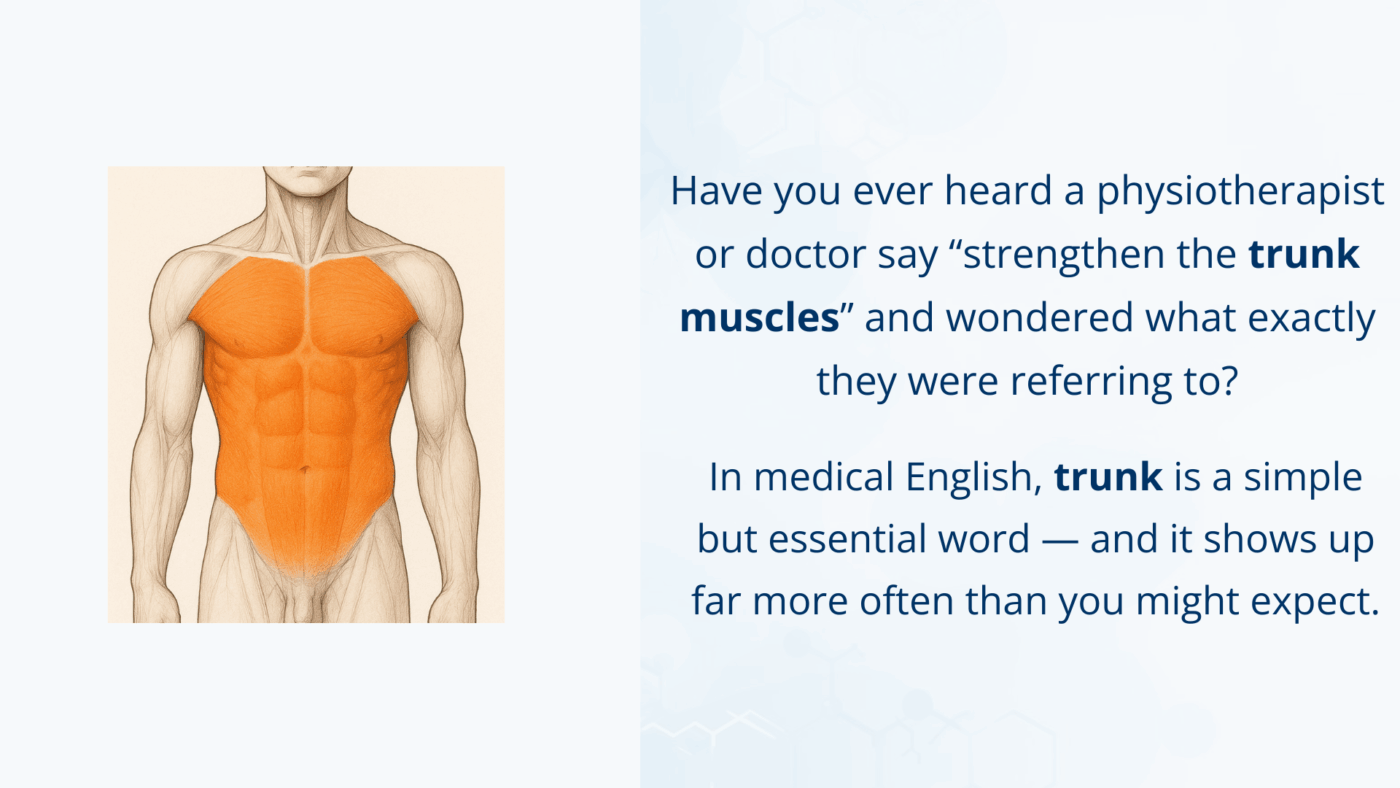
👁 What Does “Trunk” Mean?
The trunk refers to the central part of the human body, excluding the head and limbs.
It includes the thorax, abdomen, and pelvis — essentially everything between the neck and the hips.
The word comes from Latin truncus, meaning “the main stem of a tree.”
In modern medicine, trunk is used as a neutral anatomical term, particularly in physiotherapy, rehabilitation, orthopedics, and nursing documentation.
🔍 Clinical Usage
In clinical settings, trunk is used to describe movement, muscle groups, posture, injuries, and physical assessment findings. You’ll see it in:
- physiotherapy and occupational therapy notes
- nursing assessments
- rehabilitation plans
- discharge summaries
- orthopedic and neurology documentation
Healthcare professionals use the term when discussing core stability, posture, balance, and mobility, because the trunk plays a central role in all of these functions.
Common collocations include:
- trunk rotation
- trunk flexion / extension
- trunk muscles
- trunk control
- trunk stability
Here’s a natural clinical example:
“The patient demonstrated improved trunk stability during sitting balance exercises.”
→ Meaning: The patient could maintain posture more effectively while seated.
🎥 Watch the Short Video
👉 Watch our 30-second clip: Trunk – Learn how to pronounce it and remember how it’s used in real medical English.
Study with OET BANK
Stop wasting time comparing OET materials.
With OET BANK, you get:
- Premium-quality OET materials, built by professionals
- A focused, efficient study path — no unnecessary content
- A system designed to help you pass OET once — without trial and error
If you want to prepare properly and pass with confidence,
you don’t need to look anywhere else.
Pick your materials and start today — with OET BANK.