

OET Medical Vocabulary, Word of the Day
Nasolabial Fold (Smile Line) – Meaning and Usage in Medical English
Nov
👁 What Does “Nasolabial Fold” Mean?
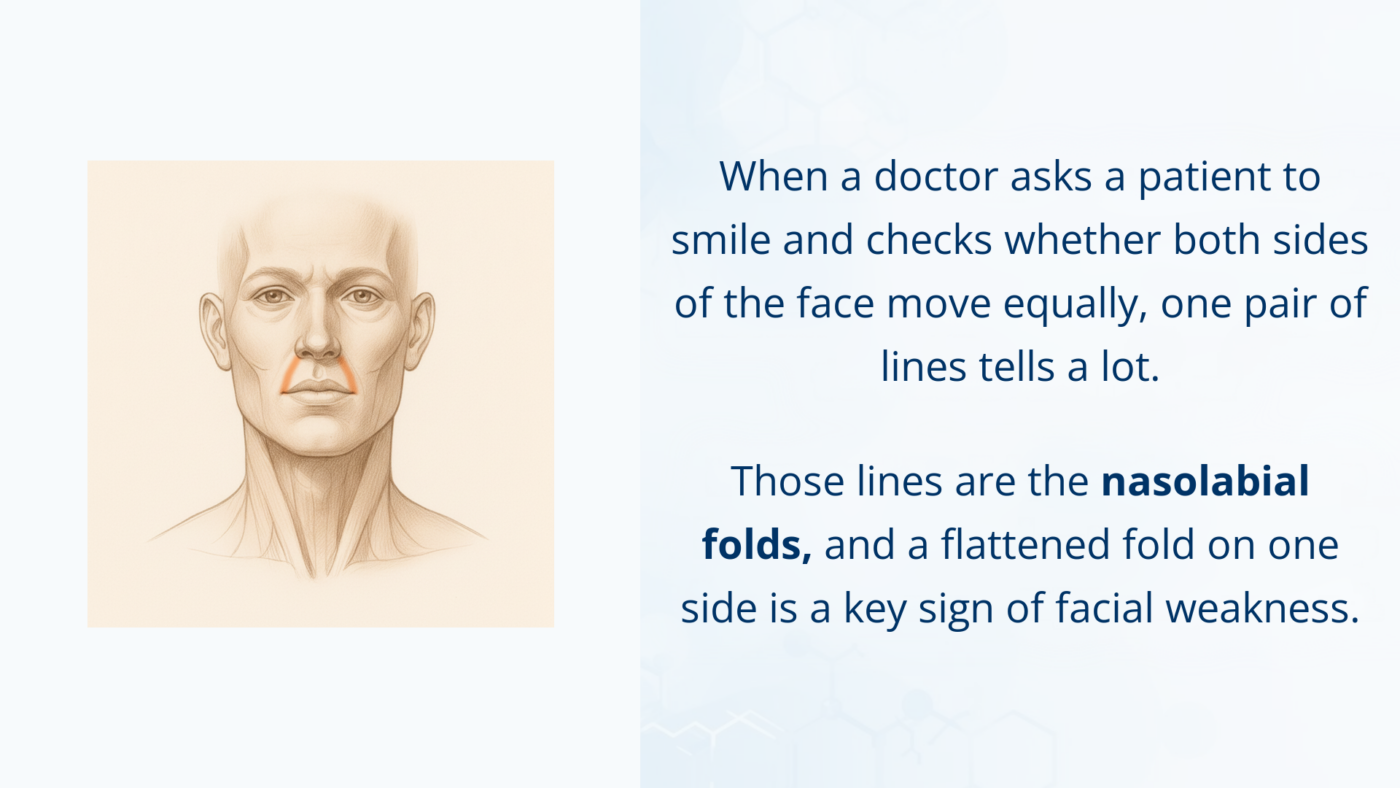
The nasolabial fold is the smile line: the skin crease that runs from the side of the nose to the corner of the mouth. There is one on each side of the face, and both deepen when a person smiles.
Nasolabial combines Latin nasus, “nose”, and labium, “lip”. The plural is nasolabial folds, often shortened to NLFs in neurology and cosmetic notes.
🔍 Clinical Usage
The nasolabial fold appears in neurology, emergency, dermatology and cosmetic notes:
- flattened nasolabial fold — loss of the line on one side, a sign of facial weakness in stroke or Bell’s palsy
- facial nerve examination — the fold is checked at rest and when smiling
- seborrheic dermatitis — a scaly red rash that often affects the folds
- dermal fillers — cosmetic injections used to soften deep folds
- nasolabial flap — skin from this area used to repair defects of the nose
Common collocations include:
- left / right nasolabial fold
- flattening of the nasolabial fold
- asymmetry of the nasolabial folds
- deep nasolabial folds
Here’s a natural clinical example:
“Flattening of the right nasolabial fold with sparing of the forehead; right arm weakness.”
→ Meaning: The right smile line is less visible, the forehead still moves normally, and the right arm is weak, which suggests a stroke rather than Bell’s palsy.
Try OET Practice Questions for Free
Exam-style questions with every answer explained.
Listening · Reading · Writing · Speaking — No sign-up needed
🗣 Pronunciation
nay-zoh-LAY-bee-ul — the stress is on the third syllable.
💡 OET Tip
With patients, say the line from your nose to the corner of your mouth. In writing, nasolabial fold is standard. Remember the difference: weakness that spares the forehead suggests a central cause such as stroke, while weakness that includes the forehead suggests Bell’s palsy.
🔗 Related Words
Browse every term in our Medical English Body Parts A–Z guide.
For the clinical words you will meet in the OET, with what to say to patients, see our OET Vocabulary guide.