

OET Medical Vocabulary, Word of the Day
Nail Plate (Fingernail) – Meaning and Usage in Medical English
Nov
👁 What Does “Nail Plate” Mean?
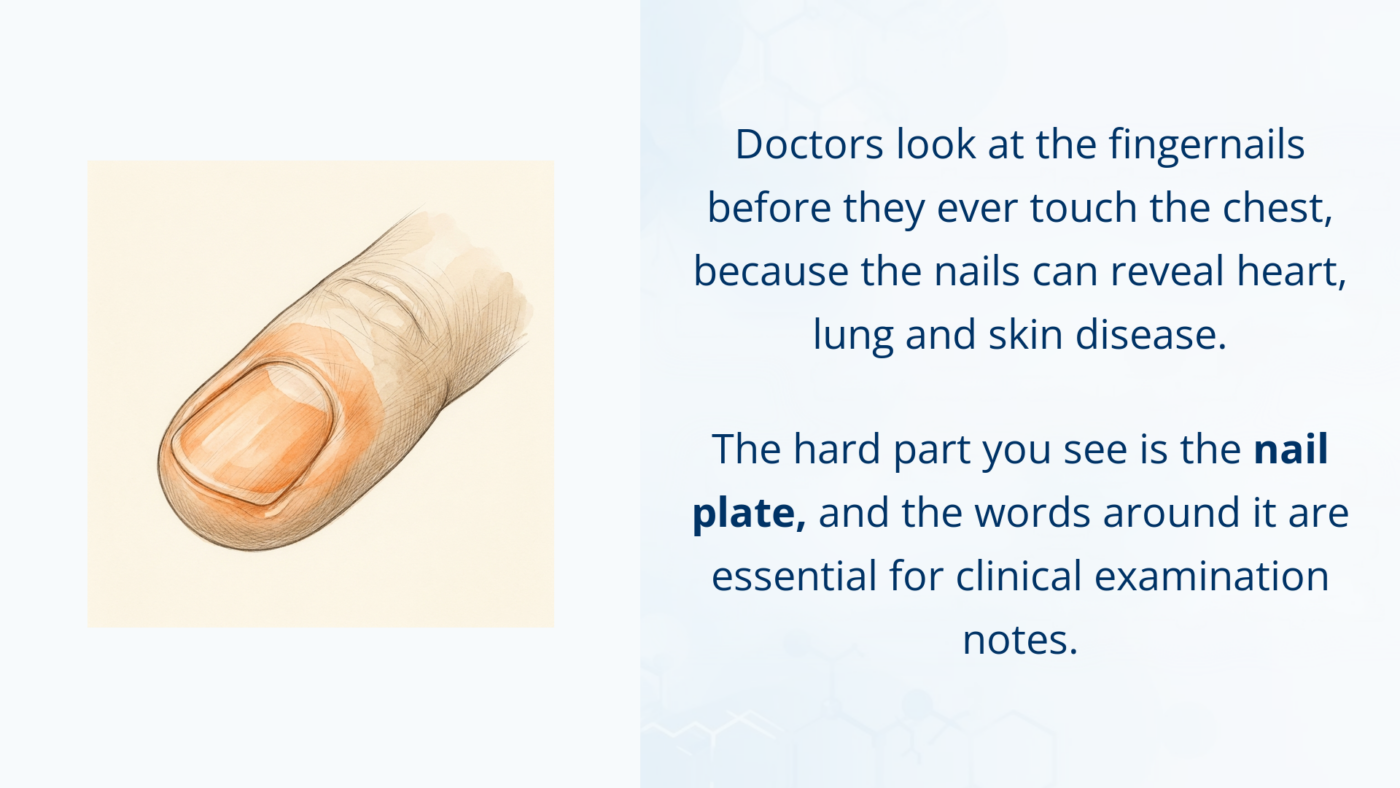
The nail plate is the fingernail: the hard, translucent layer of keratin that covers the top of the fingertip. It grows from the nail matrix under the skin fold at its base, and rests on the nail bed. The pale half-moon at the base is the lunula, and the skin fold is the cuticle.
The medical adjective is ungual or subungual, from Latin unguis, “nail”, as in subungual hematoma.
🔍 Clinical Usage
The nails appear in general medicine, dermatology, respiratory and emergency notes:
- clubbing — loss of the normal angle at the nail base, linked to chronic lung and heart disease
- paronychia — infection of the skin fold around the nail
- subungual hematoma — blood trapped under the nail after a crush injury
- onychomycosis — fungal infection of the nail
- nail pitting — small dents seen in psoriasis
Common collocations include:
- finger clubbing
- nail bed injury
- capillary refill time
- discolored, thickened nails
Here’s a natural clinical example:
“Finger clubbing present; no cyanosis; capillary refill under two seconds.”
→ Meaning: The fingertips and nails are rounded and enlarged, the skin is not blue, and blood returns quickly after pressing the nail.
Try OET Practice Questions for Free
Exam-style questions with every answer explained.
Listening · Reading · Writing · Speaking — No sign-up needed
🗣 Pronunciation
NAYL playt. Subungual is sub-UNG-gwul; paronychia is pa-roh-NIK-ee-uh.
💡 OET Tip
With patients, say nail or fingernail. In writing, use precise terms such as nail bed and nail fold. Don’t confuse paronychia (infection around the nail) with onychomycosis (fungal infection of the nail itself).
🔗 Related Words
Browse every term in our Medical English Body Parts A–Z guide.
For the clinical words you will meet in the OET, with what to say to patients, see our OET Vocabulary guide.