
OET Vocabulary, Word of the Day
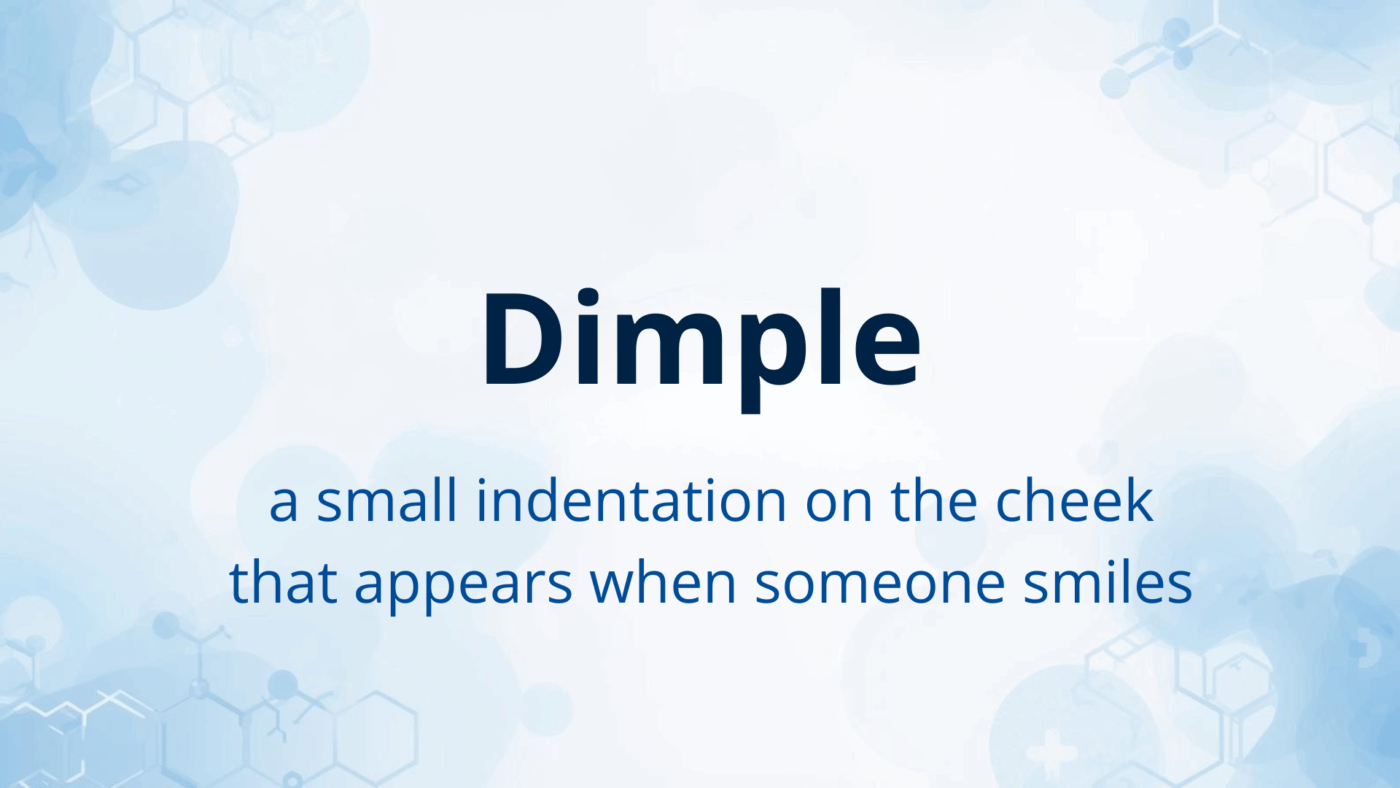
What Does Dimple Mean? Medical Term for Cheek Indentation
Oct
Have you ever noticed the small hollow that appears on someone’s cheek when they smile?
Those charming little features have a clear name in medical English. Today’s term is dimple.
👁 What Does “Dimple” Mean?
A dimple refers to a small natural indentation in the skin, most commonly found on the cheeks.
The word comes from Middle English and Germanic origins, meaning a small hollow or pit.
Although seen as a cosmetic trait rather than an anatomical structure, dimples are described in medical contexts when observing facial features, craniofacial variation, or surgical outcomes.
They are often present from birth due to a variation in the zygomaticus major muscle, which creates a visible indentation when a person smiles.
🔍 Clinical Usage
Dimples are generally benign and are not considered a medical problem.
However, they can be relevant in specific clinical situations, such as facial nerve assessment, dermatological evaluation, or cosmetic discussions.
Healthcare professionals may reference dimples in:
- Physical examination notes describing facial symmetry
- Pre- or post-operative cosmetic assessments
- Genetic or craniofacial evaluations where prominent facial features are documented
Short clinical example:
“Dimples visible symmetrically on smiling; no facial nerve weakness observed.”
Dimples may also be intentionally created through a cosmetic procedure known as dimpleplasty, which some patients pursue for aesthetic reasons.
🎥 Watch the Short Video
👉 Watch our 20-second clip: Dimple – Learn how to pronounce it and remember how it is used in real medical English.
Study with OET BANK
Stop wasting time comparing OET materials.
With OET BANK, you get:
- Premium-quality OET materials, built by professionals
- A focused, efficient study path — no unnecessary content
- A system designed to help you pass OET once — without trial and error
If you want to prepare properly and pass with confidence,
you don’t need to look anywhere else.
Pick your materials and start today — with OET BANK.