

OET Vocabulary, Word of the Day
Brachium – Meaning and Usage in Medical English

Oct
👁 What Does “Brachium” Mean?
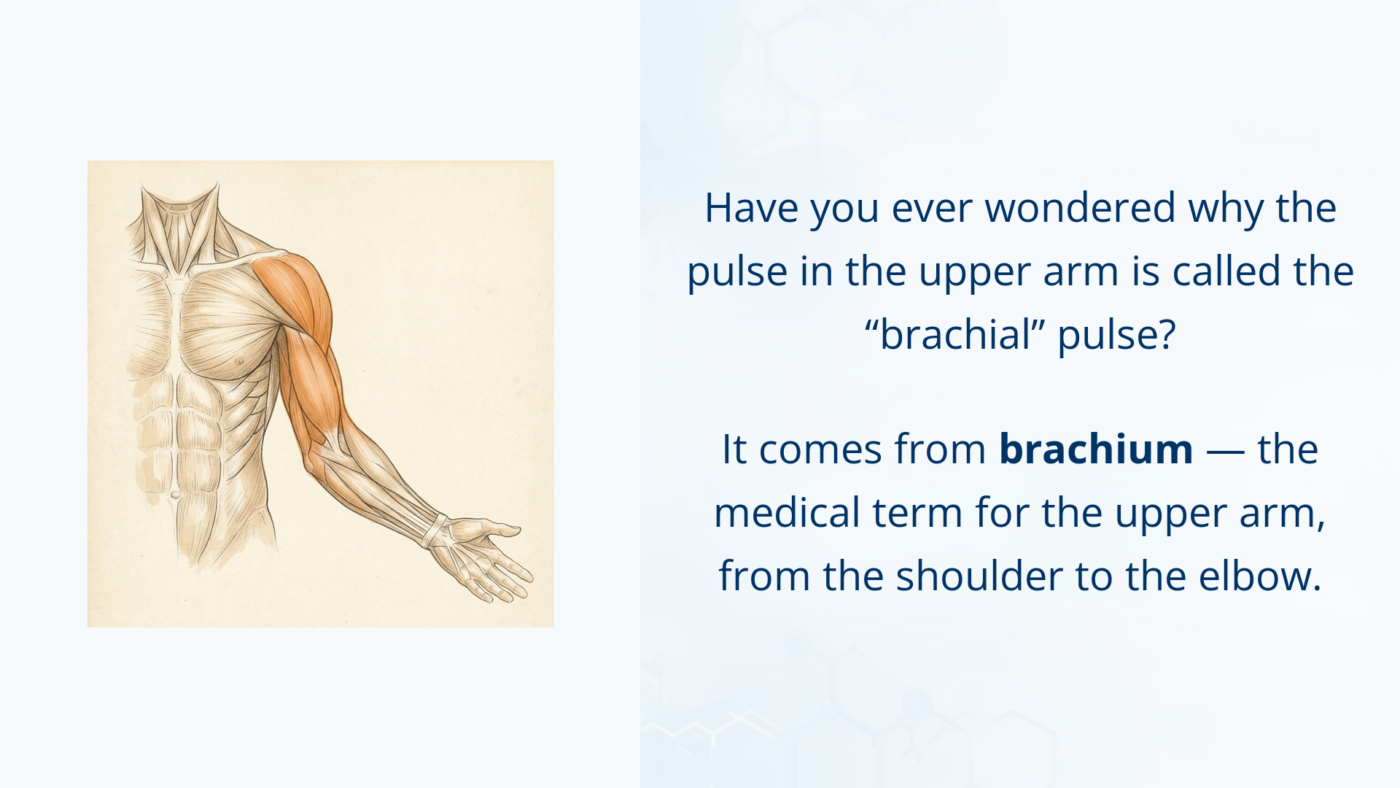
The brachium is the upper arm — the part of the upper limb between the shoulder and the elbow. It contains a single bone, the humerus.
The word comes from Latin bracchium, meaning “arm”. The plural is brachia, and the adjective is brachial.
Interestingly, in strict anatomical terms the word “arm” refers only to this segment. The part below the elbow is the forearm (antebrachium).
🔍 Clinical Usage
You will rarely see brachium on its own in clinical notes — most clinicians simply write “upper arm”. The adjective brachial, however, appears everywhere:
- brachial pulse — felt on the inner side of the upper arm or elbow
- brachial artery — used for blood pressure measurement
- brachial plexus — the network of nerves supplying the arm
- biceps brachii — the “two-headed muscle of the arm”
Knowing the root brachi- helps you decode all of these terms quickly in the Reading and Listening sub-tests.
Here’s a natural clinical example:
“Brachial pulses palpable and equal bilaterally.”
→ Meaning: The pulse in the upper arm could be felt on both sides, and it was the same strength on each side.
Try OET Practice Questions for Free
Exam-style questions with every answer explained.
Listening · Reading · Writing · Speaking — No sign-up needed
🗣 Pronunciation
BRAY-kee-um — and the adjective brachial is BRAY-kee-ul.
💡 OET Tip
In OET Writing, “upper arm” is perfectly professional for describing location. Save the brachial terms for their fixed expressions, such as brachial pulse or brachial plexus injury.