

OET Medical Vocabulary, Word of the Day
Metacarpophalangeal Joints (Knuckles) – Meaning and Usage in Medical English
Nov
👁 What Does “Metacarpophalangeal Joints” Mean?
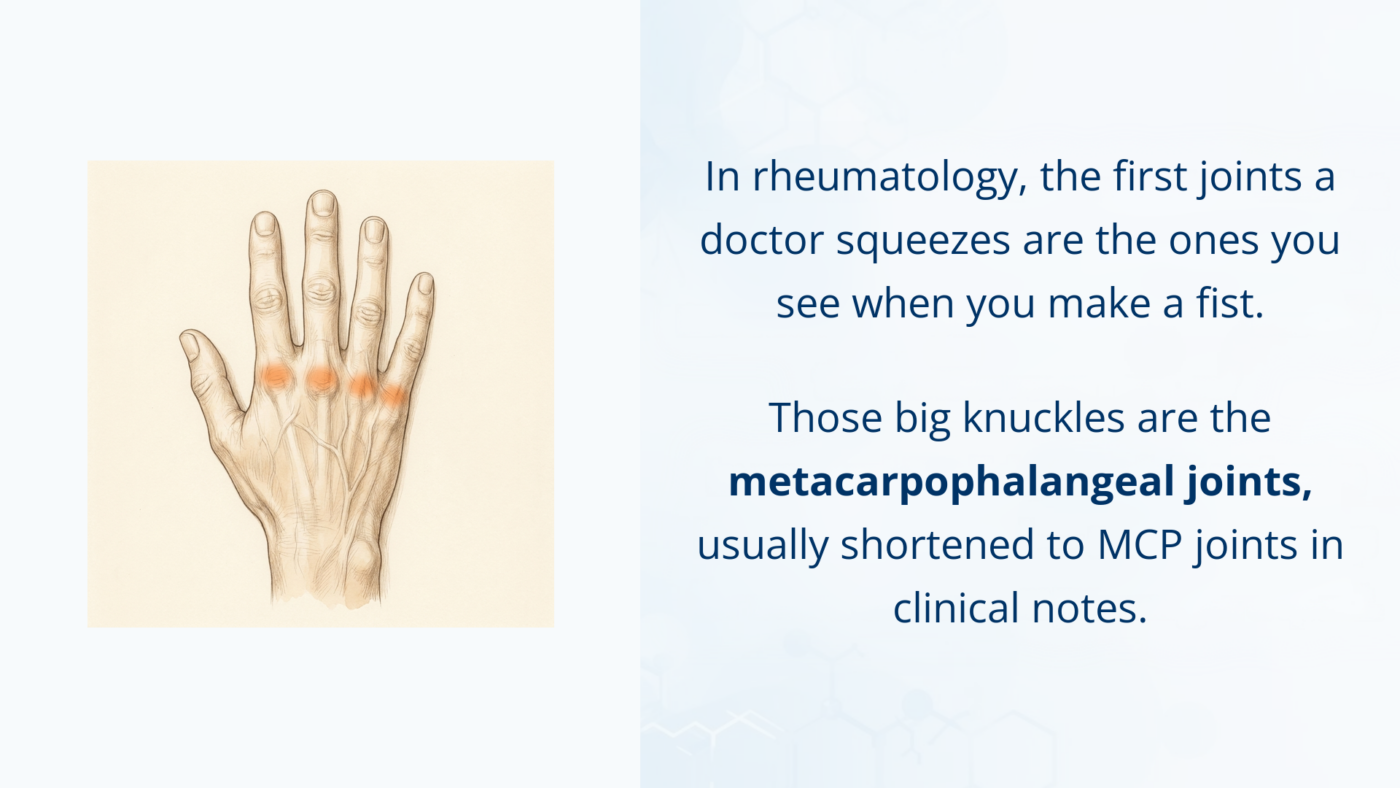
The metacarpophalangeal joints are the knuckles: the joints where the long bones of the hand meet the first bones of the fingers. There are five, one for each digit, and they let the fingers bend at the base.
The term combines metacarpal (hand bone) and phalangeal (finger bone), from Greek. The singular is metacarpophalangeal joint, abbreviated MCP or MCPJ. The middle and end finger joints are the PIP and DIP joints.
🔍 Clinical Usage
The MCP joints appear in rheumatology, orthopedic, hand therapy and emergency notes:
- rheumatoid arthritis — typically causes symmetrical swelling of the MCP joints
- fight bite — a tooth wound over a knuckle from punching, with high infection risk
- ulnar deviation — the fingers drift toward the little-finger side in long-standing arthritis
- boxer’s fracture — a break just behind the fifth knuckle
Common collocations include:
- MCP joint swelling
- squeeze test of the MCP joints
- second and third MCP joints
- laceration over the knuckle
Here’s a natural clinical example:
“Bilateral MCP joint swelling and tenderness; positive squeeze test; morning stiffness lasting over an hour.”
→ Meaning: The knuckles on both hands are swollen and painful, squeezing them across hurts, and the hands are stiff for a long time each morning.
Try OET Practice Questions for Free
Exam-style questions with every answer explained.
Listening · Reading · Writing · Speaking — No sign-up needed
🗣 Pronunciation
met-uh-KAR-poh-fuh-LAN-jee-ul — stress KAR and LAN. Most clinicians simply say M-C-P.
💡 OET Tip
With patients, say knuckles. In writing, MCP joints is standard after the full term has been used once. Don’t confuse MCP (hand) with MTP (metatarsophalangeal, the equivalent joints in the foot).
🔗 Related Words
Browse every term in our Medical English Body Parts A–Z guide.
For the clinical words you will meet in the OET, with what to say to patients, see our OET Vocabulary guide.