

OET Medical Vocabulary, Word of the Day
Plantar Arch (Arch of the Foot) – Meaning and Usage in Medical English

Nov
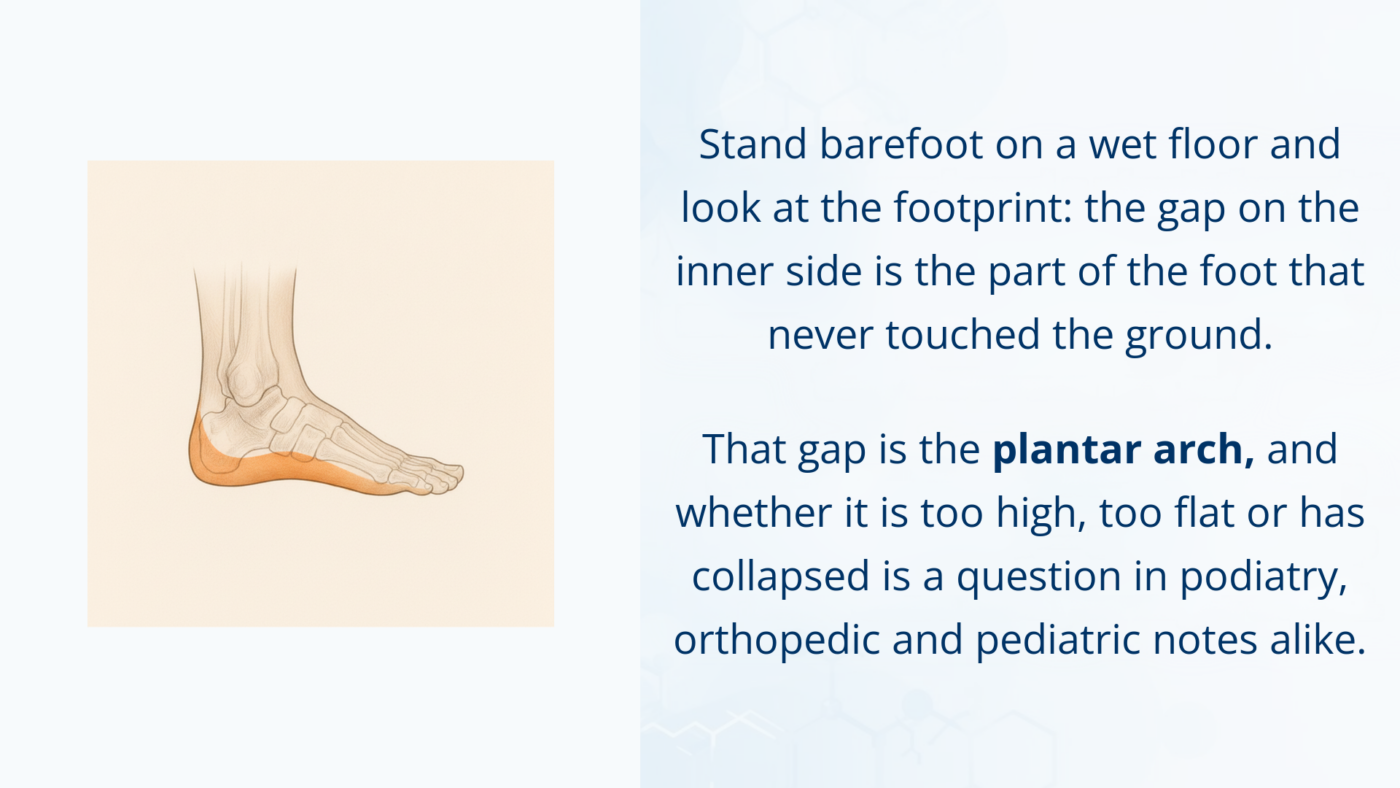
👁 What Does “Plantar Arch” Mean?
The plantar arch is the arch of the foot: the curved part of the sole on the inner side, between the heel and the ball of the foot, that does not touch the ground when you stand. Anatomically it is the medial longitudinal arch, the highest and most important of the foot’s three arches.
The arch is held up by the shape of the bones, the plantar fascia and several ligaments and tendons, the most important of which is the tibialis posterior. Plantar comes from Latin planta, “sole”.
🔍 Clinical Usage
The arch is assessed by looking at the standing foot and its footprint, and is described in:
- podiatry and orthotic prescriptions (arch support, medial arch pad)
- pediatric notes (flexible flat foot is normal in young children)
- orthopedic and physiotherapy letters (adult-acquired flat foot from tibialis posterior dysfunction)
- sports medicine (high arches increase the load on the heel and ball of the foot)
Two terms you will see often:
- pes planus — flat foot, a low or absent arch
- pes cavus — a high arch
Common collocations include:
- medial longitudinal arch
- collapse of the arch / flattening of the arch
- arch pain
- arch support insoles
Here’s a natural clinical example:
“Bilateral pes planus with collapse of the medial longitudinal arch on standing; arch reforms on tiptoe.”
→ Meaning: Both feet are flat when standing, but the arch returns when the patient rises onto the toes, which shows the flat foot is flexible rather than rigid.
Try OET Practice Questions for Free
Exam-style questions with every answer explained.
Listening · Reading · Writing · Speaking — No sign-up needed
🗣 Pronunciation
PLAN-tar ARCH — the stress is on the first syllable of plantar. Pes planus is PEZ PLAY-nus; pes cavus is PEZ KAY-vus.
💡 OET Tip
Patients say “my arch” or “the instep”; arch of the foot works in both speech and writing. Use medial longitudinal arch or pes planus when you want the orthopedic reader to know you assessed it formally, and always say whether the flat foot is flexible or rigid.
🔗 Related Words
Browse every term in our Medical English Body Parts A–Z guide.
For the clinical words you will meet in the OET, with what to say to patients, see our OET Vocabulary guide.