

OET Vocabulary, Word of the Day
Phalanges (Finger Bones) – Meaning and Usage in Medical English

Oct
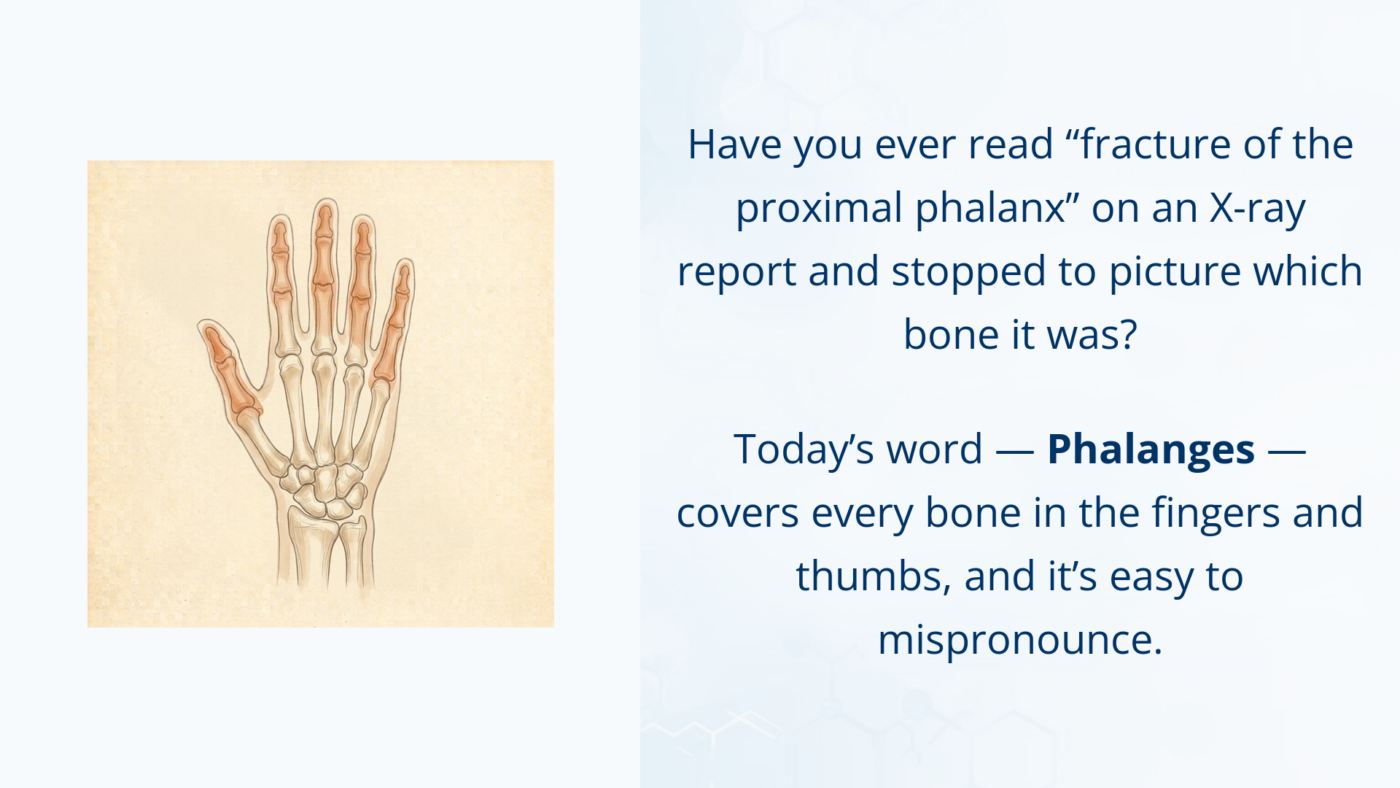
Phalanges are the small bones of the fingers and toes (singular: phalanx); each finger has three and each thumb has two.
👁 What Does “Phalanges” Mean?
Phalanges are the bones of the fingers and toes. The singular form is phalanx.
Each finger has three phalanges — proximal, middle and distal — while the thumb has only two (proximal and distal). That makes 14 phalanges in each hand.
The word comes from Greek phalanx, meaning “a line of soldiers”, because the bones sit in neat rows.
🔍 Clinical Usage
Phalanges appear constantly in:
- X-ray and radiology reports
- emergency department notes for hand and foot injuries
- orthopedic and hand surgery letters
- podiatry notes (for the toes)
Common collocations include:
- proximal / middle / distal phalanx
- fracture of the base of the proximal phalanx
- distal phalanx crush injury
- interphalangeal joint (PIP / DIP joint)
Here’s a natural clinical example:
“Undisplaced fracture of the base of the proximal phalanx of the left little finger.”
→ Meaning: There is a crack, with the bone still in place, at the bottom of the finger bone closest to the hand in the left little finger.
Try OET Practice Questions for Free
Exam-style questions with every answer explained.
Listening · Reading · Writing · Speaking — No sign-up needed
🗣 Pronunciation
Plural phalanges: fuh-LAN-jeez. Singular phalanx: FAL-angks.
💡 OET Tip
A common mistake is writing “a phalange”. In professional writing, use phalanx for one bone and phalanges for more than one. With patients, “finger bone” or “toe bone” is clearer.
🔗 Related Words
Browse every term in our Medical English Body Parts A–Z guide.