

OET Vocabulary
How to Read Case Notes Effectively in OET Writing
Mar
In OET Writing, candidates are required to write a referral letter based on the provided case notes (patient records).
These notes form the sole source of clinical information for the task. How you read these case notes, and how you decide which information to use, has a direct and significant impact on your Writing score.
Many candidates focus heavily on language accuracy, but in practice, performance is often determined earlier—at the stage where you interpret and filter the information in front of you.
Understanding what the case notes are designed to test can help clarify what is expected.
The task is not about reproducing data, but about demonstrating clinical judgement in written communication. This begins with how the notes are read.
What Are Case Notes?
Case notes are structured records that summarise a patient’s current condition, treatment history, past medical history, and social background.
In the OET exam, they are presented in bullet-point form, with a large amount of information condensed into a limited space.
This format reflects real clinical documentation, where efficiency and density are prioritised over narrative flow.
In the actual exam, the case notes are presented in a format similar to the one below.
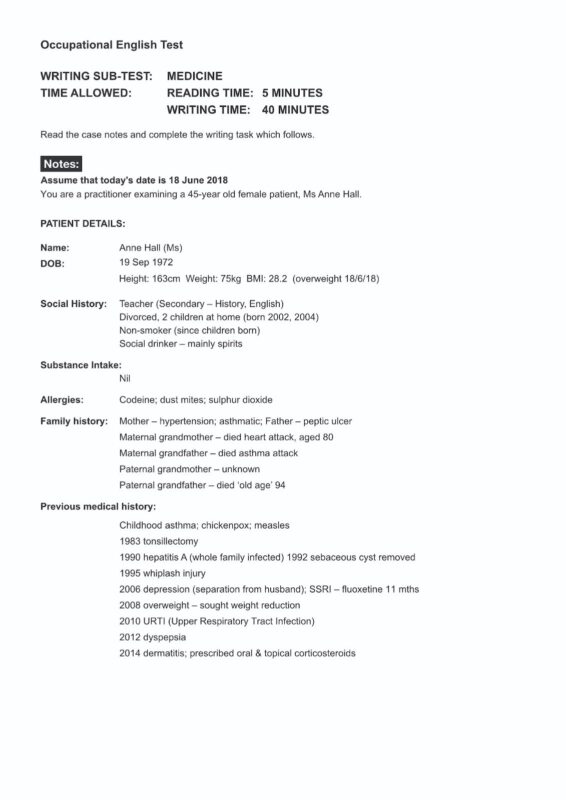
Candidates are expected to interpret this set of information and write a referral letter addressed to an appropriate reader, such as a specialist, a facility manager, or a care coordinator.
The challenge lies not in understanding individual data points, but in recognising how those data points relate to the purpose of the referral.
Write Only What the Recipient Needs to Know
The most important principle when working with case notes is simple but often overlooked: you should not use all the information provided.
Instead, your task is to extract only what the reader actually needs to know in order to take over care or make decisions.
This principle is directly linked to two assessment criteria: Content and Conciseness & Clarity. Including too much information can weaken both.
In practice, the following categories of information tend to be particularly important:
- The main complaint or key clinical signs that prompted the referral
- Objective data related to current symptoms or disease progression
- Relevant treatment history or investigation results that the receiving professional will need
- Background factors that affect ongoing care, such as home situation, medication use, or mobility
Each of these elements should be selected in light of the referral purpose. The same patient details may be relevant in one referral and unnecessary in another.
What matters is whether the information supports the receiving reader’s next clinical actions.
A Common Mistake: Including Unnecessary Information
A frequent issue, especially among less experienced candidates, is the assumption that every item in the case notes must be used.
This approach is understandable, but it often leads to letters that feel unfocused or overly long.
In reality, information that the reader is likely to already know—or that does not affect care after the referral—can reduce clarity rather than improve it. Examples of information that is often unnecessary include:
- Minor past medical issues that have no bearing on the current referral
- Conditions that have already been fully treated and resolved
- Details unrelated to post-referral management, such as historical events with no current impact
As a general rule, this type of information should be omitted. Doing so does not mean ignoring the case notes; it means applying selective clinical reasoning.
When writing, it is helpful to pause and ask a simple question:
What does the receiving doctor truly need to know to manage this patient appropriately?
If a detail does not contribute to that goal, it is unlikely to strengthen your letter.
Why This Matters in OET Writing
Ultimately, effective case-note reading demonstrates professional written communication, not just English ability.
OET assesses whether you can prioritise, synthesise, and communicate information in a way that reflects real clinical practice.
By focusing on relevance over completeness, and on purpose-driven selection of information, you create letters that are clearer, more concise, and more clinically appropriate.
This approach not only aligns with the marking criteria, but also mirrors how healthcare professionals communicate in real referral settings.
Understanding how to read case notes effectively, therefore, is not an isolated exam skill.
It is a reflection of how well you can translate clinical information into meaningful communication—an ability that sits at the core of safe and effective healthcare practice.
Watch the Video
Prefer video? Here’s a quick walkthrough of this article.
Study with OET BANK
Stop wasting time comparing OET materials.
With OET BANK, you get:
- Premium-quality OET materials, built by professionals
- A focused, efficient study path — no unnecessary content
- A system designed to help you pass OET once — without trial and error
If you want to prepare properly and pass with confidence,
you don’t need to look anywhere else.
Pick your materials and start today — with OET BANK.