

OET Strategies, Writing
What OET Writing Examiners Are Actually Looking For
Mar
In OET Writing, examiners do NOT assess only whether your English is “correct.”
What they are evaluating is whether your letter functions as clear, effective medical communication—the kind of document that would be genuinely useful in a real clinical setting.
This distinction is critical. A letter can be grammatically accurate and still fail if it does not meet the practical expectations of professional healthcare writing.
For this reason, OET Writing assessment goes far beyond vocabulary and grammar. It reflects how clinicians actually read and use letters in daily practice.
Examiners look at structure, information selection, clarity, and professional tone because these are the skills required when patient care depends on written communication.
Understanding this perspective helps explain why the assessment criteria are designed the way they are.
The Six Assessment Criteria Used in OET Writing
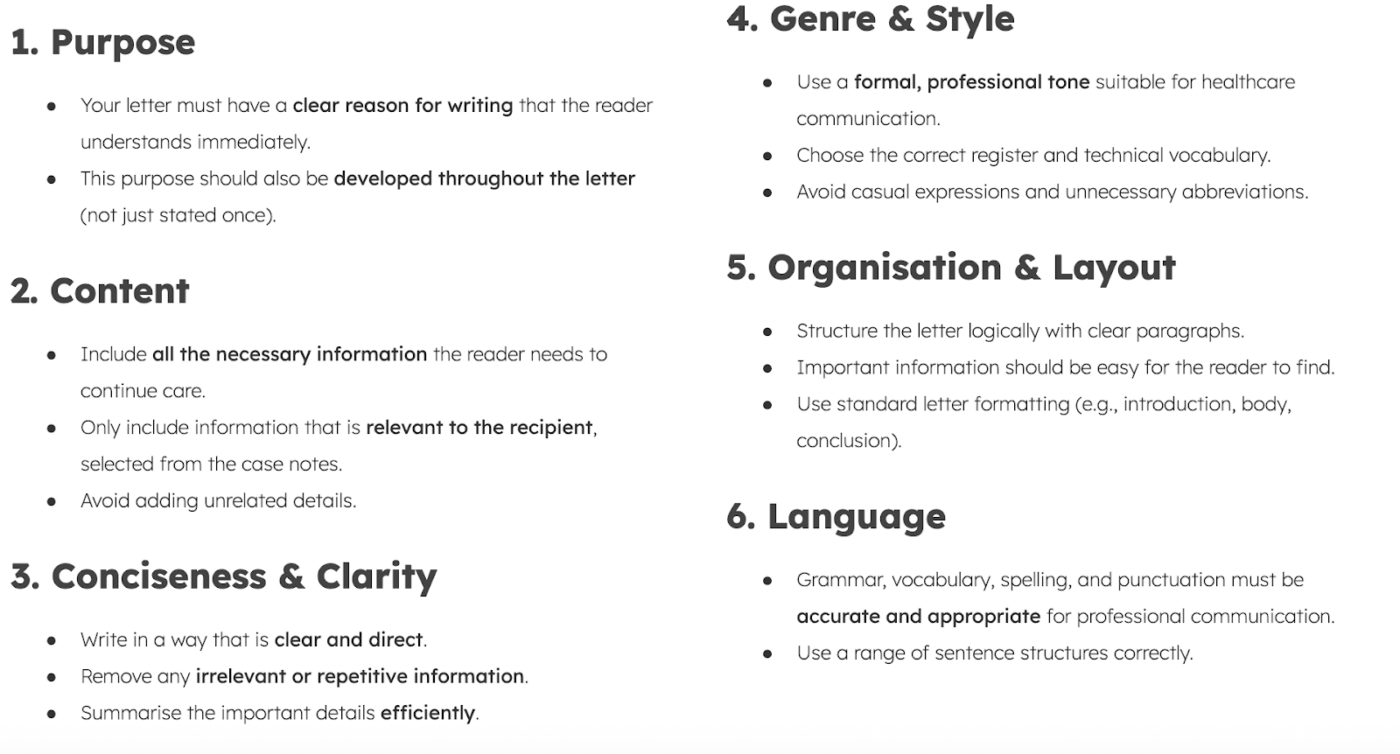
OET Writing is marked across six official assessment criteria. Each one reflects a different aspect of real-world clinical correspondence.
Rather than viewing them as abstract scoring categories, it is more helpful to see them as practical checkpoints examiners use to judge whether your letter would work in its intended context.
If you want to improve your score, it is essential to understand what examiners are looking for and then apply those expectations consistently when writing your letters.
Key Points for Each Assessment Criterion
1. Purpose — Making the Purpose Clear
The first criterion focuses on whether the purpose of the letter is immediately clear.
The opening paragraph should state why the letter is being written—such as a referral, transfer of care, discharge, or request for assessment.
From the examiner’s perspective, the reader should not need to search for this information. A clear purpose signals that the writer understands professional clinical priorities.
2. Content — Choosing the Right Information
Content assesses what information you include and why. Examiners look for relevance to the reader’s role and responsibilities.
This means selecting details that support clinical decision-making, explaining cause–effect relationships, and providing essential background without overwhelming the reader.
Including too much information can be just as problematic as including too little, because it obscures what truly matters.
3. Conciseness & Clarity — Being Clear and Direct
This criterion focuses on whether your message is easy to follow on first reading.
Examiners expect you to omit information the reader is likely to already know and remove details that do not affect ongoing care.
Case notes should be paraphrased into clear, logical prose, not copied mechanically. Clarity here reflects an understanding of how busy healthcare professionals process information.
4. Genre & Style — Using an Appropriate Professional Tone
Genre and style evaluate whether your writing matches accepted medical communication conventions. A formal, professional tone is required throughout. This includes using correct titles, clearly identifying the reader’s role, and avoiding casual language or question-style sentences. Referring to the individual as “the patient” rather than by name reflects standard professional distance and documentation norms.
5. Organisation & Layout — Structuring the Letter Clearly
Organisation and layout assess how easily the reader can navigate your letter.
Each paragraph should have a clear focus, and information should follow a logical sequence, often reflecting time or clinical progression.
Linking words help guide the reader through your reasoning, while spacing between paragraphs improves readability. This criterion recognises that visual clarity supports clinical safety.
6. Language — Vocabulary and Grammar Accuracy
Language accuracy covers grammar, vocabulary choice, and sentence control.
Examiners look for variety without unnecessary complexity. Long sentences that require rereading reduce clarity, even if they are technically correct.
Attention to articles, pronouns, and verb tenses is essential because small errors can affect meaning in clinical contexts.
Understanding the Pass Requirement
To pass OET Writing, candidates generally need at least 2 out of 3 for Purpose and 5 or above for each of the other criteria.
Among these, Content and Language tend to be more challenging because they require independent judgement—deciding what matters and expressing it accurately.
In contrast, Conciseness & Clarity, Genre & Style, and Organisation & Layout often improve more quickly when candidates begin writing within established, reliable structures.
How to Study: Build the Structure First, Then Improve Accuracy
An efficient approach to OET Writing preparation is to build structural control first.
This means learning the standard components of an OET letter, practising consistent paragraph patterns, and developing a clear sense of information priority.
Once structure is stable, attention can shift to refining grammar, word choice, and precision.
In OET Writing, success does not come from developing a personal writing style. It comes from aligning your writing with professional expectations, then steadily improving accuracy within those frameworks.
Over time, this approach leads to letters that meet the assessment criteria naturally—without conscious checklist thinking—because they reflect how effective medical communication actually works.
Watch the Video
Prefer video? Here’s a quick walkthrough of this article.
Study with OET BANK
Stop wasting time comparing OET materials.
With OET BANK, you get:
- Premium-quality OET materials, built by professionals
- A focused, efficient study path — no unnecessary content
- A system designed to help you pass OET once — without trial and error
If you want to prepare properly and pass with confidence,
you don’t need to look anywhere else.
Pick your materials and start today — with OET BANK.