

OET Strategies
Why OET Fits Healthcare Professionals Better Than General English Exams
Feb
“Aren’t IELTS and TOEFL the only English tests that matter?”
This is a question many healthcare professionals ask when they first start exploring overseas registration.
It is true that exams such as IELTS and TOEFL are widely accepted for professional registration in countries like Australia, the UK, and the United States.
They are well established and effective at measuring general academic English ability across reading, writing, listening, and speaking.
However, what these exams primarily assess is general-purpose English, rather than the specific communication skills required in clinical environments. This difference becomes important once you look beyond the exam score itself.
Even after meeting the required IELTS or TOEFL score, many doctors and nurses find that they still need to study medical English separately in order to function safely and confidently at work.
For many candidates, this turns into a second phase of preparation, requiring additional time and effort after the language test is already completed.
For nurses in particular, passing an English exam is rarely the final step. Afterward, most candidates must also prepare for country-specific licensing or clinical assessments, such as NCLEX or OSCE-style exams.
These assessments focus heavily on clinical communication: explaining procedures, responding to patient concerns, and documenting information accurately. This is where OET offers a clear structural advantage.
Much of OET’s content overlaps with the communication skills tested in professional healthcare exams, creating a strong sense of continuity between English preparation and clinical readiness.
In contrast, IELTS has little direct connection to medical contexts. The skills you develop for IELTS often do not transfer smoothly into clinical communication, which means you may need to start a new and unrelated study process later.
By choosing OET, candidates can work on English proficiency and professional communication at the same time, rather than treating them as separate goals.
Over the long term, this often leads to a more efficient and realistic pathway toward working in healthcare overseas.
Comparing Passing Standards Across English Exams
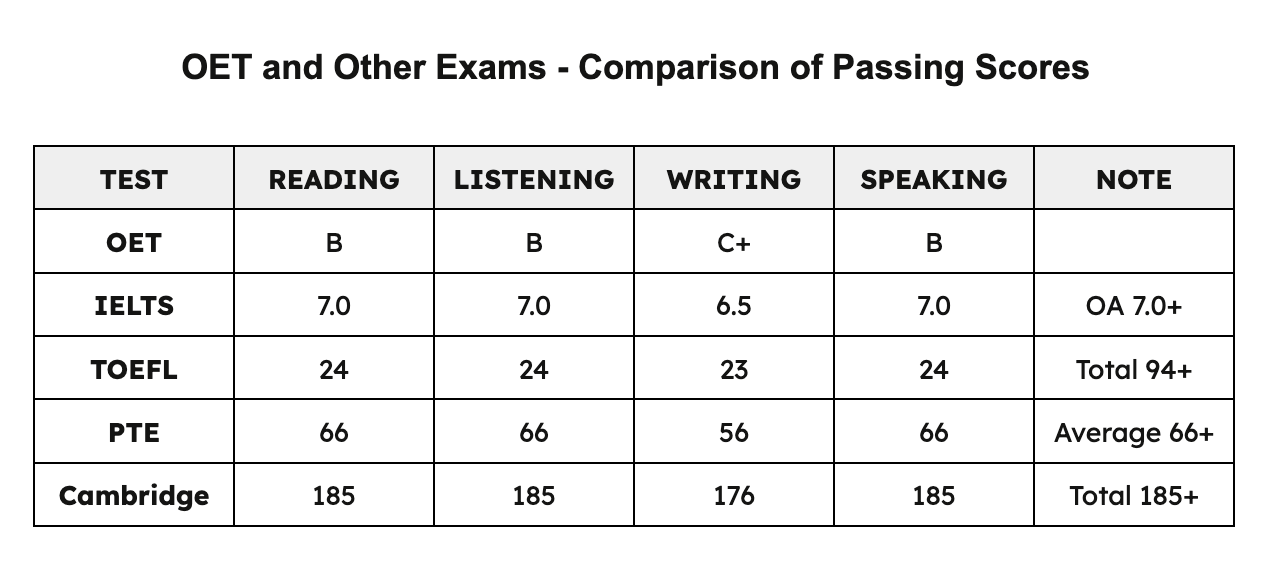
The table below compares the required passing levels for major English exams such as IELTS, TOEFL, and OET.
One area that deserves particular attention is how Speaking and Writing are assessed.
For example, IELTS typically requires a Speaking score of 7.0 or higher, while TOEFL often requires 24 or above. Achieving these scores usually demands near-native performance, including strong pronunciation, natural fluency, wide lexical range, and well-structured responses.
In addition, these exams require candidates to respond spontaneously to abstract or non-clinical topics, such as environmental issues, education systems, or economic inequality. While these topics may be intellectually interesting, they are rarely connected to daily clinical work.
Nevertheless, performance on these topics has a major impact on the final score.
Writing follows a similar pattern. Candidates are expected to produce almost error-free, native-like expressions, which can make score stability difficult even for advanced English users. Many candidates experience score fluctuations despite having similar levels of ability each time they sit the test.
OET takes a different approach.
It evaluates candidates through profession-specific scenarios, grounded in their actual role as a nurse, doctor, or other healthcare professional. This leads to several important differences that shape both preparation and outcomes.
- Topics are limited and clearly medical, allowing focused and efficient preparation
- Assessment prioritizes clear intent, polite interaction, and the ability to guide a conversation, rather than accent or native-like delivery
- Test formats follow relatively consistent patterns, making targeted preparation more achievable
Because of these features, OET is particularly well suited to candidates with clinical experience and a defined goal of overseas practice.
For healthcare professionals whose objective is real-world employment rather than academic certification alone, OET often proves to be the most practical option.
Just as importantly, it offers a higher likelihood of consistent, repeatable results, helping candidates plan their careers with greater confidence and clarity.
Watch the Video
Prefer video? Here’s a quick walkthrough of this article.
Study with OET BANK
Stop wasting time comparing OET materials.
With OET BANK, you get:
- Premium-quality OET materials, built by professionals
- A focused, efficient study path — no unnecessary content
- A system designed to help you pass OET once — without trial and error
If you want to prepare properly and pass with confidence,
you don’t need to look anywhere else.
Pick your materials and start today — with OET BANK.