

OET Vocabulary
Understanding the OET Reading Section: Structure, Focus, and What It Really Tests
Feb
The OET Reading section is designed to assess information-processing skills essential to clinical work, rather than simple language comprehension.
While general understanding is necessary, the focus goes further. Candidates are expected to demonstrate the ability to
- locate specific information efficiently
- select only what is clinically relevant
- interpret meaning using medical context and professional background knowledge
These abilities closely reflect how doctors and nurses engage with written information in real healthcare settings, where time pressure and prioritisation are constant.
The Reading test consists of three parts completed within a total of 60 minutes.
Each part targets a different aspect of professional reading, and together they form a structured assessment of how effectively a candidate can manage written clinical information.
Below is an overview of this structure.
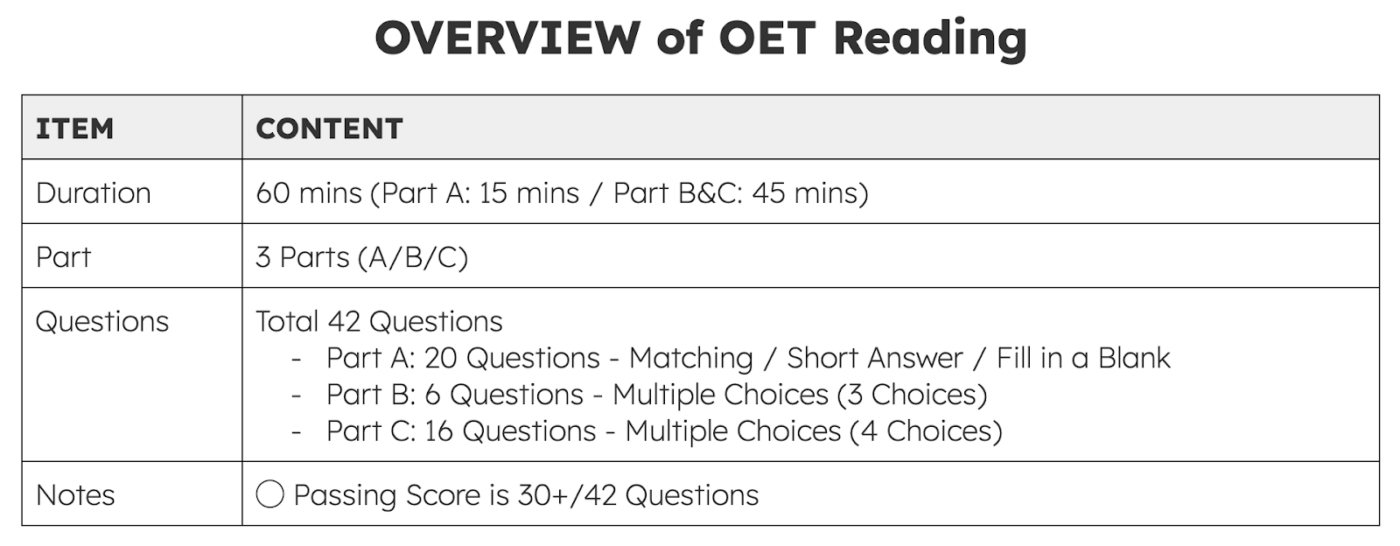
Broadly speaking, the Reading section is divided into Part A and Parts B & C, each with distinct demands and skill requirements.
A summary of these differences is shown below.
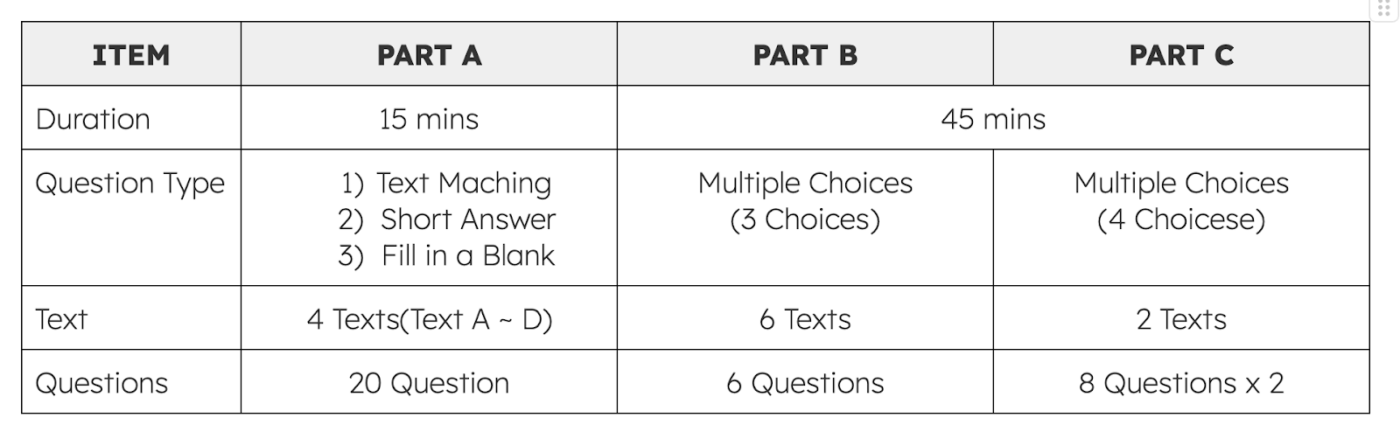
As with Listening, Part A carries a heavier weighting within the overall Reading score.
In practice, candidates aiming for a stable and reliable result generally need to secure around 80% of the available points in Part A.
This reflects the importance OET places on rapid information handling, a skill that underpins safe and effective clinical decision-making.
The Distinctive Nature of Part A: Information-Scanning Tasks
One of the most distinctive features of OET Reading is the structure and strict time limit of Part A.
In this section, candidates work with four short healthcare-related texts, such as patient complaints, treatment descriptions, or brief clinical records.
These texts are intentionally concise but information-dense, mirroring the types of documents clinicians encounter daily.
Candidates answer three different question types:
- Information classification questions
→ identifying which text contains the relevant detail - Short-answer questions
→ extracting key information in two to three words - Gap-fill questions
→ completing sentences using exact wording from the texts
The total time limit for Part A is 15 minutes, leaving less than 45 seconds per question. This time pressure is deliberate.
Rather than encouraging careful, line-by-line reading, Part A tests the ability to scan rapidly, recognise keywords, and locate precise information without hesitation.
Success in Part A depends on efficient information handling. This means identifying relevant sections almost instantly, confirming the required detail, and moving on without over-reading.
These are the same skills clinicians use when reviewing referral letters, charts, or test summaries under time constraints.
In this sense, Part A is less about reading accuracy in isolation and more about controlled speed and decisiveness in information selection.
Key Differences Compared with Other English Exams
Compared with IELTS and TOEFL, OET Reading typically involves a smaller overall reading volume. However, this does not make the test easier in a simple sense.
Because the content is clinically focused, candidates with medical training often find the subject matter more familiar and intuitively structured. Existing medical vocabulary and professional context can support understanding rather than hinder it.
At the same time, OET Reading places much stronger emphasis on contextual judgment and rapid extraction of key information.
Success depends less on broad general English proficiency and more on understanding how information is organised, where critical details are likely to appear, and what can safely be ignored.
In other words, being generally “good at English” is not enough. Performance is strongly influenced by how you read: where your attention goes first, how quickly you dismiss irrelevant details, and how confidently you move on once the answer is found.
These habits directly affect time management and accuracy, particularly in Part A.
Watch the Video
Prefer video? Here’s a quick walkthrough of this article.
Study with OET BANK
Stop wasting time comparing OET materials.
With OET BANK, you get:
- Premium-quality OET materials, built by professionals
- A focused, efficient study path — no unnecessary content
- A system designed to help you pass OET once — without trial and error
If you want to prepare properly and pass with confidence,
you don’t need to look anywhere else.
Pick your materials and start today — with OET BANK.