

OET Vocabulary
Understanding OET Speaking Assessment Criteria
One of the most important differences between OET Speaking and other exams such as IELTS is that OET Speaking is not a test of personal opinions.
Instead, it assesses whether you can communicate appropriately as a healthcare professional.
In practical terms, the exam looks beyond general English and focuses on how effectively you use English in clinical interactions—the kind of communication expected in real consultations, not abstract discussion.
OET Speaking is assessed in two broad areas. The first is your language performance itself, and the second is how well you communicate in a clinically appropriate way.
Together, these areas reflect a simple reality: OET evaluates both English accuracy and control and professional communication behaviours that patients and colleagues rely on.
Assessment Areas in OET Speaking
① Linguistic Criteria: How Language Is Assessed
The Linguistic Criteria assesses whether you can use English accurately and naturally.
What is evaluated here is not your clinical knowledge or the medical “correctness” of what you say. The focus is how you speak, not what you say.
In other words, even when you are discussing clinical topics, the scoring is driven by language performance:
whether your pronunciation is clear, your grammar is controlled, your vocabulary is appropriate, and your delivery is smooth enough to support the interaction.
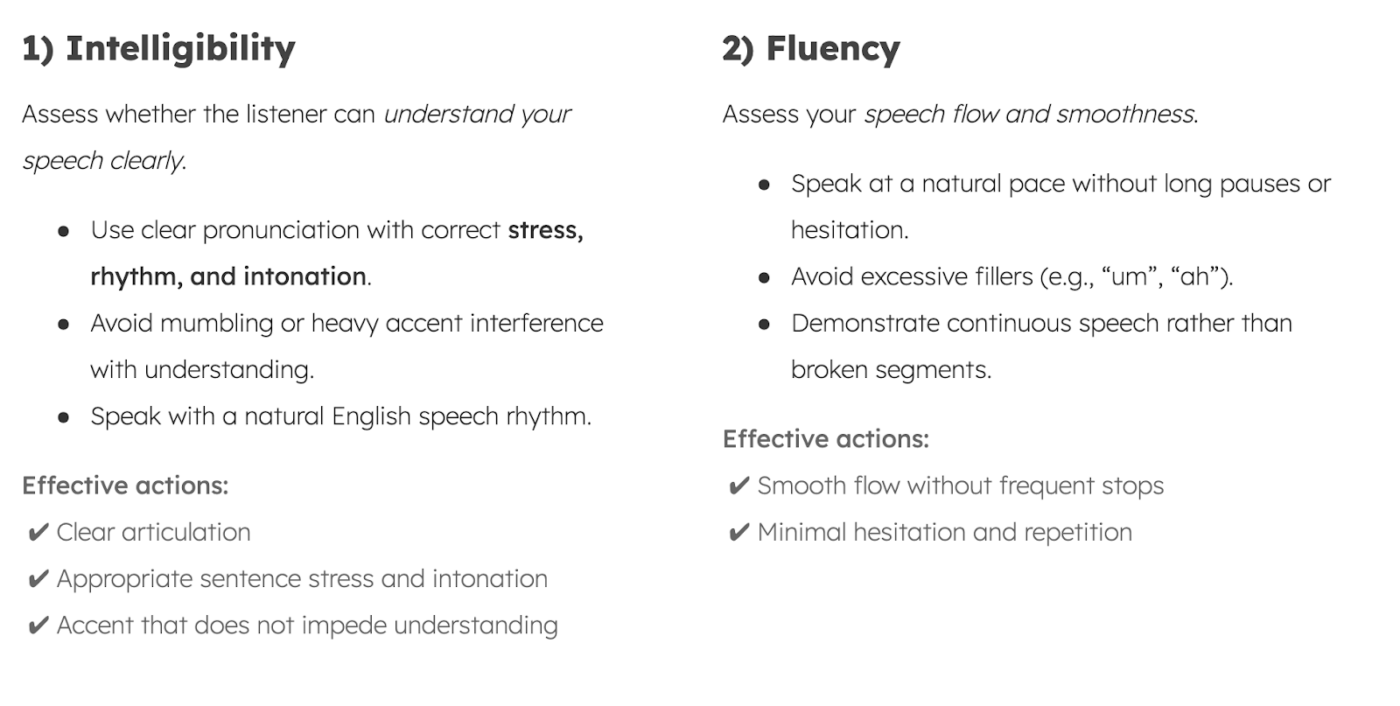
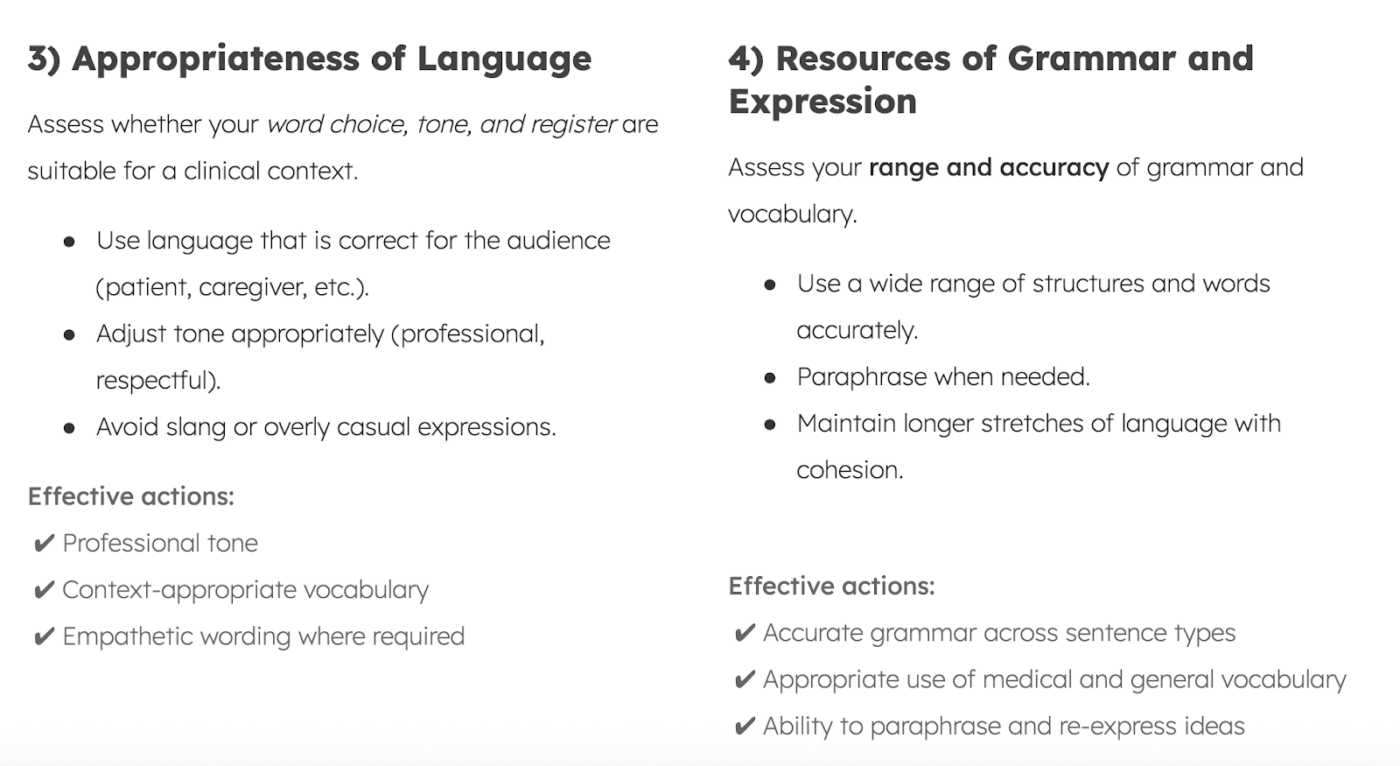
Overall, these criteria can be understood as indicators of how well you operate in spoken English under pressure.
Within this area, pronunciation and sense of rhythm matter more than many candidates expect.
OET Speaking is not a free conversation; it typically involves structured questioning and explanation. Because of this structure, the language you use often comes from a relatively limited set of recurring patterns.
To raise your score in Linguistic Criteria, reading aloud and practising complete phrases as units is a key training method, because it develops rhythm, clarity, and automaticity in the kinds of sentences you will actually use.
② Clinical Communication Criteria: Clinical Communication Skills
In the Clinical Communication Criteria, what matters is NOT simply “how good your English is,” but whether you respond appropriately with clinical consideration as a doctor or nurse.
Put differently, this is not a test of how fast or fluently you speak. It is a test of how you interact.
The assessment focuses on whether you can communicate in a way that is suitable for real clinical situations—showing empathy, listening actively, explaining clearly, and maintaining an appropriate tone and manner.
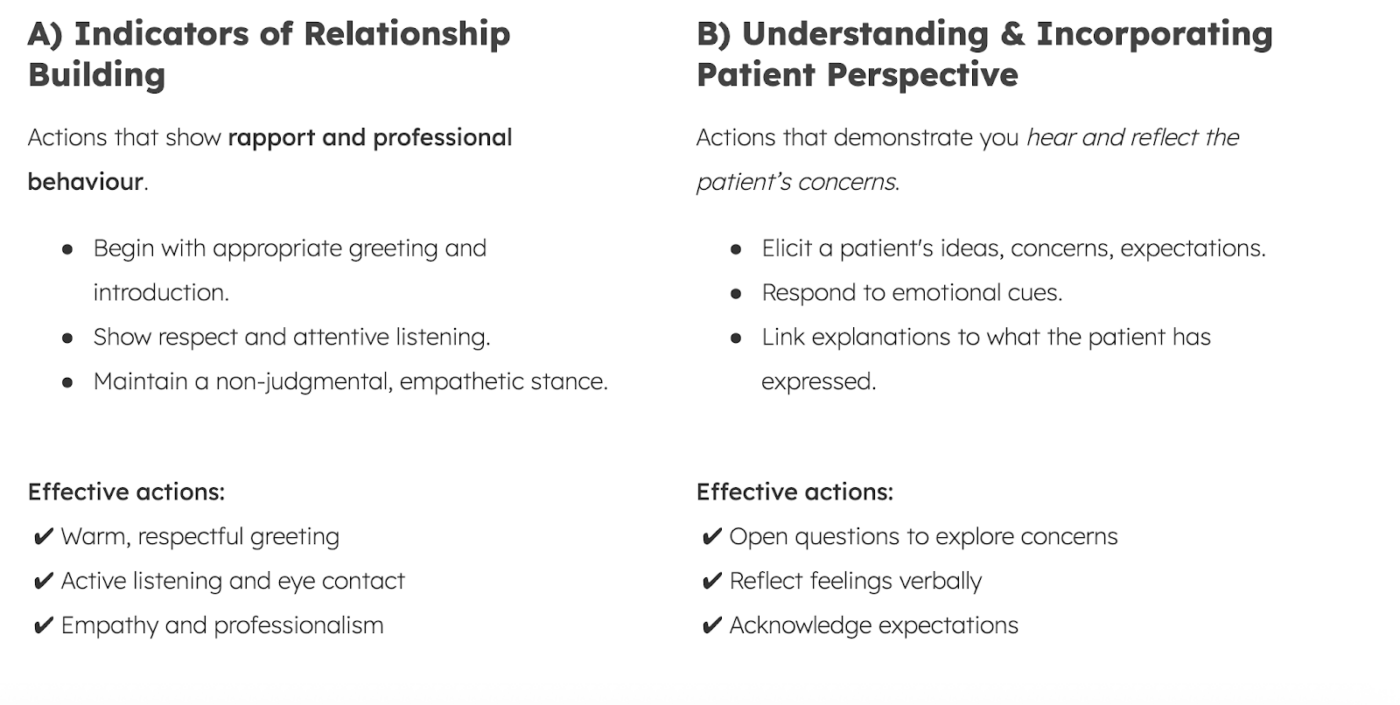
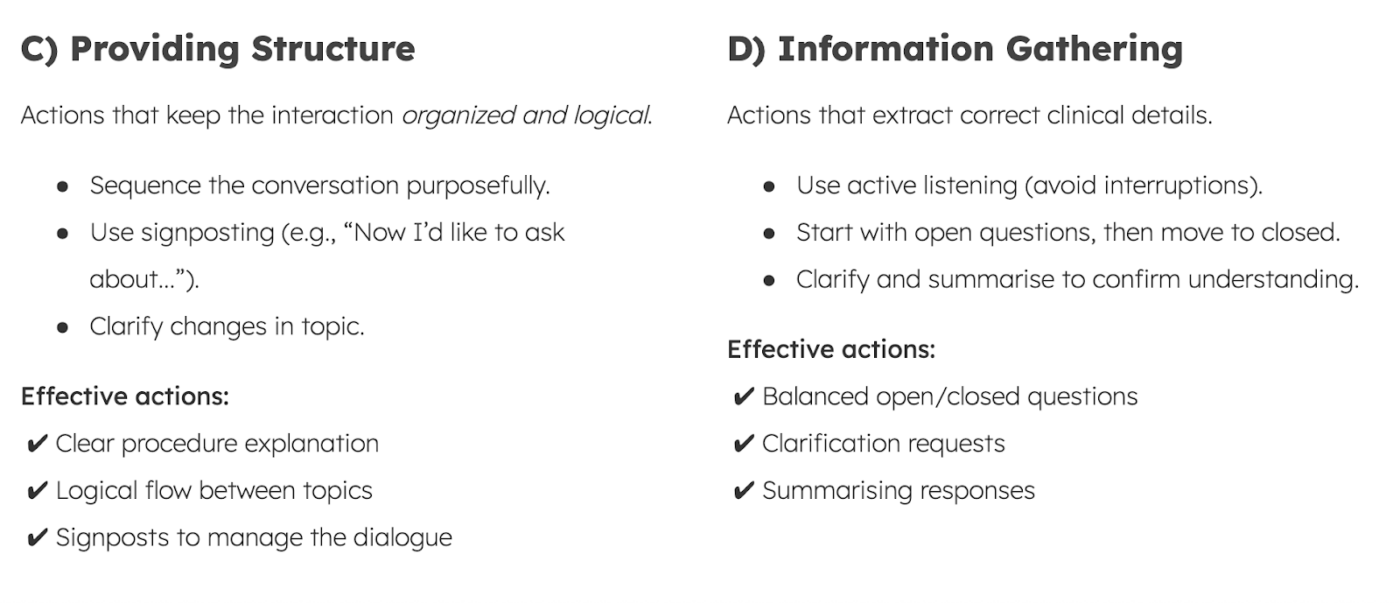
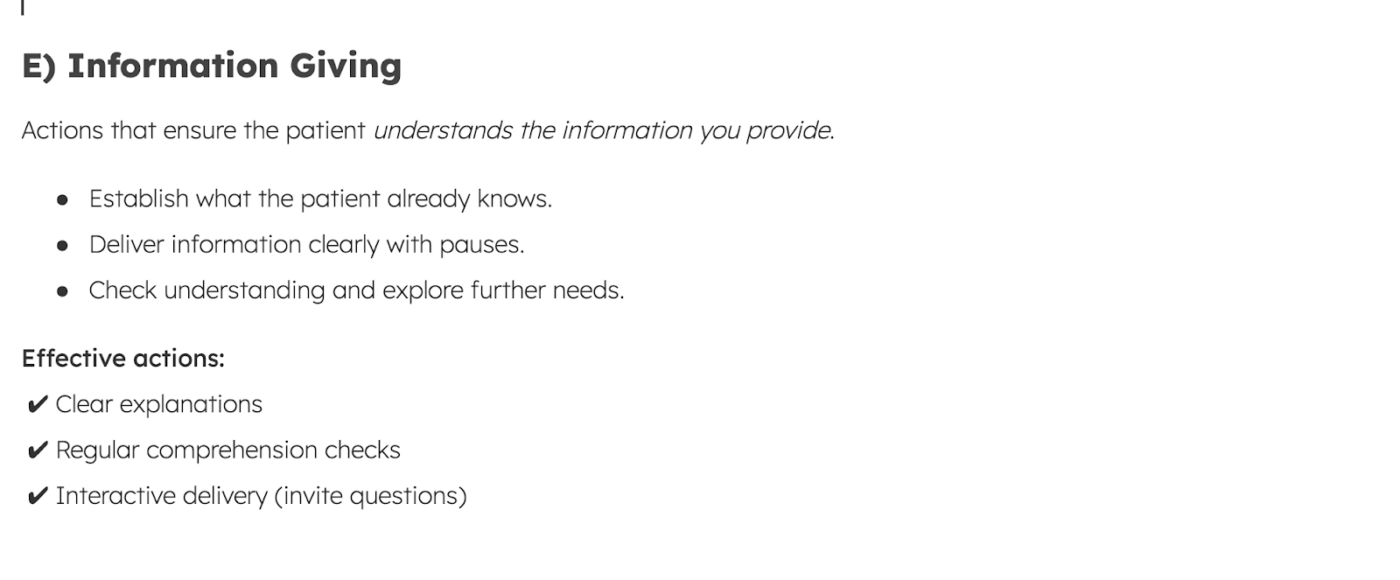
One key feature of this area is that even if your English sounds slightly awkward at times, you can still receive a strong score if care and consideration are clearly communicated.
Seen another way, acting like a good healthcare professional—through your wording, pacing, and responsiveness—is one of the keys to performing well.
Because scoring is based on the recorded role-play audio, your moment-to-moment delivery matters.
That includes how you respond to patient cues, how you sound when explaining or reassuring, and how consistently your communication style fits the situation.
For this reason, it can be effective to prepare core expressions in advance and practise until they can be delivered smoothly in a natural flow.
Study with OET BANK
Stop wasting time comparing OET materials.
With OET BANK, you get:
- Premium-quality OET materials, built by professionals
- A focused, efficient study path — no unnecessary content
- A system designed to help you pass OET once — without trial and error
If you want to prepare properly and pass with confidence,
you don’t need to look anywhere else.
Pick your materials and start today — with OET BANK.