

OET Strategies
Understanding OET Passing Requirements

Feb
Understanding how OET scores are calculated—and what is actually required to pass—is an important step for healthcare professionals planning to work abroad.
Many candidates feel uncertain not because the exam is unclear, but because the requirements are often misunderstood.
This article aims to clarify what the passing standards mean in practical terms, and how they apply across different sections of the test.
Overall scoring and grades
OET is scored on a 0–500 scale for each section, and each numerical score is converted into a grade from A to E. In most countries and professions, the standard requirement is Grade B (350 or above).
Importantly, this requirement applies to each section individually, not to an overall average. Even if your total performance feels strong, one section below the required grade can affect your eligibility.
This section-based requirement reflects how OET is used in real clinical settings.
Regulators want reassurance that healthcare professionals can communicate safely and effectively in all core language skills, rather than compensating for weaknesses in one area with strengths in another.
Recent flexibility in Writing requirements
From March 2025, some flexibility has been introduced in certain contexts. In many cases, particularly for nursing and care-related professions, a C+ (300) in Writing is now accepted, while Grade B is still required in the other sections.
This change acknowledges the practical realities of clinical communication while maintaining overall standards.
However, this flexibility is role- and country-dependent, and candidates should always confirm the exact requirement for their target profession.
The key point is that Writing is no longer always treated as an absolute barrier at Grade B, but it still needs to meet a defined professional threshold.
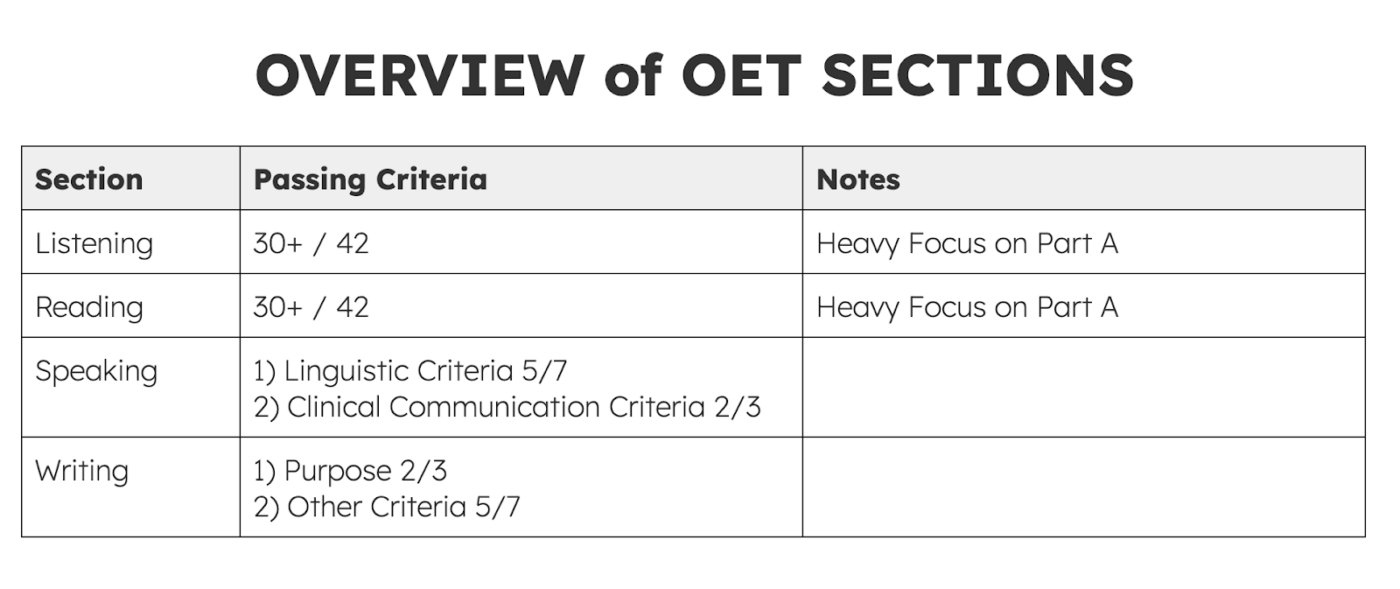
Listening and Reading: practical score expectations
For Listening and Reading, OET does not publish a fixed rule such as “X correct answers equals a pass.”
There is no official pass mark based on raw scores alone. That said, as a practical guideline, around 30 correct answers out of 42 (approximately 70%) is often associated with achieving Grade B.
This estimate helps candidates set realistic expectations, but it should not be treated as a guaranteed rule. OET scoring involves statistical scaling, meaning the same number of correct answers may not always produce the same grade across different test versions.
Within Listening, Part A carries particular weight. Because it contains more questions, performance here has a strong impact on the final Listening score.
As a result, consistent accuracy in Part A is one of the most reliable ways to stabilise and improve overall Listening results.
Candidates who struggle in Part A often find that their total Listening score fluctuates, even if Parts B and C feel manageable.
Writing and Speaking: performance-based assessment
Writing and Speaking differ fundamentally from Listening and Reading.
There is no clear concept of “right” or “wrong” answers. Instead, these sections are evaluated using assessment criteria, meaning the scoring is performance-based rather than objective.
In Writing, examiners focus on how well information is organised, how effectively relevant details are selected, and how clearly the message is presented to the reader.
The task is not about displaying advanced vocabulary, but about producing a document that works in a real clinical context.
In Speaking, emphasis is placed on situational language use, clarity of explanation, and empathetic, patient-centred communication.
Candidates are assessed on how naturally and appropriately they respond to the scenario, rather than on memorised phrases or scripted language.
What this means for preparation
Because of this scoring structure, memorisation alone is not enough. While familiarity with formats helps, reliable improvement comes from template-based practice combined with repeated feedback.
This approach allows you to refine structure, adjust language choices, and gradually stabilise performance across different scenarios.
The goal is not to sound perfect, but to perform consistently at the required professional level.
Understanding the passing requirements helps shift preparation away from guesswork and toward strategic, outcome-focused study.
In the following chapters, we will look in detail at what is actually assessed in Writing and Speaking, based directly on the marking criteria.
Use this section as a foundation to move from intuitive studying to a more structured and predictable preparation approach.
Watch the Video
Prefer video? Here’s a quick walkthrough of this article.
Study with OET BANK
Stop wasting time comparing OET materials.
With OET BANK, you get:
- Premium-quality OET materials, built by professionals
- A focused, efficient study path — no unnecessary content
- A system designed to help you pass OET once — without trial and error
If you want to prepare properly and pass with confidence,
you don’t need to look anywhere else.
Pick your materials and start today — with OET BANK.