

Registration & Pathways
UK Consultant Pathways for IMGs: PLAB, MRCP, and Beyond
Dec
Among IMGs who want to work in the UK, many are ultimately aiming for a consultant position.
If you completed medical school outside the UK and want to practise medicine there, your first major step is registration with the GMC.
The GMC is the public body that regulates doctors and maintains the medical register in the UK. There are three main routes to obtain GMC registration:
- PLAB route
- MRCP route
- Portfolio Pathway
PLAB and MRCP are both examinations that assess clinical competence. The Portfolio Pathway is a document-based route where you submit evidence of your specialist experience.
Depending on which route you choose, the time it takes to reach a consultant post can differ significantly.
In this article, we will explain how IMGs can work as consultants in the UK.
Becoming a Consultant in the UK
What is a Consultant?
First, let’s review what a consultant is in the UK system.
A consultant is the most senior hospital doctor grade in the National Health Service (NHS).
There is no perfect one-word equivalent in many other countries, but you can think of a consultant as similar to a senior attending physician, often with responsibilities comparable to a department lead or head of service.
Consultants possess advanced specialist knowledge and provide expert clinical care to patients. They also lead teams within the hospital and are responsible for ensuring that patients receive the highest standard of care through effective teamwork.
They work as part of a multidisciplinary team, delivering specialist care while also referring patients to other services or specialties when needed. In addition, consultants are expected to teach, supervise, and support junior doctors.
In recent years, there has also been a growth in locum consultant posts. A locum doctor is a physician who works in a temporary or substitute role, rather than in a permanent contract.
Salary varies with years of service. The basic consultant salary in the NHS starts at £99,532 and can rise to around £131,964 with seniority.
IMGs appointed as consultants typically start at the lower end of this scale and progress as they gain UK experience. In practical terms, this level of income is significantly higher than that of many specialist posts in other countries.
Career Structure in the UK
To become a consultant, you must complete the full UK medical training pathway (or demonstrate an equivalent level of training and competence through an alternative route).
The NHS defines the main training grades. Very roughly, they can be compared as follows:
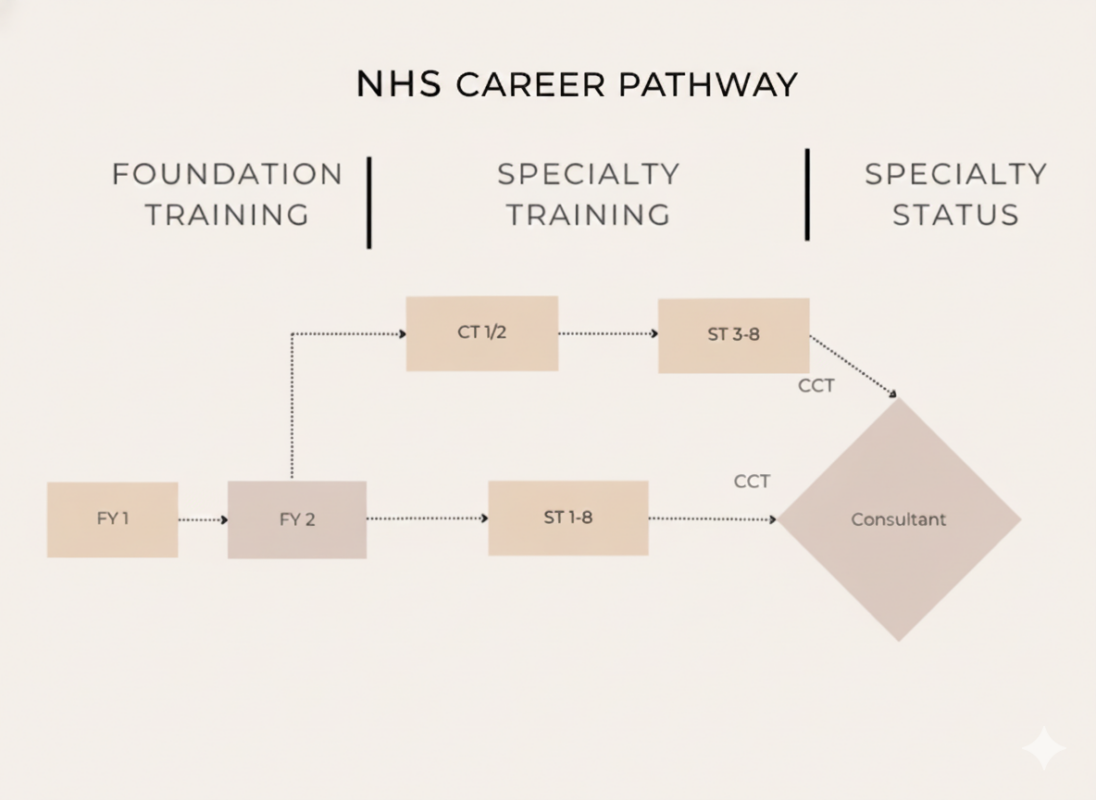
- FY1 (Foundation Year 1): first year of postgraduate training
- FY2 (Foundation Year 2): second year of postgraduate training
- ST1+ (Specialty Training year 1 and above): specialty training in a chosen field
- CT1+ (Core Training year 1 and above): core training, often more general or broad-based
All of these grades together are commonly referred to as “junior doctors”, even though they may already have several years of post-graduate experience.
The goal of junior doctor training is to develop a clear specialty focus while accumulating broad clinical experience in hospital practice.
During FY1 and FY2, doctors rotate through various hospitals and departments, gaining exposure to the NHS system and different clinical environments.
After that, they progress to either ST1 (Specialty Training) or CT1 (Core Training).
- ST1 and ST2 focus more specifically on a chosen specialty.
- CT1 and CT2 focus on broader core training, depending on the programme.
After completing ST1/2 or CT1/2, doctors move on to higher specialty training at ST3+. From this point, they train in their chosen specialty with the goal of obtaining CCT (Certificate of Completion of Training).
The CCT (Certificate of Completion of Training) is the official certificate confirming that a doctor has completed specialist training and is eligible to be appointed as a consultant. From ST3+ to CCT usually takes around 8 years.
In other words, from graduation from medical school to appointment as a consultant, the fastest realistic timeframe is at least 12 years.
For IMGs, the total time needed to become a consultant varies widely depending on which route they choose. Let’s look at each one.
The PLAB Route
First is the PLAB route. This is the pathway where you start in a junior doctor post in the UK and then progress all the way to consultant.
For IMGs, this is the most common route, because PLAB was specifically designed for doctors who qualified outside the UK.
PLAB stands for “Professional and Linguistic Assessments Board”. Because it is tailored to IMGs, many doctors find that it is more straightforward to prepare for than UK-focused postgraduate exams.
The PLAB route is suitable if you:
- want to start your medical career in the UK as early as possible, and/or
- have not yet obtained a specialist qualification in your home country.
If you choose GMC registration via PLAB, you can apply for posts from FY2 up to ST/CT2 level. In practical terms, this often means starting again at a junior level after arriving in the UK.
For IMGs who are already working as specialists in their home country, this can feel like a step backwards. Via the PLAB route, it generally takes at least around 10 years to progress from initial UK appointment to a consultant post.
The MRCP Route
Next is the MRCP route, where you begin in a more senior training post and aim for a consultant role from there.
MRCP stands for “Membership of the Royal College of Physicians”. In many countries, it is roughly comparable to a postgraduate internal medicine specialist exam.
MRCP is recognised as a postgraduate qualification at master’s level, allowing you to demonstrate a broader range of skills and competencies than PLAB alone.
However, MRCP is primarily designed for doctors who have trained in the UK, so the difficulty level is high for IMGs, especially because language challenges are not taken into account.
If you have MRCP, the path to CCT is usually shorter. After passing MRCP, you can often start directly at ST3+ in your specialty. Some doctors are even appointed at a more senior level depending on their experience.
This means that, via the MRCP route, it is often possible to reach a consultant post within a few years up to around 8 years, depending on your prior experience and how smoothly your training progresses.
Importantly, you do not have to repeat foundation training from the beginning. If your previous experience is recognised as sufficient, you may be able to enter directly into higher specialty training or obtain specialist registration more quickly.
For a more detailed comparison of PLAB and MRCP, you can refer to the following article:
https://oet-bank.com/plab-vs-mrcp/
The Portfolio Pathway
Finally, we have the Portfolio Pathway.
Through this route, you can obtain GMC specialist registration without completing a formal UK training programme. In practice, this means you may be able to work as a consultant from the outset, if your application is successful.
Specialist registration is granted on the basis of a large body of documentary evidence demonstrating that your training and experience are equivalent to a CCT holder in the UK.
At first glance, a document-based route may sound easier—but in reality, it is not. You must prove that you can meet the same responsibilities and standards as a UK-trained consultant, so collecting, organising, and presenting the evidence can be extremely time-consuming.
Until recently, this route was known as CESR (Certificate of Eligibility for Specialist Registration). To address workforce shortages in certain specialties, the CESR process has been streamlined and clarified, and the new system is now referred to as the Portfolio Pathway.
The process usually begins by contacting the GMC. It is advisable to discuss your previous specialist training and experience and to seek guidance on how well your background aligns with UK needs in your specialty.
For IMGs who have already built a substantial consultant-level or specialist career outside the UK, the Portfolio Pathway can be a very attractive option to consider.
If you are interested in the Portfolio Pathway, it is worth reading a dedicated, detailed guide on the requirements and evidence needed.
Study with OET BANK
Stop wasting time comparing OET materials.
With OET BANK, you get:
- Premium-quality OET materials, built by professionals
- A focused, efficient study path — no unnecessary content
- A system designed to help you pass OET once — without trial and error
If you want to prepare properly and pass with confidence,
you don’t need to look anywhere else.
Pick your materials and start today — with OET BANK.