

OET Strategies, Speaking
Overview of OET Speaking and Test Format
Feb
Instead of a traditional question-and-answer interview, candidates participate in role-play scenarios.
In these scenarios, the examiner takes on the role of a patient or a family member, and you respond as the healthcare professional.
This structure places you directly into a simulated consultation, where your task is to explain, reassure, advise, and respond—just as you would in clinical practice.
Assessment is based on more than linguistic accuracy.
While vocabulary and grammar are important, equal weight is given to interpersonal skills, such as demonstrating empathy, structuring explanations clearly, responding sensitively to concerns, and adapting your communication to the patient’s needs.
In other words, the test reflects the communication demands you may encounter when working abroad.
Test Structure
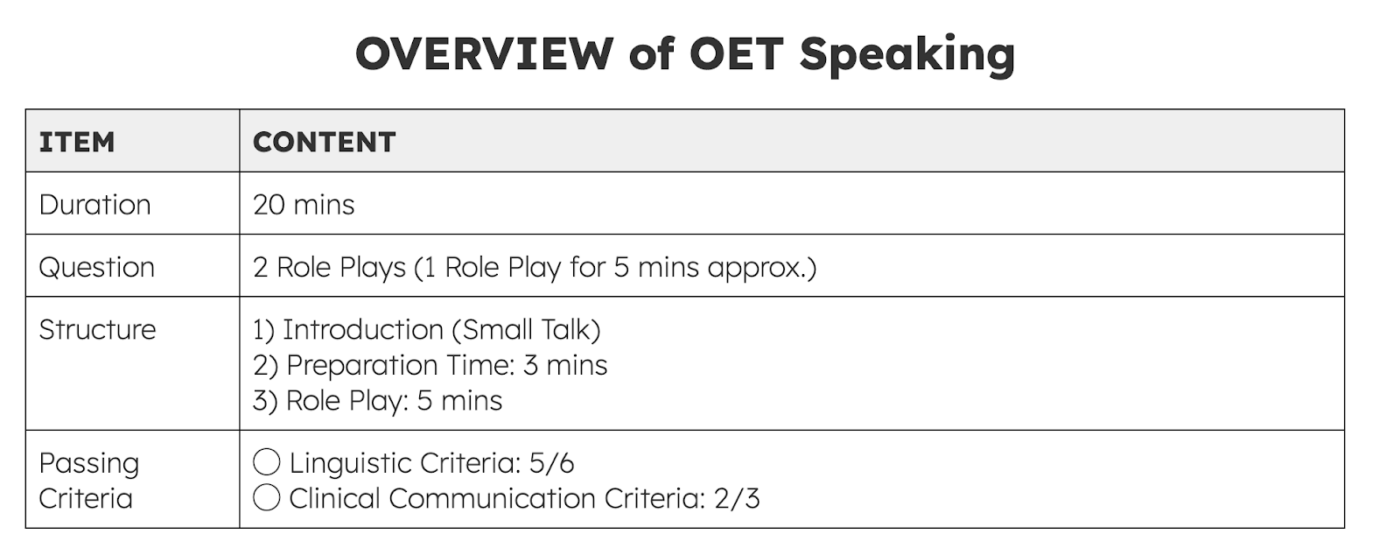
The Speaking test follows a clear structure.
It begins with a short Introduction (approximately 2 minutes). This is light conversation between you and the examiner. Importantly, this stage is not assessed. Its purpose is to help you settle into the environment and reduce initial tension.
Next, you receive a role-play card, along with 3 minutes of preparation time. During these three minutes, you read the scenario carefully and make notes.
This preparation period allows you to organise your thoughts, decide how to structure the interaction, and anticipate the patient’s likely concerns.
Many candidates find that this short planning phase makes a significant difference in how confidently they begin the role-play.
After preparation, the role-play begins. There are two role-plays, each lasting 5 minutes. The examiner acts as a patient or relative, while you take the professional role.
During these interactions, you may be expected to explain a diagnosis, provide lifestyle advice, suggest management options, respond to worries, or offer reassurance.
The format closely mirrors what happens in a consultation room. As a result, OET Speaking functions as a scenario-based examination, rather than a conventional language interview.
What Is a Role-Play Card?
At the start of each task, you are handed a role-play card.
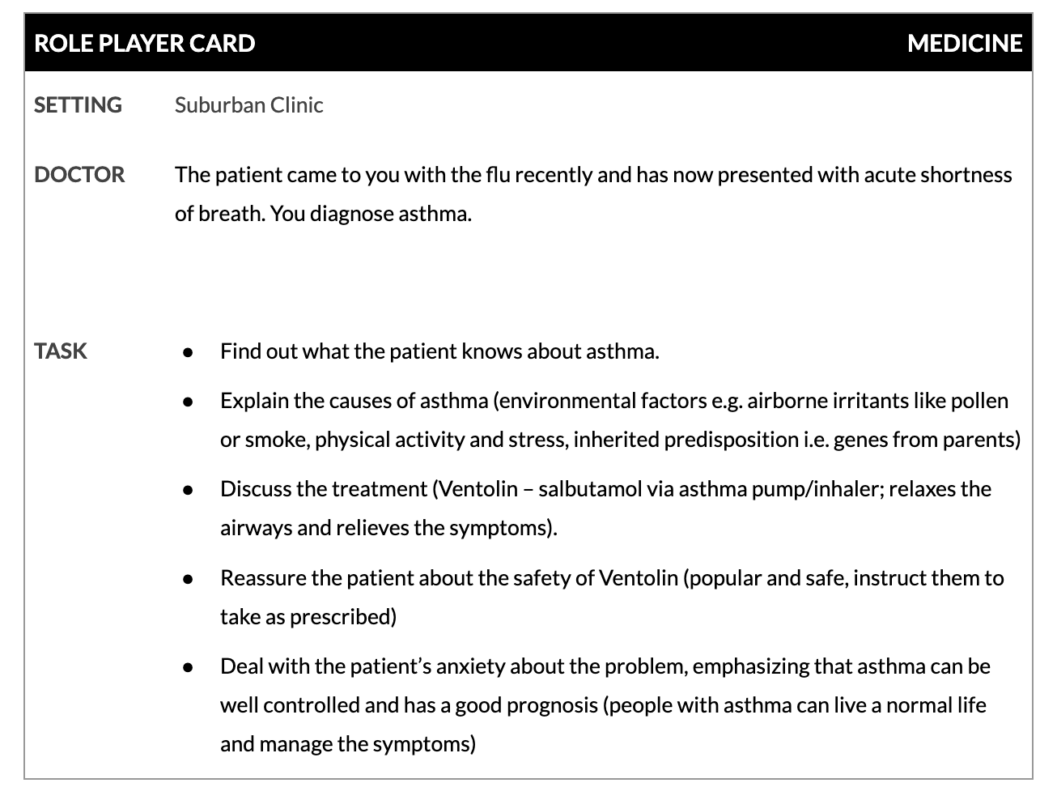
The card outlines the setting, the patient’s background, and several tasks that guide the interaction.
These prompts indicate what kind of explanations or responses are expected. Within a limited time frame, you must quickly organise your approach and conduct a structured, patient-centred conversation.
This reflects a familiar professional reality: in clinical practice, you often enter a consultation with limited preparation time.
The ability to prioritise information and communicate clearly under time constraints is therefore central to the assessment.
Tasks Are Not “Mandatory”
A common misunderstanding is that every listed task must be completed in full. In reality, scoring is not based on task completion. Examiners do not count how many bullet points you cover.
Instead, assessment is based on language ability and clinical communication skills. The tasks themselves are not direct marking criteria.
However, they are closely linked to the Clinical Communication Criteria, which include demonstrating empathy, structuring information logically, listening actively, and responding appropriately to patient concerns.
This means that even if you do not complete every task within five minutes, you can still perform strongly—provided that your communication is effective and patient-focused.
From a practical perspective, a balanced approach across both role-plays—ensuring that you address the communication criteria clearly and consistently—is more likely to result in a higher score than attempting to rush through every bullet point.
Ultimately, OET Speaking assesses how you function as a healthcare communicator. It evaluates whether you can deliver safe, empathetic, and structured communication in a realistic clinical context.
For doctors and nurses preparing to work internationally, this format reflects not only an exam requirement, but also the communication standards expected in everyday professional practice.
Study with OET BANK
Stop wasting time comparing OET materials.
With OET BANK, you get:
- Fast progress — focused learning, no wasted effort
- Smart pricing — high-quality materials without the high cost
- Study anywhere — full flexibility, on your schedule
If you want to prepare properly and pass with confidence,
you don’t need to look anywhere else.
Pick your materials and start today — with OET BANK.