

OET Strategies, Writing
OET Writing: What It Measures and Why It Matters
Feb
OET Writing assesses your ability to produce professional written communication used in real clinical settings.
Rather than testing grammar or vocabulary in isolation, this section focuses on purpose-driven communication—who you are writing to, what information is relevant, and how clearly you convey it.
For many healthcare professionals, this immediately feels familiar. The task mirrors the type of written communication you already encounter in daily practice, such as referrals, discharge summaries, or handover letters, where clarity and relevance matter more than stylistic flair.
At its core, OET Writing evaluates clinical judgment expressed through writing. You are not rewarded for complex sentence structures or advanced vocabulary.
Instead, the emphasis is on whether the reader can quickly understand the patient’s situation, your reason for writing, and the actions you are requesting or recommending.
This makes the section less abstract than general English writing tasks and more aligned with real-world clinical expectations.
Below is a summary of the Writing test format:
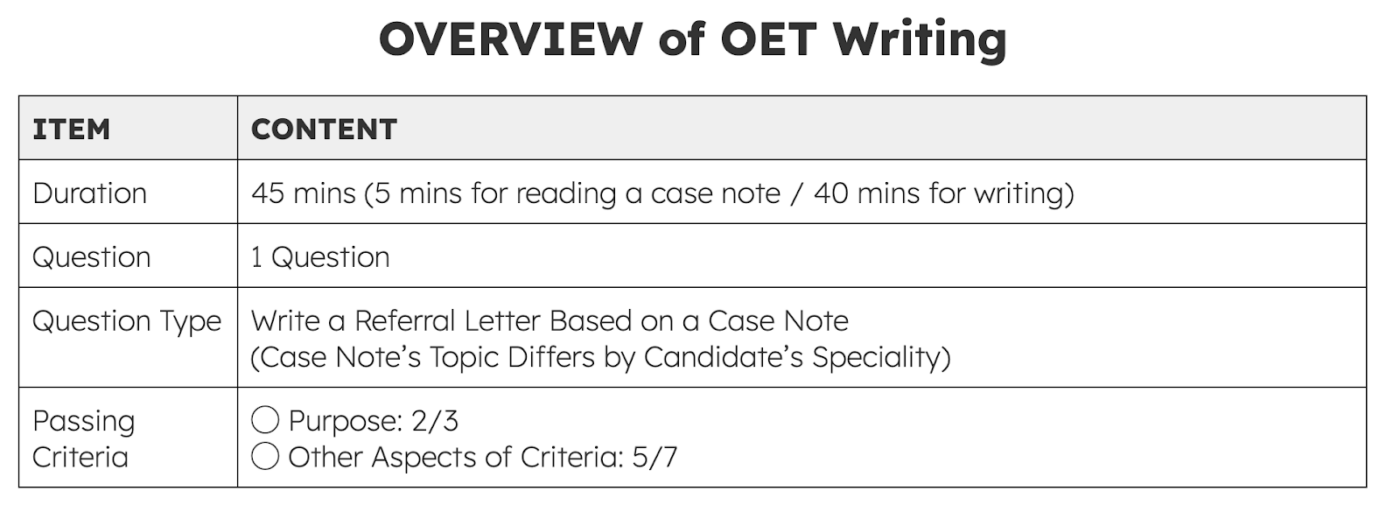
You are given 40 minutes to complete one writing task, with an expected length of around 180–200 words.
Compared with writing tasks in IELTS or other general English exams, OET Writing is less time-pressured and more structured, which many candidates find reassuring.
Importantly, you are allowed to refer to the case notes throughout the task. This means there is no requirement to memorise all clinical details in the opening minutes.
Instead, the challenge lies in selecting what truly matters and organising it logically for the reader. This design reflects how writing works in clinical practice.
When drafting a referral or handover, you rarely rely on memory alone; you review notes, prioritise key details, and shape the information for a specific audience.
OET Writing deliberately mirrors this process, testing information filtering and organisation rather than recall.
A Letter-Based Task Across All Professions
Although the clinical scenarios and case notes differ by profession, the task format is identical for all candidates.
You are required to write a formal referral or handover letter based on the provided notes. Because this is a letter-writing task, several expectations follow naturally.
Bullet points or note-style writing are not allowed. Information must be presented in clear, connected sentences that guide the reader smoothly from one idea to the next.
The letter should feel coherent and purposeful, not like a collection of copied notes. The focus is not on stylistic sophistication, but on clarity, relevance, and appropriateness for the reader.
In practical terms, this means demonstrating that you understand the reader’s role and needs.
A specialist receiving a referral does not need every detail from the patient’s history; they need the information that explains why the referral is being made and what support is expected.
OET Writing assesses whether you can make these judgments and reflect them clearly in writing.
Lower Passing Threshold from 2025: The Bar Is More Achievable
One significant update is that from 2025 onward, many countries have lowered the OET Writing requirement to C+ (300 points).
This adjustment reflects the recognition that safe and effective clinical communication does not require advanced or highly polished English. As a result, perfection is no longer the benchmark for most candidates.
If you can follow a standard letter structure, select only relevant information, and write clear, polite, and accurate sentences, you can realistically reach the passing level.
This shift reduces pressure for candidates who may worry about minor language imperfections but can communicate competently and professionally.
Because of this change, Writing can be considered a lower-priority section within an overall OET study plan, particularly for candidates who already write clinical letters in English or have experience working in English-speaking environments.
That said, “lower priority” does not mean unimportant. It means that focused, structured preparation—rather than extensive language study—is usually sufficient.
Overall, OET Writing rewards clear clinical thinking expressed in writing.
When you understand what the task is truly measuring, it becomes less about exam performance and more about demonstrating a skill you already use as a healthcare professional: communicating the right information, to the right person, for the right reason.
Study with OET BANK
Stop wasting time comparing OET materials.
With OET BANK, you get:
- Premium-quality OET materials, built by professionals
- A focused, efficient study path — no unnecessary content
- A system designed to help you pass OET once — without trial and error
If you want to prepare properly and pass with confidence,
you don’t need to look anywhere else.
Pick your materials and start today — with OET BANK.