

OET Strategies, Reading
OET Reading Part A: How to Find the Right Information Fast
Feb
In OET Reading Part A, you are presented with four short texts related to a single medical condition, usually labelled Text A to Text D.
Using these materials, you answer 20 questions that require you to locate and extract specific information.
This section is designed to reflect real clinical reading, where healthcare professionals rarely read one document in isolation.
Instead, you are expected to move quickly between multiple sources, identify where relevant information is located, and retrieve it efficiently.
Text Structure and Key Characteristics
The texts used in Part A are practical, work-related materials commonly seen in clinical settings. Each text has a distinct role, and recognising these roles early is essential.
- Text A usually provides an overview, such as symptom summaries or guideline-style lists.
- Text B often outlines treatment options or procedural steps.
- Text C typically contains medication information, precautions, or safety notes.
- Text D may present case reports, clinical notes, or patient information leaflets.
Together, these texts cover symptoms, management, and clinical details from different perspectives. You are expected to move between them, using each text for what it is best suited for rather than reading them sequentially.
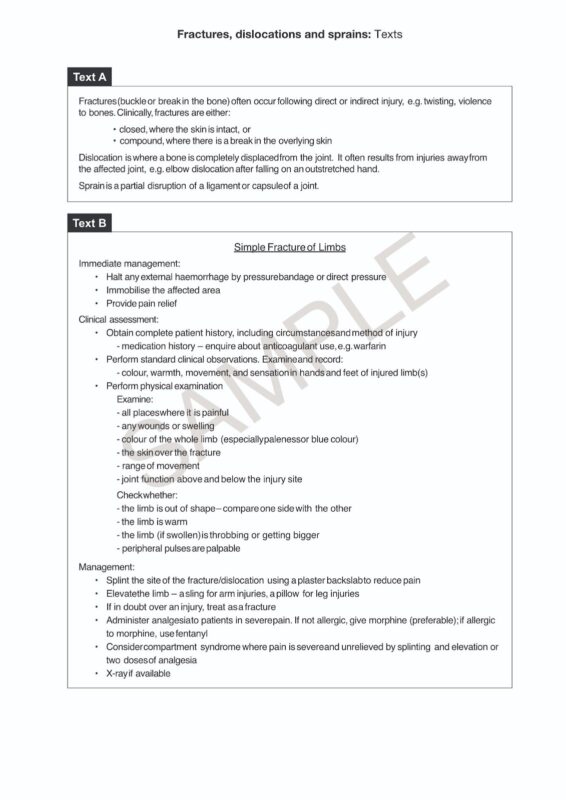
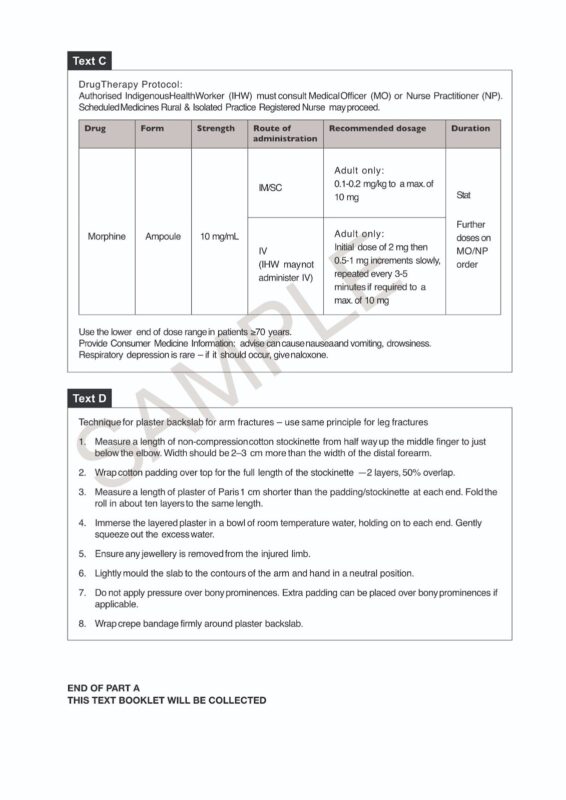
Below is an example of how these texts are laid out in the actual test.
Seeing the layout visually matters, because Part A requires you to recognise text function at a glance, not through careful reading.
What Part A Is Really Testing
Part A is not about reading every word carefully. Instead, it focuses on knowing where to look and retrieving the right information quickly from multiple sources. This mirrors real healthcare environments, where time pressure is constant and efficiency matters.
Understanding this purpose helps explain both the structure of the texts and the strict timing of the section.
Question Types and Time Limit
There are three main question types in Part A:
- Matching questions, which ask which text contains specific information
- Short Answer questions, requiring brief answers taken directly from the text
- Gap-Fill questions, where you complete a sentence using a word or phrase from the text
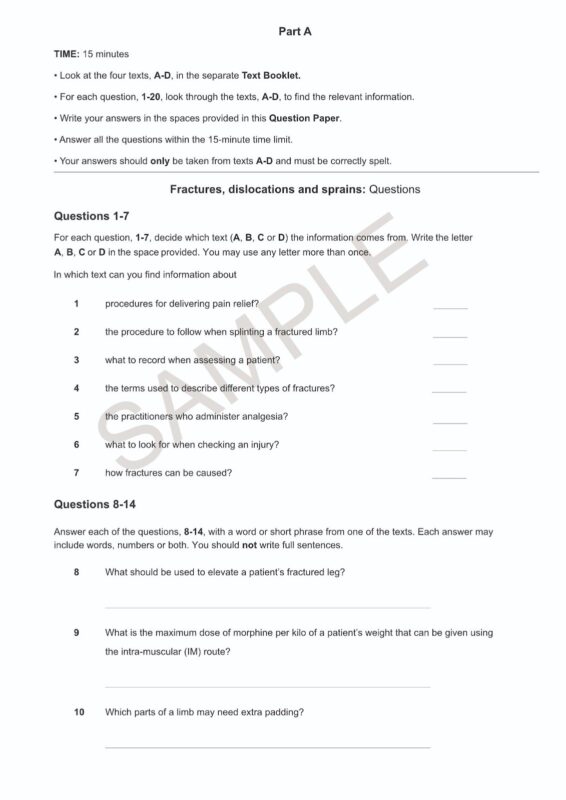
An example question format is shown below.
A visual reference helps clarify how questions link back to multiple texts at once, which is a core challenge of Part A.
The most important feature of Part A is its strict 15-minute time limit. This is the only part of the Reading test with a fixed time allocation. With 20 questions in 15 minutes, you have around 45 seconds per question.
Because of this, speed of information processing is critical. For Short Answer and Gap-Fill questions, answers must be taken directly from the text, which makes accuracy just as important as speed.
Accuracy and Spelling Matter
In Part A, spelling is assessed strictly. Unlike Listening, spelling errors are not tolerated.
For Short Answer and Gap-Fill questions, you must:
- Copy words exactly as they appear in the text
- Respect plural forms, verb tense, and abbreviations
- Follow word limits, usually one to three words
Paraphrasing is not accepted. Even small spelling mistakes can result in lost marks.
Strategic Targets for Passing
For OET Reading overall, the passing range is generally considered to be around 30 correct answers. To stay on track, candidates usually aim to secure at least 15 correct answers in Part A.
This highlights an important point: Part A tests more than reading comprehension. It evaluates your ability to organise information and retrieve what you need instantly, a skill that closely reflects real clinical reading behaviour.
How to Approach Part A Strategically
Because of the severe time limit, strategy matters as much as comprehension. A commonly recommended approach is:
- Skim all four texts first to grasp their overall purpose
- Start with Short Answer or Gap-Fill questions
- Leave Matching questions for last
Short Answer and Gap-Fill questions target specific, concrete details. Once you understand each text’s structure, you can often predict where the answer is likely to be and search directly for it.
Matching questions, on the other hand, tend to be more abstract and may require a broader overview of the texts, making them more time-consuming if attempted too early.
What to Do If You Run Out of Time
In the exam, feeling pressed for time is common. In these situations, Matching questions are the easiest to rescue. Because each answer is simply one letter (A–D), it is possible to complete several questions quickly, even with limited time remaining.
This is another reason why leaving Matching questions until last is a safer strategy. It reduces the risk of unanswered questions and allows you to accumulate points under pressure.
Speed and Accuracy Must Work Together
Part A is not a traditional reading test. It assesses your ability to locate information quickly and extract it accurately under time pressure. With only 15 minutes available, slow, careful reading is not realistic.
Effective preparation therefore focuses on building two skills together:
- Search speed, knowing where to look
- Extraction accuracy, copying the correct words precisely
Training these skills in parallel is the most reliable way to secure marks and build a stable path toward passing OET Reading.
Watch the Video
Prefer video? Here’s a quick walkthrough of this article.
Study with OET BANK
Stop wasting time comparing OET materials.
With OET BANK, you get:
- Premium-quality OET materials, built by professionals
- A focused, efficient study path — no unnecessary content
- A system designed to help you pass OET once — without trial and error
If you want to prepare properly and pass with confidence,
you don’t need to look anywhere else.
Pick your materials and start today — with OET BANK.