

Listening, OET Strategies
OET Listening Part C: Managing Long, Complex Audio with Confidence
Feb
In OET Listening Part C, you listen to a longer recording of about five minutes, such as an interview or a lecture, and answer six multiple-choice questions in real time as the audio plays.
The question format is the same as Part B — three-option multiple choice — but the overall difficulty is clearly higher.
The audio is longer, denser, and more information-heavy, which means you must process key points more quickly and accurately.
Below is an example of a typical Part C question.
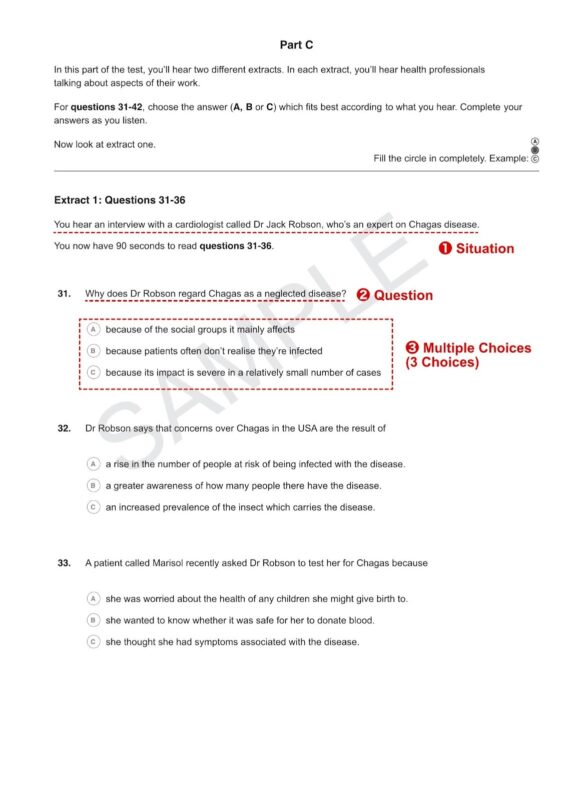
The questions are generally arranged to follow the overall flow of the audio. However, speakers may sometimes move back and forth between themes.
Because of this, it is essential to keep asking yourself:
“Which stage of the talk are we in right now?”
Maintaining awareness of the overall structure is one of the most effective ways to improve your score in Part C.
How to Approach Part C Step by Step
A structured approach is especially important for Part C, where the audio is long and the information density is high. The following four-step process helps you stay focused and organized:
1. Identify the type and theme of the audio
Before the recording begins, clarify who is speaking and what kind of talk it is. For example, is this a doctor giving a lecture or a nurse presenting a case? Understanding the setting and speaker role helps you anticipate the style and purpose of the information.
2. Read all six questions carefully
You only have about 90 seconds of preparation time, so you need to read quickly and efficiently. Focus on what each question is really asking and what kind of information you need to listen for.
3. Listen while tracking the relevant questions
During the recording, you must listen and read at the same time, staying focused on the question currently being tested. Trying to track all six questions at once can overload your attention, so staying aligned with the audio flow is essential.
4. Choose answers based on the main message
Avoid getting trapped by individual words or small expressions. Instead, base your decision on the speaker’s overall point and intention.
It is not realistic to read every option in detail during preparation time. Rather than trying to cover everything, it is often more effective to focus on the first one to three questions and clearly understand what they are asking.
Knowing the questions in advance makes it much easier to match the audio to the task, reducing cognitive load while listening.
Key Strategy 1: Predict the Flow of the Talk from the Questions
Part C recordings are long and often technical. Relying on listening alone can quickly become overwhelming. This is where the questions themselves become your strongest support.
In OET Listening Part C, the questions usually follow the order of the audio. By carefully reading them in advance, you gain a roadmap of the discussion — an idea of what will be asked, and when.
This allows you to anticipate upcoming topics and mentally prepare for transitions.
With this “structural map” in mind, you can distribute your attention more efficiently. Instead of reacting to every sentence, you listen with a sense of direction.
This helps reduce the perceived difficulty of the listening task and keeps you focused on what truly matters.
Key Strategy 2: Separate the Big Picture from the Details
In long listening tasks like Part C, trying to understand every single detail can actually work against you.
Because the information load is heavy, focusing too much on small points can cause you to lose concentration — or miss the answers that matter most.
Instead, train yourself to distinguish between:
- The big picture: the main message, argument, or conclusion
- Details: examples, statistics, comparisons, or supporting explanations
In English lectures and professional talks, the main point is usually presented in topic sentences, followed by supporting information.
Once you recognize this pattern, you can listen more strategically — identifying “This is a key point” versus “This is supporting detail.”
By prioritizing the main message, you protect your attention and avoid being distracted by less relevant information.
This allows you to maintain focus, follow the overall logic of the talk, and make more confident choices when selecting answers.
Watch the Video
Prefer video? Here’s a quick walkthrough of this article.
Study with OET BANK
Stop wasting time comparing OET materials.
With OET BANK, you get:
- Premium-quality OET materials, built by professionals
- A focused, efficient study path — no unnecessary content
- A system designed to help you pass OET once — without trial and error
If you want to prepare properly and pass with confidence,
you don’t need to look anywhere else.
Pick your materials and start today — with OET BANK.