

Listening, OET Strategies
OET Listening Part B: Strategy Guide
Feb
In OET Listening Part B, each question is based on a short audio recording of about one minute.
For every recording, you answer one multiple-choice question by selecting the correct option from three choices. The format looks simple on paper.
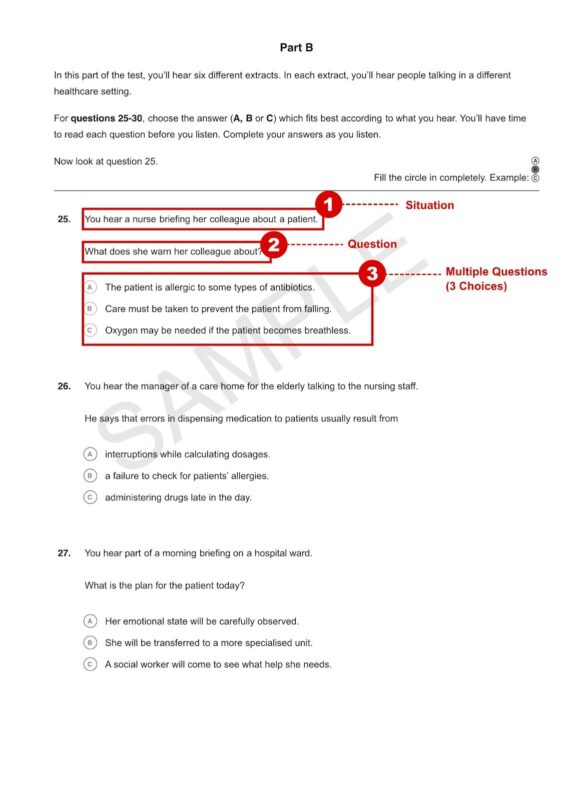
At first glance, it’s natural to think: only three options—this should be manageable. However, Part B includes a distinct OET-specific challenge that often catches even strong English users off guard.
In many questions, the audio contains information connected to all three options. That means you can’t rely on spotting a familiar word and reacting quickly.
Instead, you must decide how the information should be interpreted and which point is truly the most important.This is why Part B rewards meaning and logic more than surface-level word matching.
The question is not “Did I hear the same word?”
It’s “What is the speaker actually doing here—informing, advising, warning, reassuring, instructing, clarifying?”
Once you start listening with that mindset, Part B becomes much more predictable and less stressful, even under time pressure.
How to Approach Part B Step by Step
In Part B, each short recording is paired with a single question. You listen to a brief exchange or explanation, then choose the most appropriate answer from three options.
To score consistently, the key is how effectively you use the short preparation time (about 15 seconds) before the audio begins.
A practical step-by-step approach is as follows:
- Identify the situation
Think: who is speaking, and in what context? This helps you interpret tone and purpose quickly. - Read the question carefully
Make sure you understand exactly what is being asked—for example, a concern, an intention, or an instruction. The question tells you what type of meaning to listen for. - Scan the answer choices
Predict how each option might develop, and decide what keywords or ideas you should listen for. This helps you stay focused once the audio starts.
If you complete these steps before the audio begins, you reduce hesitation during listening and can focus your attention entirely on understanding the audio.
While listening, compare what you hear with each option and use elimination to narrow down the correct answer. This is the core strategy for Part B—not guessing quickly, but judging clearly.
Key Strategy 1: Identify What You Need to Listen For
The most important skill in Part B is knowing what information the question is asking for before the audio starts.
If you begin listening without understanding the question’s focus, it becomes easy to lose track of what truly matters and pay attention to details that feel relevant but are actually secondary.
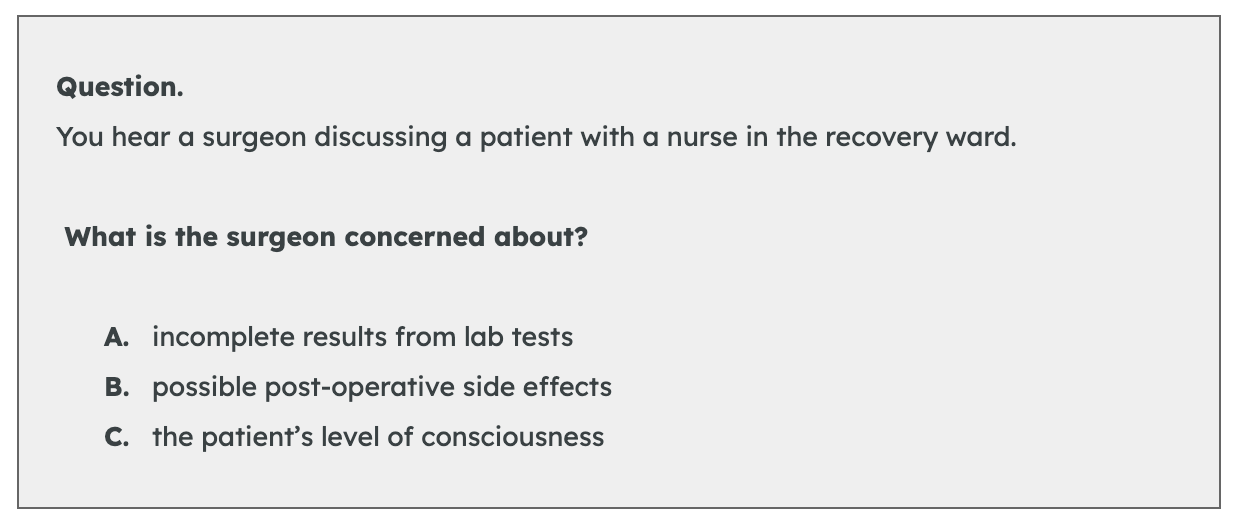
For example, you may be asked what the surgeon is concerned about. However, the exact phrase “concerned about” may not appear in the audio.
Instead, the speaker may use paraphrased expressions such as worry, trouble, issue, or unsure.
In Part B, what matters is not the wording itself, but what the concern actually is in that moment.
To score well, listen for the underlying issue or anxiety being expressed, not just specific keywords. When you know the target in advance—what the question wants—you can filter the audio more effectively.
This is especially important when the recording contains extra information that sounds medically relevant but does not answer the question directly.
Key Strategy 2: Judge by Context, Not Individual Words
In OET Listening multiple-choice questions, relying only on individual words in the options can be risky.
Many questions are designed so that all options sound plausible at first glance, especially when similar vocabulary appears repeatedly.
Part B often tests whether you can interpret meaning within the full context, not whether you can recognise isolated terms.
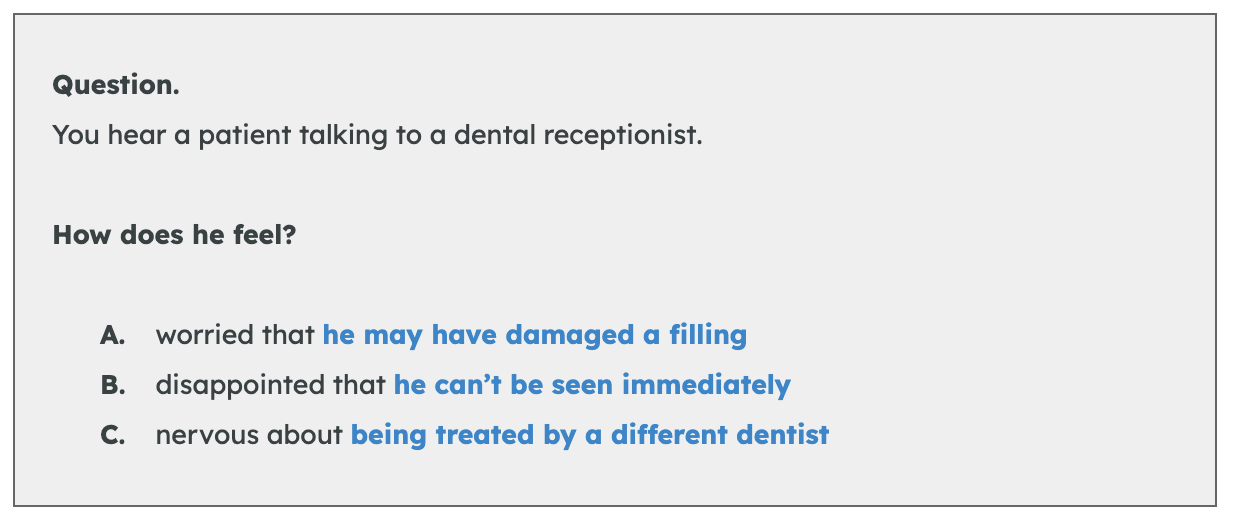
For instance, options A to C might include similar emotion-related words such as worried, disappointed, and nervous.
If you focus only on the adjective, the choices may feel interchangeable. What truly matters is the clause that follows it:
- worrying about having damaged a filling
- feeling disappointed about not being seen promptly
- feeling nervous about being treated by a different dentist
In other words, focus on who is feeling what, about which situation, and why. That’s where the real meaning sits, and that’s what the audio will clarify—sometimes indirectly.
By grasping the full context, rather than reacting to single words, you can make logical, confident choices and avoid common traps in Part B.
The goal is not to catch vocabulary; it is to identify the most accurate interpretation of what is happening in the recording.
Watch the Video
Prefer video? Here’s a quick walkthrough of this article.
Study with OET BANK
Stop wasting time comparing OET materials.
With OET BANK, you get:
- Premium-quality OET materials, built by professionals
- A focused, efficient study path — no unnecessary content
- A system designed to help you pass OET once — without trial and error
If you want to prepare properly and pass with confidence,
you don’t need to look anywhere else.
Pick your materials and start today — with OET BANK.