

Listening, OET Strategies
OET Listening Exam Format and Section Overview
Dec
OET Listening checks whether you can follow spoken English in real healthcare settings.
This part of the exam is not about academic lectures or abstract topics. Instead, it focuses on whether you can understand conversations that sound like what you hear at work — with patients, colleagues, and other healthcare professionals.
In this article, we’ll walk through the structure of the OET Listening test and explain what each part is designed to assess.
Knowing the format in advance makes preparation more efficient and helps you feel more confident on test day.Let’s start with the overall structure of OET Listening.
Overall Characteristics of OET Listening
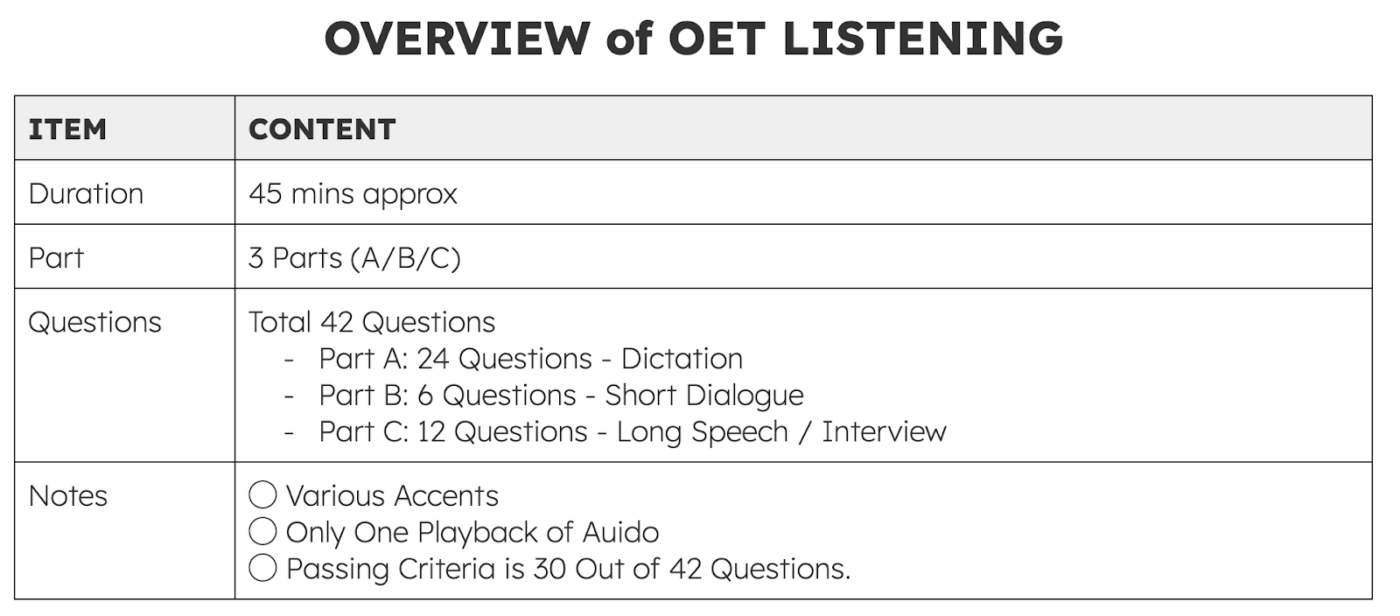
One key feature of OET Listening is its use of realistic clinical conversations. The recordings are based on situations that healthcare professionals commonly encounter, such as patient consultations, workplace explanations, and communication between colleagues.
Because of this, the English you hear is practical and workplace-oriented. You are expected to follow how people actually speak in clinical settings, not how language appears in textbooks.
The recordings include everyday idioms and common collocations, making the listening style more conversational than academic.
You’ll also notice Australian English accents appearing regularly, as OET was developed in Australia. These accents are generally clear and not overly strong.
With a solid listening foundation, most candidates adjust quickly and do not find accent differences to be a major issue.
With this overall picture in mind, let’s look at how each part of the Listening section works.
Breakdown of Each Listening Part
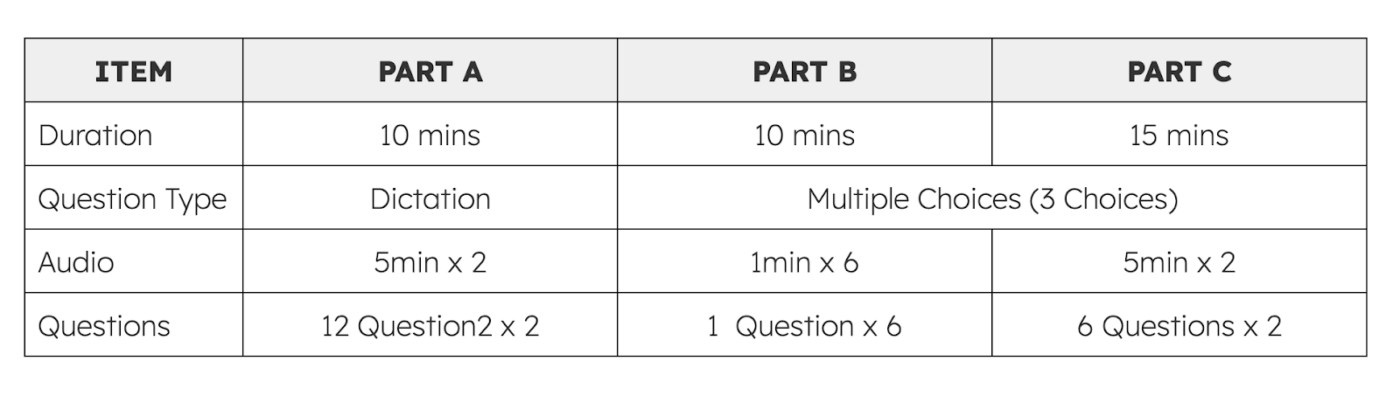
The OET Listening section is divided into three parts, each focusing on different listening skills used in healthcare communication.
Part A: Consultation-Based Listening
Part A is based on consultations between a healthcare professional and a patient. You listen to two conversations and complete clinical notes using the information you hear.
This part tests your ability to pick up key clinical details — such as symptoms, timing, and relevant background — while listening in real time.
A major feature of Part A is dictation-style listening. You must understand spoken English accurately and record it correctly under time pressure.
This reflects real clinical tasks, like documenting patient histories or consultation notes.
Parts B and C: Workplace Communication
Parts B and C focus on workplace communication, including handovers, short talks, and professional explanations.
After listening, you choose the best answer from three options. These parts test whether you can follow the main message and overall flow, not just individual keywords.
Understanding speaker intention and emphasis is essential here, as the correct answer often depends on why something is said, not just what is said.
What This Means for Preparation
One important point to keep in mind is that dictation-style tasks make up more than half of OET Listening. For many candidates, this feels unfamiliar at first.
Because dictation is not commonly emphasised in Japanese English education, it’s normal to find this section challenging early on.
The difficulty usually comes from processing spoken English quickly, rather than from lack of vocabulary.
The good news is that OET Listening follows very consistent task patterns. Once you become familiar with how information is presented, improvement becomes much more manageable.
With focused and repeated practice, steady score gains are well within reach.
Study with OET BANK
Stop wasting time comparing OET materials.
With OET BANK, you get:
- Premium-quality OET materials, built by professionals
- A focused, efficient study path — no unnecessary content
- A system designed to help you pass OET once — without trial and error
If you want to prepare properly and pass with confidence,
you don’t need to look anywhere else.
Pick your materials and start today — with OET BANK.