

OET Strategies
Understanding the Structure of the OET Exam
Feb
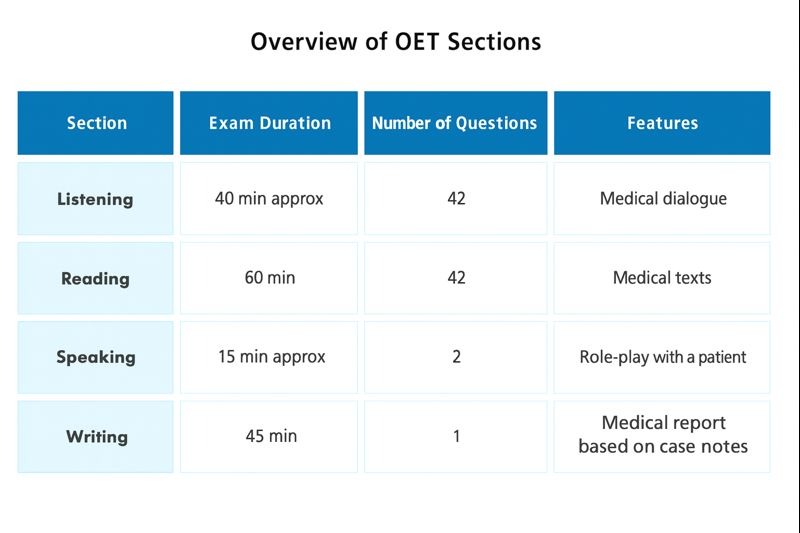
OET consists of four core skills, each designed around realistic clinical scenarios.
Together, they assess whether you have the English ability actually required to work safely and effectively in healthcare settings.
Rather than testing language in isolation, OET evaluates how English is used in everyday clinical practice, where accuracy, clarity, and judgement matter.
Each section reflects real workplace communication, ensuring that language ability is assessed in context, not as abstract knowledge.
For doctors and nurses planning to work abroad, this structure offers a clear picture of what is expected in real clinical environments.
Listening
The Listening section is divided into three parts, each reflecting a different type of healthcare communication.
Part A focuses on consultations between a healthcare professional and a patient. You complete notes in a dictation-style format across two tasks (12 questions × 2 tasks). This mirrors real consultations where you must listen carefully, extract key information, and document it accurately.
Part B involves short recordings of around one minute, such as handovers or brief workplace discussions. You answer multiple-choice questions (6 questions), testing your ability to follow concise, information-dense communication.
Part C features longer interviews or presentations of around five minutes, followed by multiple-choice questions (6 questions × 2 tasks). These resemble professional discussions or educational talks commonly encountered in healthcare settings.
Across all three parts, the audio is drawn from common clinical situations.
Part A is particularly important because it directly assesses your ability to identify clinically relevant details from patient interactions.
Performance here depends heavily on how well you catch medical idioms, colloquial expressions, and key information.
To pass Listening, candidates generally need around 30 correct answers out of 42, and Part A carries the greatest impact on the final score.
If dictation-style tasks feel challenging, focused training is essential. Strengthen the full process of listen → write → confirm meaning, rather than listening only for general understanding.
Reading
The Reading section also consists of three parts, each testing a different reading skill required in healthcare.
Part A involves four short texts related to symptoms, followed by classification, gap-fill, and short-answer questions. This section demands rapid information processing across multiple sources.
Part B uses short workplace texts of about 100–150 words, such as guidelines or notices, with multiple-choice questions (6 questions). These reflect everyday written communication in clinical settings.
Part C includes two longer medical texts (700–800 words each) with detailed comprehension questions (8 questions × 2 texts). These texts often resemble articles or reports encountered in professional practice.
Among these, Part A requires the most strategic preparation. With 20 questions in just 15 minutes, you have less than 45 seconds per question, making speed and accuracy equally critical.
Parts B and C place more emphasis on vocabulary recognition and careful reading. Because topics are often medically familiar, candidates with regular exposure to medical English may find this section more approachable.
Across all parts, medical vocabulary in context plays a decisive role. The faster you recognize where key information is located, the more confidently you can respond.
Writing
In the Writing section, you produce a referral letter or similar professional document based on case notes from your profession.
The recommended length is 180–200 words, and the intended reader is another healthcare professional.
What matters most is not advanced language, but clear organization and appropriate information selection.
A strong letter delivers the right information, to the right person, for the right purpose. Because of this, structure often matters more than grammatical complexity.
Many candidates benefit from using one paragraph per key issue or symptom, following a consistent internal structure.
Including a clear Purpose Statement at the beginning—explaining who the letter is for and why it is written—greatly improves readability and often leads to higher scores.
Speaking
The Speaking section consists of two role-play tasks, each lasting about five minutes.
You act as a healthcare professional, while the examiner plays a patient or family member. This closely mirrors real clinical encounters.
Assessment is based on two criteria. Linguistic Criteria cover grammar, vocabulary, pronunciation, and fluency. Clinical Communication Criteria evaluate empathy, clarity, and sensitivity to patient concerns.
What truly matters is not just correct English, but whether the patient feels understood and reassured. Memorized phrases alone are not enough. A calm, patient-centered manner is essential.
The key strength of OET Speaking is this: it evaluates trust-building communication, not just language accuracy.
In other words, OET assesses your ability to communicate as a healthcare professional, using English to build trust in real clinical settings.
Watch the Video
Prefer video? Here’s a quick walkthrough of this article.
Study with OET BANK
Stop wasting time comparing OET materials.
With OET BANK, you get:
- Premium-quality OET materials, built by professionals
- A focused, efficient study path — no unnecessary content
- A system designed to help you pass OET once — without trial and error
If you want to prepare properly and pass with confidence,
you don’t need to look anywhere else.
Pick your materials and start today — with OET BANK.