

OET Strategies
How to Design an Effective OET Study Schedule
Feb
When preparing for OET, the way you design your study schedule is an extremely important factor.
Because of the nature of the exam, your score is influenced by where your time goes, especially toward the areas where you are currently weakest.
In practice, many healthcare professionals have limited study time due to shifts, family responsibilities, or relocation planning.
That constraint makes scheduling less about motivation and more about strategic allocation of attention.
Core Principles for OET Preparation
Compared with IELTS or TOEFL, OET places higher demands on listening and speaking, and it requires a strong level of reproducibility in performance—not just understanding content once, but being able to perform reliably under time pressure.
For this reason, your schedule should be built around three principles: focus on your weakest areas, practise listening and speaking daily, and use materials slightly above your current level.
What you should avoid most is mechanically completing the same type of material every day without much thought.
This kind of surface-level repetition can feel productive because it creates a sense of momentum, but it does not match what OET evaluates.
OET is built around practical communication and real-time performance, which means progress depends on deliberate adjustment, not routine completion.
What Determines Results: The Quality of Review
In OET preparation, results depend largely on how carefully you review each task and improve based on reflection.
It is not enough to “finish” an exercise and move on. What matters is whether each attempt leads to a clearer understanding of why an error happened and what you will do differently next time.
A useful mindset is to pause after practice and ask:
“Why did I make this mistake?”
“Why didn’t my message come across clearly?”
These questions push your review beyond correctness and toward communication quality.
Over time, simply keeping this mindset can change your study efficiency, because you begin to study with cause-and-effect awareness, rather than repeating the same patterns.
Section Priorities and Time Allocation
In OET, you do not need to study all sections with equal intensity. What matters most is concentrating your limited time on the skills that are below the passing level. After identifying your weaknesses, use your time strategically.
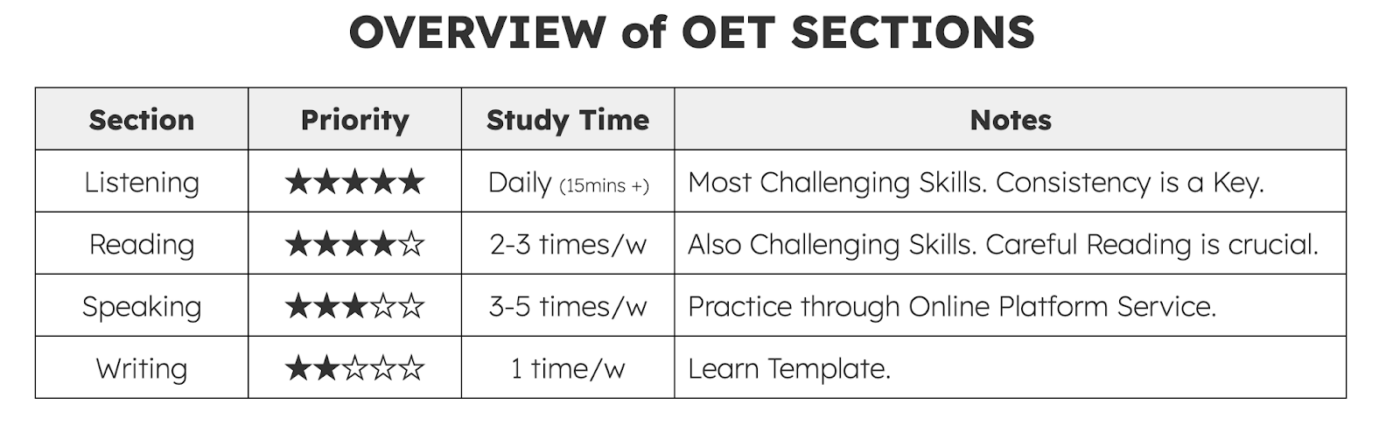
Listening, in particular, is a section where simple cause-and-effect rules—such as “if you study X, you will improve Y”—do not easily apply.
It is best understood as a skill-development section, where steady accumulation and familiarity matter more than quick breakthroughs.
For this reason, an effective schedule often places listening at the core, then adds other sections based on personal challenges.
If your basic vocabulary and sentence structure are weak, it makes sense to strengthen reading. If you lack experience speaking in English, speaking should be prioritised.
Listening practice can also serve multiple purposes: reading transcripts supports reading, and reading aloud or overlapping audio supports speaking.
Structuring your schedule this way helps one activity reinforce another, without adding extra hours.
Writing: Maximum Effect with Minimum Effort
Writing is the one section where the passing threshold is relatively low.
Once you understand structure and templates, it is possible to prepare effectively without investing excessive time.
The practical implication for scheduling is balance: keep writing practice present, but approach it with an emphasis on efficiency, so that listening and speaking—the more skill-dependent areas—receive consistent attention.
“Muscle-Training” Skills: Listening and Speaking
Listening and speaking are not primarily about accumulating knowledge.
They are about real-time processing speed and reaction ability. In that sense, they resemble muscle training: repetition and consistency are what change performance.
For listening, aim for at least 15 minutes every day, because consistency matters more than volume.
Choose materials that feel slightly challenging, since growth requires appropriate load. Repeatedly listening to the same material helps your ear internalise sound patterns and intonation.
For sensory skills like listening, deliberately challenging yourself with slightly difficult material is often more effective than relying only on easy content.
If you feel stuck, you can add English audio that is not directly related to OET—such as news programmes, podcasts for native speakers, or overseas medical dramas.
The key point is avoiding reliance on exam-only input, because broad auditory exposure supports flexibility in real test conditions.
Speaking is a section where many candidates feel insecure. In most cases, this is not because of poor pronunciation or inability to think in English, but because they are not yet familiar enough.
The most effective improvement comes from repeatedly practising fixed phrases until they emerge automatically, without conscious thought.
This pattern practice is a reliable approach: memorise and read aloud role-play templates so intonation and word order become internalised, practise output 3–5 times a week to build response speed and flexibility, and use spare moments for quiet “mumbling” practice to strengthen the brain–mouth connection.
By repeatedly practising the same role-play cards, your personal phrase toolbox expands. Over time, even candidates who initially struggle can reach the level required to pass.
The key is step-by-step construction, not perfection in a single leap. You are not “bad at speaking”—you are simply not used to it yet.
With that perspective, you can continue practising calmly and consistently.
Study with OET BANK
Stop wasting time comparing OET materials.
With OET BANK, you get:
- Premium-quality OET materials, built by professionals
- A focused, efficient study path — no unnecessary content
- A system designed to help you pass OET once — without trial and error
If you want to prepare properly and pass with confidence,
you don’t need to look anywhere else.
Pick your materials and start today — with OET BANK.