

OET Vocabulary, Word of the Day
Flank – Meaning and Usage in Medical English
Dec
👁 What Does “Flank” Mean?
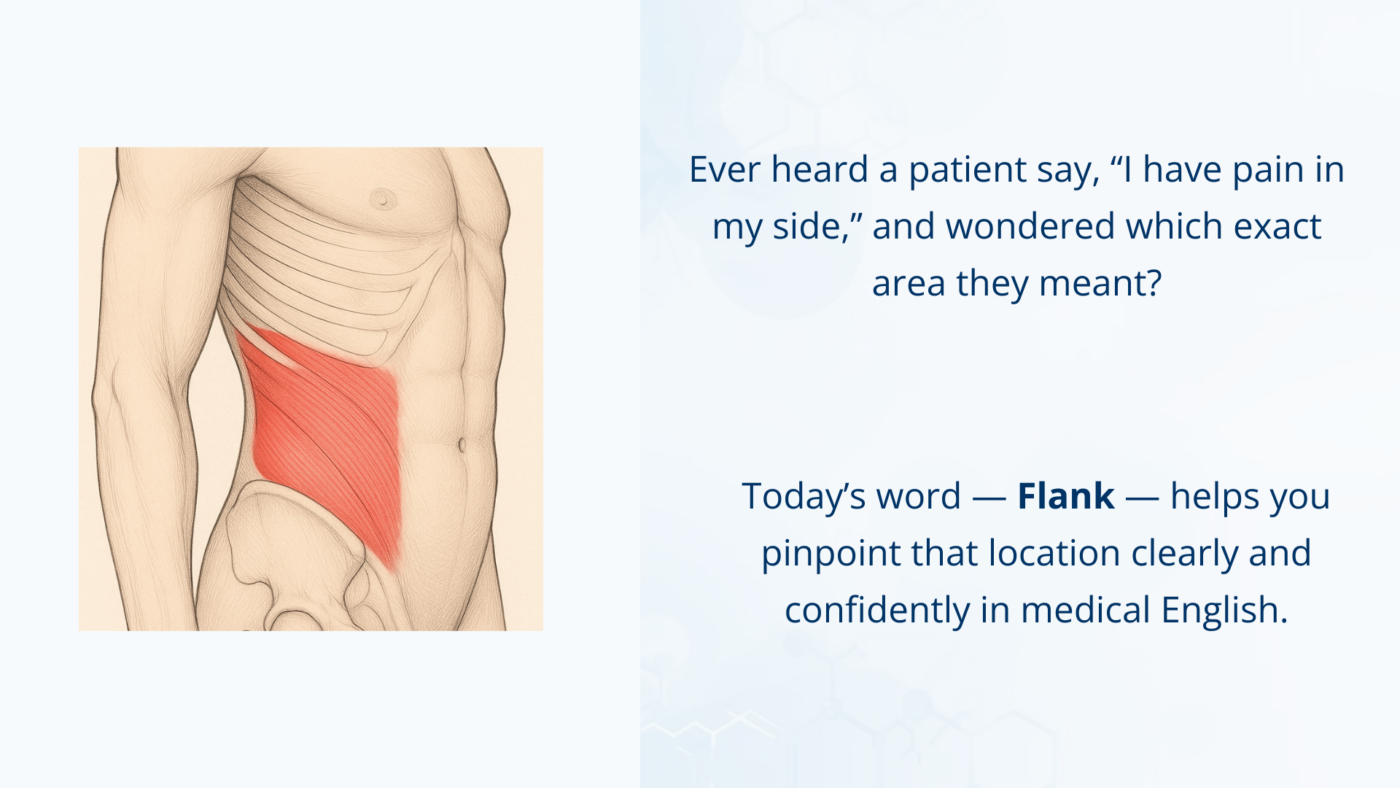
Flank refers to the side of the body between the lower ribs and the hip.
The term comes from modern English, originally describing the side or edge of something, and it was later adopted into medical language to describe this specific body region.
In clinical contexts, it is commonly used when talking about kidney-related symptoms, musculoskeletal pain, or abdominal examinations.
Because the kidneys sit beneath the rib cage toward the back, many conditions affecting them are described as causing flank pain.
🔍 Clinical Usage
In everyday healthcare communication, flank appears frequently in:
- Patient charts – documenting pain location
- Nursing notes – recording symptom checks and assessments
- Doctor progress notes – describing physical exam findings
- Discharge summaries – explaining diagnoses or treatment plans
Healthcare professionals use flank to specify an exact area of discomfort or tenderness, especially when differentiating between abdominal pain and pain originating from the kidneys or back muscles.
The most common collocations include:
- Flank pain – pain felt in the side of the body between ribs and hip
- Costovertebral angle (CVA) tenderness – tenderness over the kidney area in the flank, tested during examination
- Right flank / left flank – to localize symptoms clearly
During assessments, doctors often ask targeted questions like:
- “Is the pain in your abdomen or your flank?”
- “Is it on the right flank or the left?”
Clear use of the term avoids confusion and allows accurate documentation.
Clinical example
“The patient reports left flank pain radiating toward the back.”
This sentence tells other healthcare staff exactly where the pain is located and helps suggest possible causes, such as kidney stones, urinary tract infection, or muscle strain.
🎥 Watch the Short Video
👉 Watch our 20-second clip: Flank – Learn how to pronounce it and remember how it’s used in real medical English.
Study with OET BANK
Stop wasting time comparing OET materials.
With OET BANK, you get:
- Premium-quality OET materials, built by professionals
- A focused, efficient study path — no unnecessary content
- A system designed to help you pass OET once — without trial and error
If you want to prepare properly and pass with confidence,
you don’t need to look anywhere else.
Pick your materials and start today — with OET BANK.