

OET Vocabulary, Word of the Day
Auscultatory Triangle – Meaning and Usage in Medical English
Dec
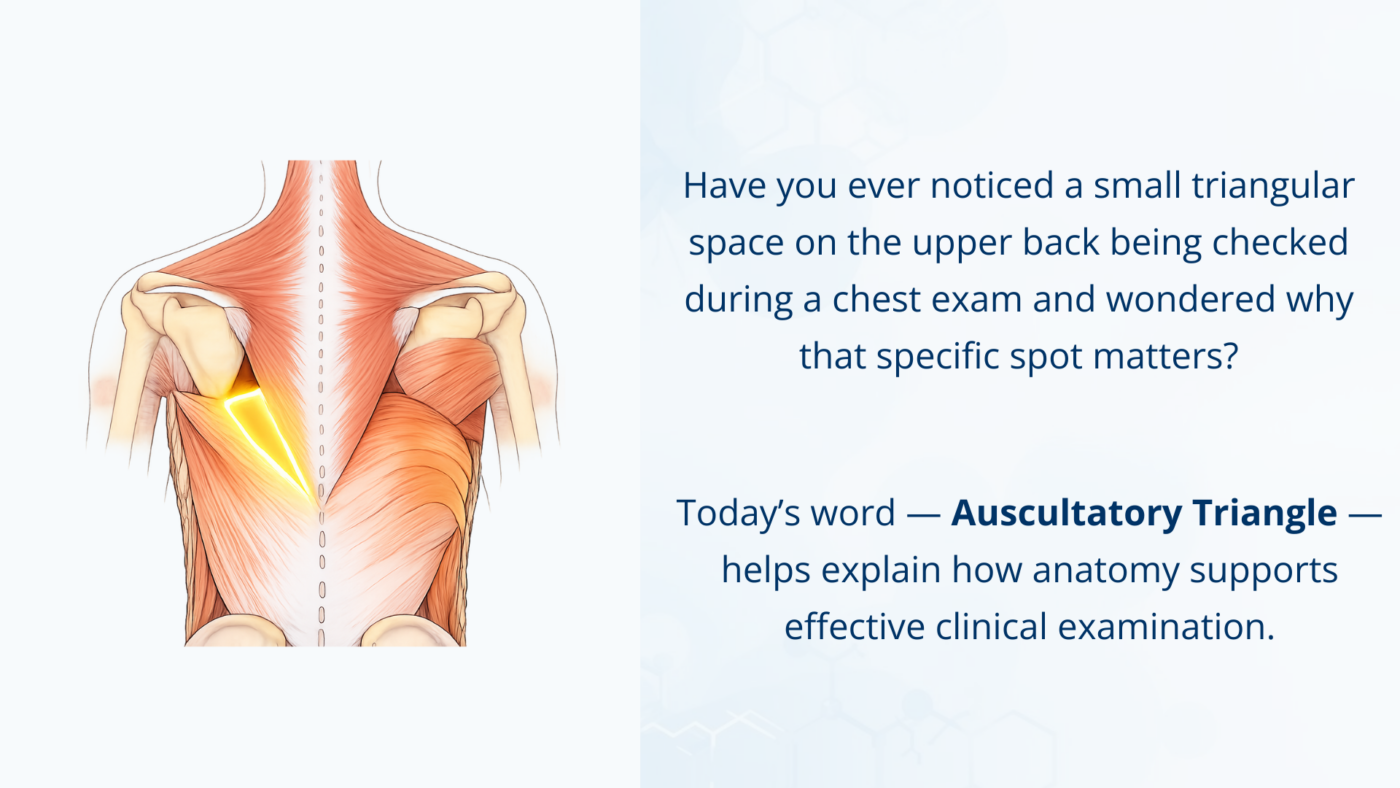
👁 What Does “Auscultatory Triangle” Mean?
The auscultatory triangle is a small triangular area on the upper back where the chest wall is relatively thin.
The term comes from Latin: auscultare, meaning to listen, combined with triangle, referring to its three-sided shape.
In medicine, this term is used mainly in anatomy and physical examination contexts.
🔍 Clinical Usage
In clinical practice, the auscultatory triangle is most often mentioned during chest examination and physical assessment training.
Because this area has less muscle coverage than surrounding regions, it can be a useful landmark when examining the upper back.
You may encounter the term in:
- physical examination guides
- anatomy textbooks
- clinical skills training
- teaching notes for chest or respiratory assessment
Healthcare professionals typically use this term when describing where an examination is performed, rather than when documenting a diagnosis.
There is no standard abbreviation for auscultatory triangle, and it is usually written out in full in educational or clinical contexts.
Example (educational context):
“The auscultatory triangle is often used during chest examination on the upper back.”
🎥 Watch the Short Video
👉 Watch our 20-second clip: Auscultatory Triangle – Learn how to pronounce it and remember how it’s used in real medical English.
Study with OET BANK
Stop wasting time comparing OET materials.
With OET BANK, you get:
- Premium-quality OET materials, built by professionals
- A focused, efficient study path — no unnecessary content
- A system designed to help you pass OET once — without trial and error
If you want to prepare properly and pass with confidence,
you don’t need to look anywhere else.
Pick your materials and start today — with OET BANK.