

OET Medical Vocabulary, Word of the Day
Mastoid Process (Bone Behind the Ear) – Meaning and Usage in Medical English
Nov
👁 What Does “Mastoid Process” Mean?
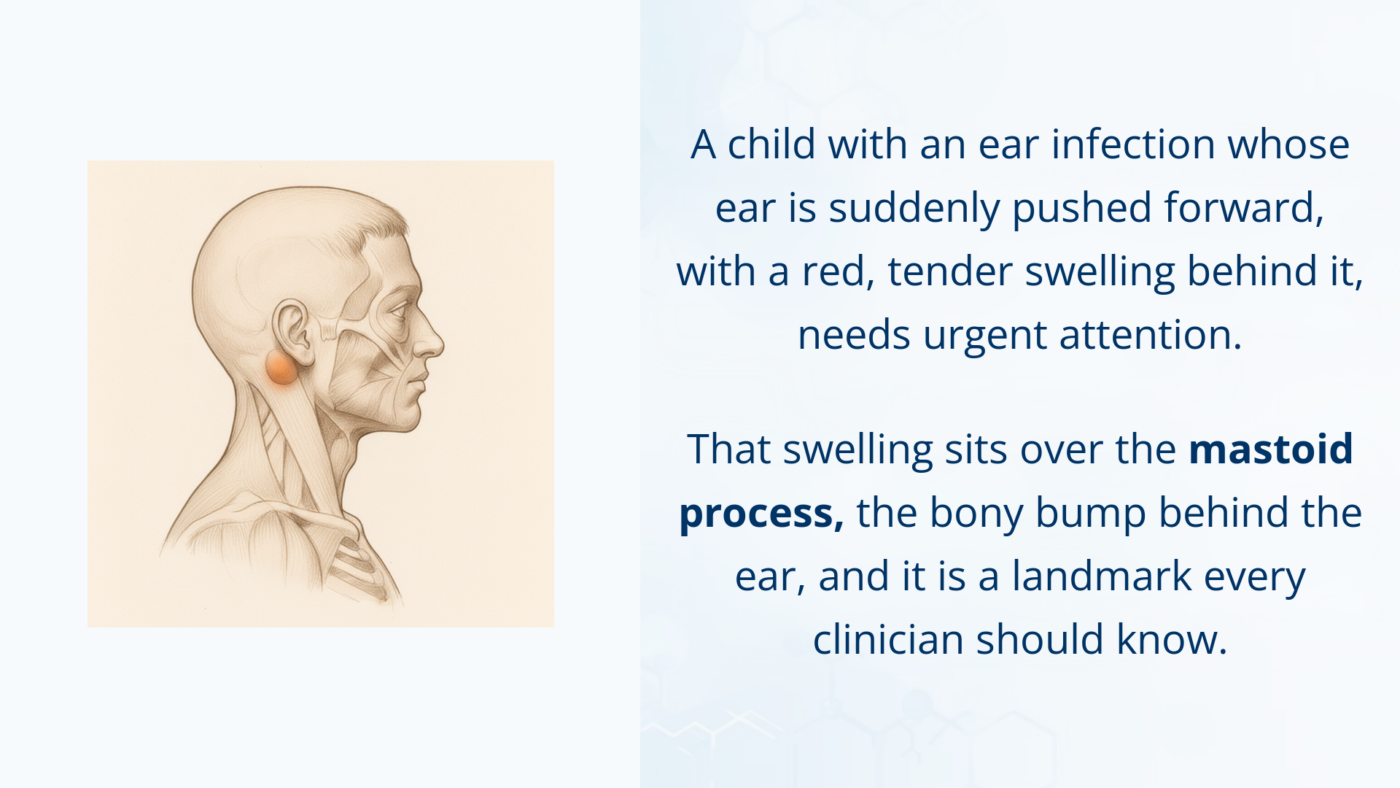
The mastoid process is the bony bump behind the ear: a rounded projection of the temporal bone of the skull. It contains small air spaces, the mastoid air cells, that connect with the middle ear, and it is the attachment point of the sternocleidomastoid muscle.
Mastoid comes from Greek mastos, “breast”, and -oid, “like”, from its rounded shape. The plural is mastoid processes, and the adjective is simply mastoid.
🔍 Clinical Usage
The mastoid process appears in ENT, pediatric, emergency and trauma notes:
- mastoiditis — infection of the mastoid air cells, usually spreading from the middle ear
- Battle’s sign — bruising behind the ear, a sign of a fracture of the base of the skull
- mastoidectomy — surgery to remove infected mastoid air cells
- mastoid tenderness — pain on pressing behind the ear
- postauricular swelling — swelling behind the ear that pushes the ear forward
Common collocations include:
- mastoid tenderness
- mastoid air cells
- swelling over the mastoid
- bruising over the mastoid process
Here’s a natural clinical example:
“Erythema and fluctuant swelling over the left mastoid process; pinna displaced anteriorly.”
→ Meaning: The skin behind the left ear is red with a soft, fluid-filled swelling, and the outer ear is pushed forward.
Try OET Practice Questions for Free
Exam-style questions with every answer explained.
Listening · Reading · Writing · Speaking — No sign-up needed
🗣 Pronunciation
MAS-toyd PROH-ses — the stress is on the first syllable of each word. Mastoiditis is mas-toy-DY-tis.
💡 OET Tip
With patients, say the bone behind your ear. In writing, mastoid is standard. Don’t confuse mastoid tenderness (behind the ear, suggesting mastoiditis) with tragal tenderness (in front of the ear canal, suggesting otitis externa).
🔗 Related Words
Browse every term in our Medical English Body Parts A–Z guide.
For the clinical words you will meet in the OET, with what to say to patients, see our OET Vocabulary guide.