

OET Medical Vocabulary, Word of the Day
Supercilium (Eyebrow) – Meaning and Usage in Medical English

Nov
👁 What Does “Supercilium” Mean?
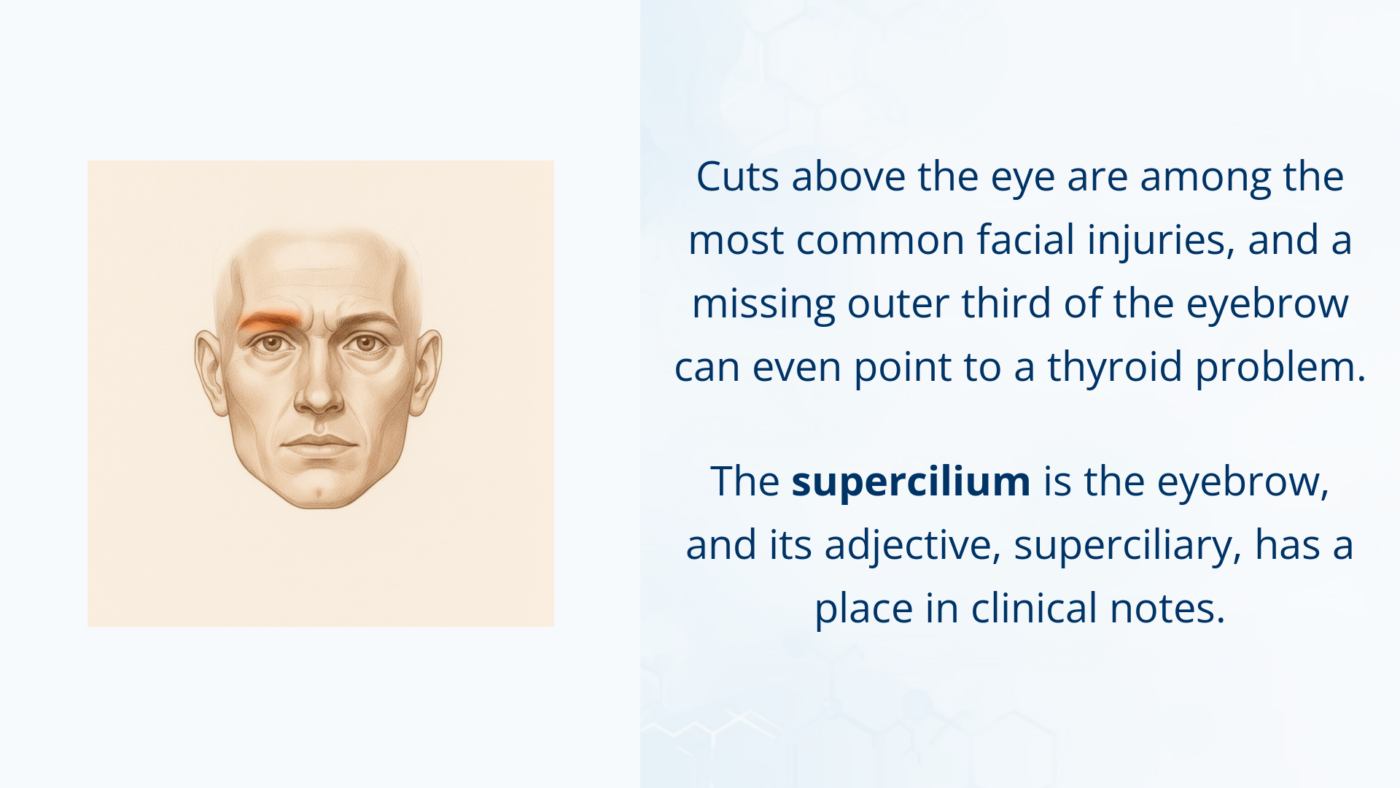
The supercilium is the eyebrow: the arch of short hairs along the upper edge of the eye socket. Eyebrows help keep sweat and debris out of the eyes and play a major role in facial expression.
The word is Latin, from super (“above”) and cilium (“eyelid” or “eyelash”). The plural is supercilia, and the adjective is superciliary, as in superciliary arch, the bony ridge beneath the eyebrow.
🔍 Clinical Usage
The eyebrow appears in emergency, neurology, endocrinology and dermatology notes:
- eyebrow laceration — a common facial cut, often from a fall or sports injury
- loss of the outer third of the eyebrow — a classic sign associated with hypothyroidism
- brow ptosis — drooping of the eyebrow, sometimes after facial nerve weakness
- eyebrow raising — tested when examining the facial nerve
- seborrheic dermatitis — scaling of the skin in and around the eyebrows
Common collocations include:
- laceration through the eyebrow
- superciliary arch / brow ridge
- ability to raise both eyebrows
- eyebrow hair loss
Here’s a natural clinical example:
“Unable to raise the left eyebrow or close the left eye fully; forehead involvement noted.”
→ Meaning: The patient cannot lift the left eyebrow or shut the left eye completely, and the weakness includes the forehead.
Try OET Practice Questions for Free
Exam-style questions with every answer explained.
Listening · Reading · Writing · Speaking — No sign-up needed
🗣 Pronunciation
soo-per-SIL-ee-um — the stress is on the third syllable. Superciliary is soo-per-SIL-ee-air-ee.
💡 OET Tip
In both speaking and writing, eyebrow or brow is usually best; supercilium is mainly found in anatomy texts. Don’t confuse the supercilium (eyebrow) with cilia (eyelashes), and never shave an eyebrow before suturing a cut through it.