

OET Strategies, Reading
OET Reading Parts B & C: How to Choose the Correct Answer
Feb
In OET Reading Parts B and C, all questions are presented in multiple-choice format, requiring you to select the most appropriate answer from several carefully designed options.
On the surface, this may feel familiar. In practice, however, these sections demand a very specific kind of reading judgment that goes beyond recognising words on the page.
Although the formats differ, the core reading skills and problem-solving principles required for Parts B and C are essentially the same.
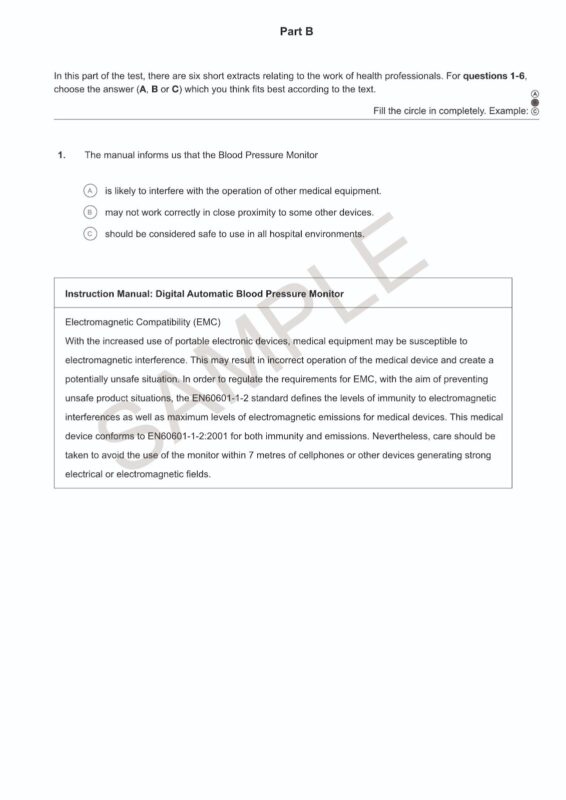
In Part B, you read short healthcare-related texts such as manuals, procedures, or workplace notices, with one question per text.
In Part C, you work with longer medical texts of around 700–800 words, each followed by eight questions.
The total time allocated for both parts is 45 minutes, and you are free to manage that time as you see fit. This flexibility places responsibility on you to read efficiently and make decisions with confidence.
Why all the answer choices look “correct”
One defining feature of OET Reading Parts B and C is that all answer options are deliberately plausible.
In many questions, there is no obviously wrong choice. This is why a simple keyword-matching approach often leads to frustration. Options may repeat words from the text, yet still fail to reflect its true meaning.
Success depends on your ability to compare options carefully and eliminate them one by one, rather than trying to “spot” the right answer instantly. What matters is not surface similarity, but underlying meaning and intention.
The real question is not which option uses similar words, but which option accurately represents what the text is saying.
This ability to judge meaning — rather than vocabulary alone — is what separates correct answers from near misses in Parts B and C.
How to approach Parts B & C
To handle multiple-choice questions effectively, it helps to follow a clear, consistent process:
- Understand the intent of the question
- Locate key phrases in the text
- Compare options using paraphrasing and elimination
Each step builds on the previous one, keeping your reading focused and purposeful.
Step 1: Understand the question’s intent clearly
Begin by reading the question sentence carefully. Your first task is to identify what kind of information the question is asking for.
Pay close attention not only to keywords, but also to the subject and verb, and ask yourself: what exactly is this question testing?
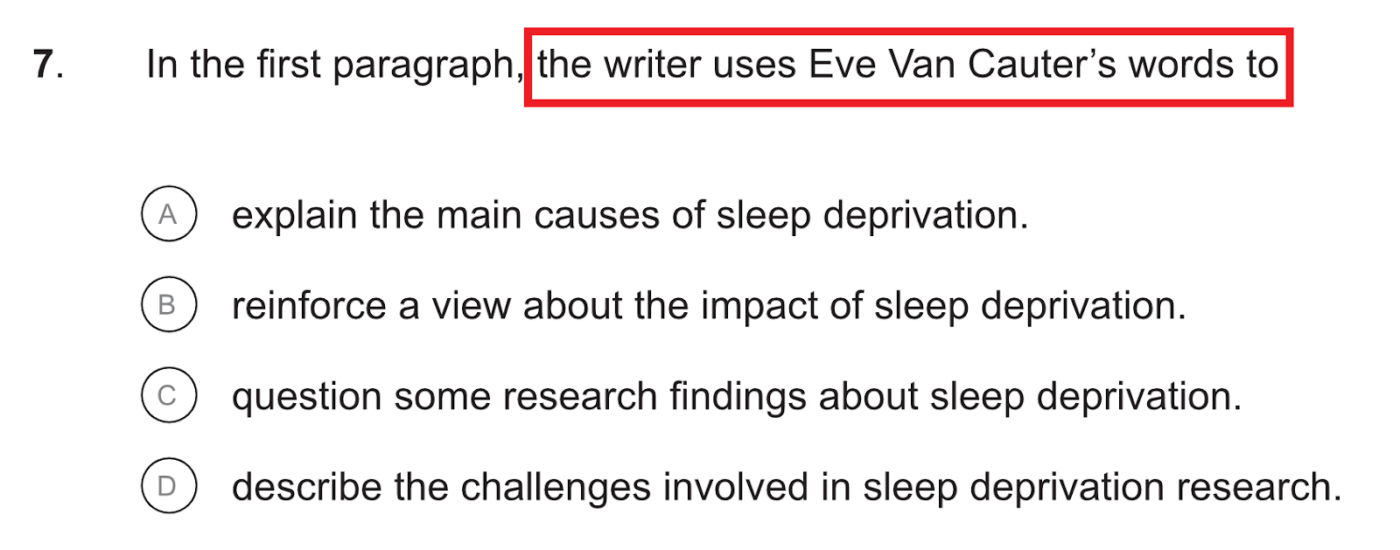
In Part C, questions tend to fall into several recurring types, such as overall understanding, specific detail, reference, or suggested meaning.
Each type requires you to focus on a different part of the text. Adjusting your reading based on question intent is key to achieving stable results.
For example, if a question asks about the purpose of using a specific example, this signals an overall understanding focus. In that case, the topic sentence is far more important than individual details.
Reading with this perspective prevents you from getting distracted by supporting information.
Why reading the options too early can lead to mistakes
Many candidates follow a familiar pattern: read the question, read all the options, then read the text. In OET, this often works against you.
Because the options are intentionally similar, reading them too early can create false expectations and bias your interpretation before you fully understand the passage.
This is especially risky in Part C, where texts are logically structured and nuanced. An option that feels convincing at first glance may subtly misrepresent the author’s intent.
A safer approach is to anchor your understanding in the text first, then evaluate the options afterward. This keeps your judgment guided by meaning, not by attractive wording.
Step 2: Locate key phrases in the text
Once you understand the question’s intent, the next step is to identify where the answer is likely to appear.
It is rarely effective to read the entire passage evenly. Instead, focus only on the section that addresses the task set by the question.
Returning to the earlier example, if the goal is to identify the purpose of an example, you should look for the abstract statement it supports — typically the topic sentence.
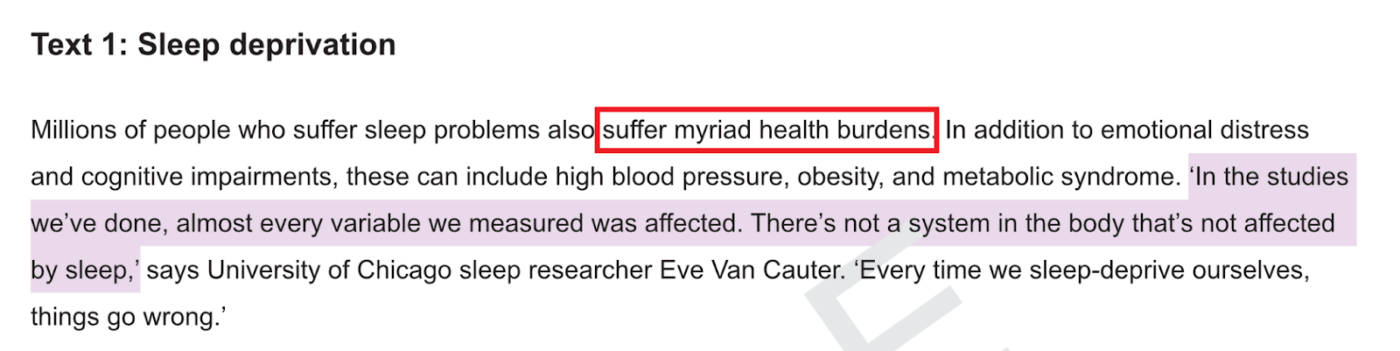
In professional writing, examples function as supporting evidence, not as the main claim. When a passage develops concrete cases to explain an abstract phrase, that phrase represents the paragraph’s central focus.
Recognising this relationship allows you to identify the correct interpretation without over-analysing details.
Step 3: Compare options using paraphrasing and elimination
At this stage, option selection should be evidence-based, not intuitive. Ask two key questions: is this a valid paraphrase, and can the other options be ruled out due to factual mismatch or nuance?
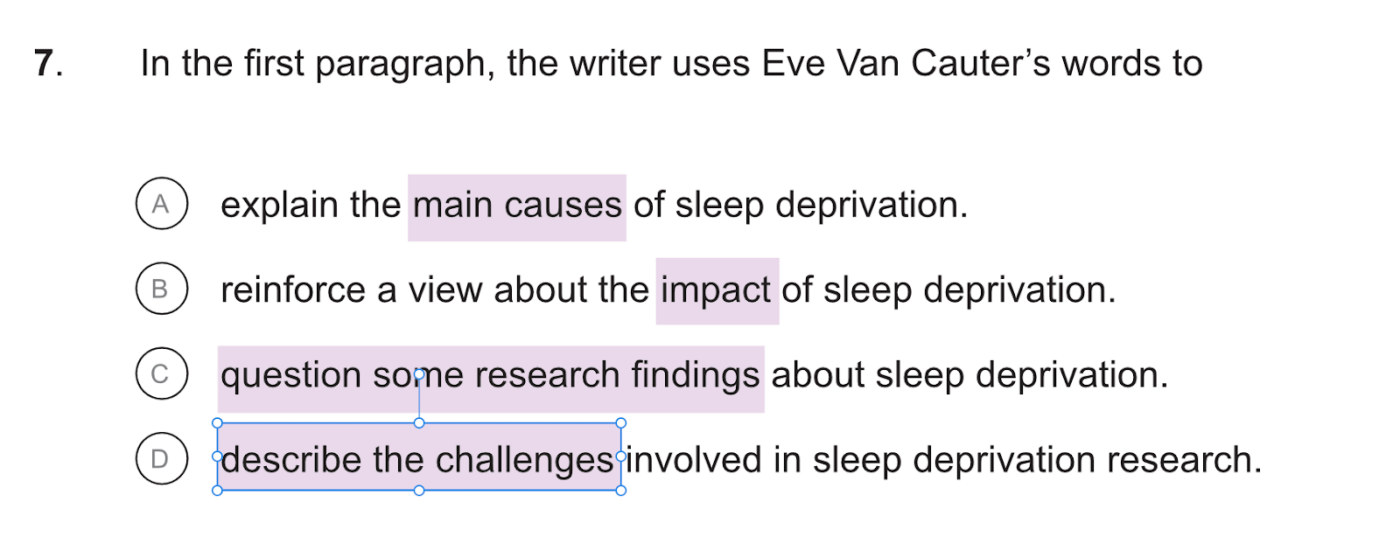
Your task is to find an option that expresses the same idea, not the same words. Language tests — including OET — are designed to assess meaning-level understanding.
When an option aligns in scope and intent with the text, it can be selected with confidence.
Why you should avoid thinking in your native language
A final caution is to avoid over-reliance on translation into your first language.
While natural, this habit can introduce ambiguity. Your native language may allow multiple interpretations that the original English does not.
For accurate decisions, anchor your judgment in English-to-English comparison. Ask what the text says in English, what the option says in English, and whether their meanings truly align.
This precision is exactly the skill OET Reading Parts B and C are designed to assess.
Watch the Video
Prefer video? Here’s a quick walkthrough of this article.
Study with OET BANK
Stop wasting time comparing OET materials.
With OET BANK, you get:
- Premium-quality OET materials, built by professionals
- A focused, efficient study path — no unnecessary content
- A system designed to help you pass OET once — without trial and error
If you want to prepare properly and pass with confidence,
you don’t need to look anywhere else.
Pick your materials and start today — with OET BANK.