

Listening, OET Strategies
OET Listening Part A: What to Expect and How to Approach It
Feb
Part A of the OET Listening test is a dictation-style task based on a clinical consultation dialogue.
You listen to a real-life interaction in a medical setting and complete missing information in structured case notes. The focus is on capturing clinically relevant details accurately while following the flow of a natural conversation.
Each task follows a clear and consistent format. You hear an audio recording of about five minutes and are asked to fill in 12 gaps using information taken directly from what you hear. The case notes guide your attention, helping you recognize what type of information is being requested at each point.
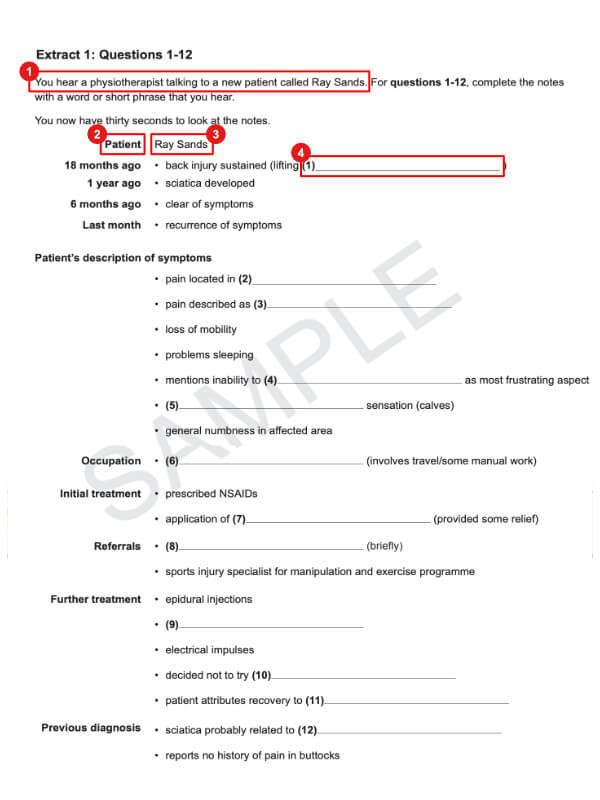
The task is typically organized around several elements. First, there is the clinical scenario, such as an initial consultation or a follow-up visit. Next, the case notes are divided into headings or categories, like Presenting Complaint or Medication History.
Around each gap, there is supporting context—short phrases that signal what kind of detail is needed. Finally, the answer space usually requires only one to three words.
In this part of the test, both accurate spelling and contextual understanding matter. However, OET does not demand perfect spelling. According to the official guidelines, minor spelling errors are accepted as long as the meaning is clear.
This allows you to focus more on understanding the message rather than worrying about every letter.
Common Information Categories in Part A
Certain types of information appear repeatedly in Part A. You will often be listening for:
- Symptoms and location of pain
- Severity and impact of symptoms, such as effects on daily activities
- Diagnosis and relevant medical history
- Treatment details and medication names
- Occupation and social or lifestyle background
- Time frames and frequency, for example “six months ago” or “once a week”
These categories are not hidden. They are clearly indicated by the headings in the left column of the case notes. This structure helps you stay oriented while listening.
One of the most important skills in Part A is recognizing paraphrasing. The same information is often expressed in different ways in spoken English.
Rather than listening for exact words, successful candidates learn to identify alternative expressions that point to the same meaning. This shift in focus—from word matching to meaning recognition—is one of the most effective ways to improve accuracy.
Key Strategy 1: Predict the Answer from Context
Before the audio begins, you are given about 30 seconds of preparation time. Using this time well can make a noticeable difference to your performance.
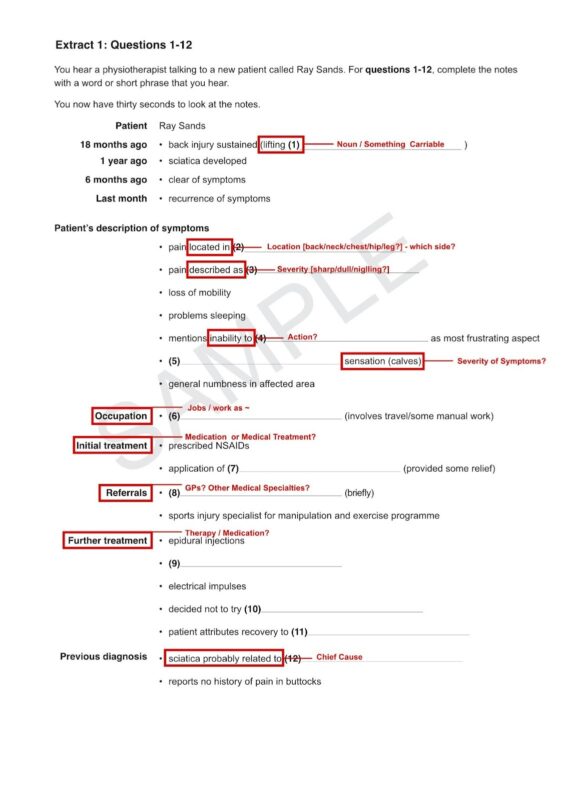
Your main goal is to predict what kind of word is likely to fit each gap. You are not guessing the exact answer, but narrowing down the type of information you should listen for.
During this short preparation phase, focus on three elements:
- Grammatical structure – decide whether the gap needs a noun, verb, adjective, or another word type
- Surrounding words – articles, prepositions, and possessive forms often give strong clues
- Category headings – identify whether the gap relates to symptoms, medication, body parts, or another clinical detail
It is important to remember that the exact wording in the audio rarely matches the wording in the case notes. Speakers usually use paraphrases or synonyms. For this reason, strong candidates focus on understanding meaning from context, not on matching words exactly.
Developing a habit of flexible listening helps you stay confident even when the phrasing changes.
Key Strategy 2: Use Phonetic Notes When Needed
If you hear a word but cannot immediately recall its correct spelling, do not panic and do not stop listening.
Medical terminology can be long and complex. Spending too much time trying to remember spelling can cause you to miss the next piece of information.
A more effective approach is to write the sound of the word phonetically—using any system that feels natural to you.
A practical method is:
- First, write what you hear based on sound
- Later, revise the spelling if it comes to you
- If not, leave the phonetic version rather than leaving the gap blank
In Part A, capturing the sound is more important than perfect spelling. The key is to develop a fast, natural note-taking style that allows you to keep up with the conversation without hesitation.
Key Strategy 3: Fill Every Gap
Even if you miss part of the audio, never leave a gap empty.
OET examiners focus on whether the intended meaning can be understood. Small spelling mistakes or minor grammatical errors may still be accepted if the message is clear.
This means that writing something—even an educated guess—often gives you a better chance of scoring than leaving the space blank.
In simple terms:
- Not sure? Write anyway.
- Unsure about spelling? Still write something.
That single word can make the difference between gaining or losing a point. Adopting the mindset of “write something, even if it’s imperfect” is a small but critical strategy that can move you closer to a passing score.
By understanding the structure of Part A, recognizing common information patterns, and applying these focused strategies, you can approach the task with greater confidence and clarity—just as you would in a real clinical documentation setting.
Watch the Video
Prefer video? Here’s a quick walkthrough of this article.
Study with OET BANK
Stop wasting time comparing OET materials.
With OET BANK, you get:
- Premium-quality OET materials, built by professionals
- A focused, efficient study path — no unnecessary content
- A system designed to help you pass OET once — without trial and error
If you want to prepare properly and pass with confidence,
you don’t need to look anywhere else.
Pick your materials and start today — with OET BANK.