

OET Medical Vocabulary, Word of the Day
Lumbar Triangle (Petit’s Triangle) – Meaning and Usage in Medical English
Dec
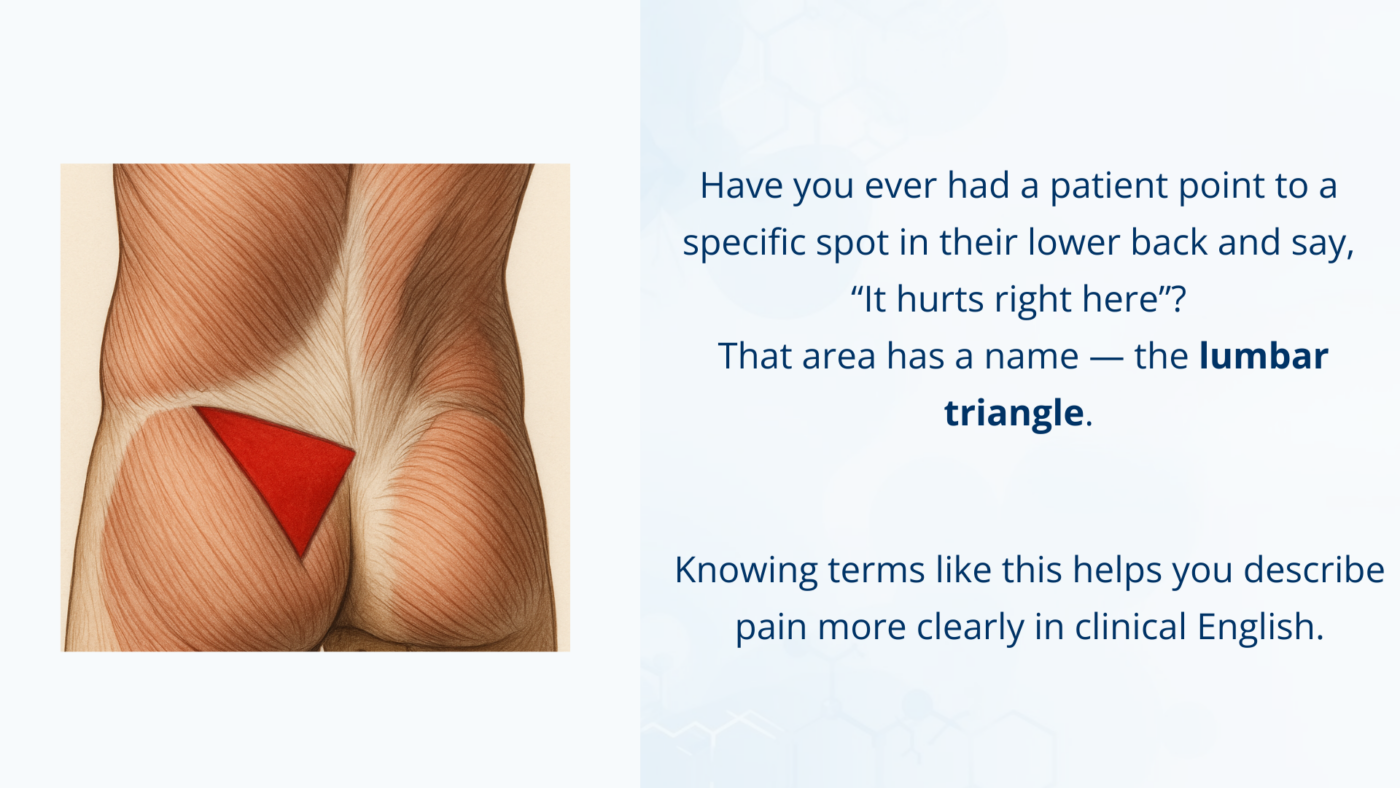
The lumbar triangle, or Petit’s triangle, is a small triangular gap in the muscles of the lower back just above the hip bone.
👁 What Does “Lumbar Triangle” Mean?
The lumbar triangle refers to a small triangular area in the lower back.
The word lumbar comes from the Latin lumbus, meaning lower back, while triangle simply describes its shape.
In anatomy, this term is used to describe a defined region rather than a muscle or organ.
🔍 Clinical Usage
In real clinical communication, lumbar triangle is mainly used in anatomical descriptions and educational contexts.
It may appear in anatomy textbooks, teaching sessions, or clinical discussions about localized back pain or structural weakness.
Healthcare professionals use this term to be precise when describing where symptoms are felt, especially when a patient points to a small area rather than the entire lower back.
While it is not commonly abbreviated in daily notes, it often appears alongside phrases related to pain, strain, or palpation in that region.
Example (educational / clinical context):
“The patient reports localized discomfort over the lumbar triangle.”
This kind of wording helps narrow down the location and avoids vague expressions like lower back pain.
Try OET Practice Questions for Free
Exam-style questions with every answer explained.
Listening · Reading · Writing · Speaking — No sign-up needed
🎥 Watch the Short Video
👉 Watch our 20-second clip: Lumbar Triangle – Learn how to pronounce it and remember how it’s used in real medical English.
🔗 Related Words
- Iliac Crest (Top of the Hip Bone)
- Infrascapular Region (Below the Shoulder Blade)
- Auscultatory Triangle (Triangle of Auscultation)
- Buttocks (Gluteal Region)
Browse every term in our Medical English Body Parts A–Z guide.